Willoughby: Endearing encounters
Tim Willoughby Follow
Leslie Willoughby/Courtesy photo
History is always the focus of my columns, but this will be a slight departure. The inspiration for the topic came from reading Terry Tempest Williams’ newest book, “The Glorians: Visitations From The Holy Ordinary.” In the beginning, explaining what a Glorian is, she writes it is an encounter, and for her, many important encounters are with other species.
An example, also in the early pages, was a half-hour following of an ant that was taking a blossom to the ant colony. This was at her home near Moab during COVID, where, due to health restrictions, she filled her days this way: “Time is listening to birdsong, Time is being in the company of animals, insects, and all manner of plants from coyotes and antelope squirrels to darkling beetles and dragonflies …”
If you are an advocate of Williams’ writing, you identify with the intensity of her bonding with nature. Each of us has our favorites, and our list can be very different than others we know. It is not necessarily the characteristics of the animal-insect but often the timing, mental feelings surrounding the encounter. Sometimes it is a single encounter, but they are what we have dreams about.
What makes Aspen a special place for us is a deep-seated bonding with what we can observe-experience in the special surroundings of our town. Here are two of mine.
One might seem odd as it was in winter, but that was what made it such a deep memory. On a day when it was slightly snowing, I was riding up alone what then was the Number Two lift. I was close to the forest that separates Dipsy Doodle and Buckhorn. My eye caught movement in the snow between the trees. Fortunately, the lift stopped. What I saw was a white ermine. I had no idea any four-legged animal lived in the snow at nearly 12,000 feet.
Ermine are one of those species that changes color seasonally: white in winter, and that begins changing usually in April. They are carnivores and feed on what they find, mice and occasionally birds. They are usually under the snow taking over burrows of other animals.
If it hadn’t been moving, I likely would not have noticed it. The lift started up, and the ermine ran off. I skied down to the location where I saw it, but couldn’t spot it. I never saw another, but I noted its tracks, and sometimes when skiing in the trees, I saw tracks that might have been ermines. A special animal to me, a species that, like me, enjoyed snow.
As an adult, my special moment was with a more common sighting, but like with the ermine, it was at high elevation and was not a single four-legged animal but a whole herd of elk. Many of my acquaintances would have been thinking of what I saw through the eyes of hunters, but I was not a hunter. I, and Leslie my wife, unexpectedly intruded into the elk’s summer hideout. The elk were mostly oblivious to my invasion of their summer home, so long as I did not move closer.
Colorado elk often head for high altitude in the summer after the snow melts because it is cooler. They forage for food. They also prefer locations where there are no roads or trails.
In this case, they were above timberline on a ridge on the north side of the valley above the Pine Creek Cookhouse. There are no trails anywhere near, and they were mostly in a depression on the ridge where you would not see them unless you, like we did, entered into that depression. We were trudging up the ridge heading to the top — it drops off on both sides — where we spotted them. It was a large herd, with calves to bulls. The ermine, compared to me, was tiny. Me compared to a bull elk with a big rack, I was tiny. We sat and observed for a couple of hours, entertained as they grazed, oblivious to our invasion of their sanctuary.
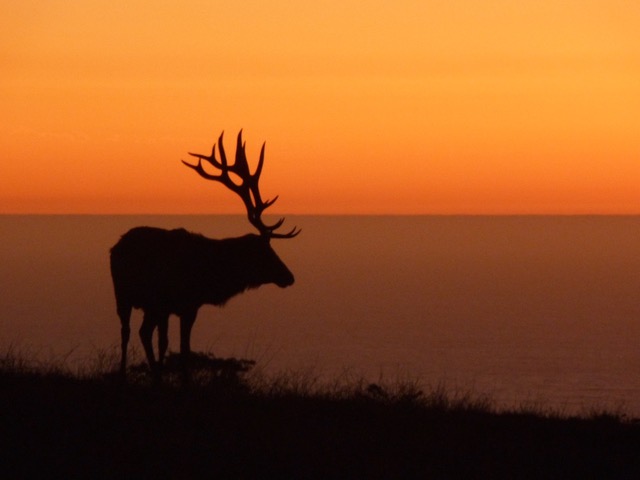
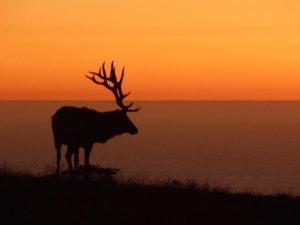
We had another similar experience with elk years later but an almost opposite: Instead of being at around 13,000 feet, they were at sea level (see photo) at Point Reyes National Seashore. They were at the northernmost part of the narrow peninsula of the park; any farther north and they would be in the Pacific. I had to get used to the idea that elk lived somewhere other than Colorado.
Those memories are deep in my psyche. The picture (see photo) hangs on one of my living room walls. On another wall, I have a painting of the view from near where we encountered the elk. A glance at either wall triggers a calming feeling.
Tim Willoughby’s family story parallels Aspen’s. He began sharing folklore while teaching at Aspen Country Day School and Colorado Mountain College. Now a tourist in his native town, he views it with historical perspective. Reach him at redmtn2@comcast.net.



Pitkin County could step in to save Maroon Bells from ‘red zone’
Pitkin County gave the go ahead on Tuesday to begin pursuing a special use permit to take over operations at the Maroon Bells Scenic Area from the U.S. Forest Service in light of concerns around funding and federal support.