Colorado governor signs bill regulating coal plants amid federal push to prevent closures
Measure comes following the Trump administration’s order to keep a coal plant in Craig running beyond its retirement date, which is being challenged in federal court

Robert Tann Follow
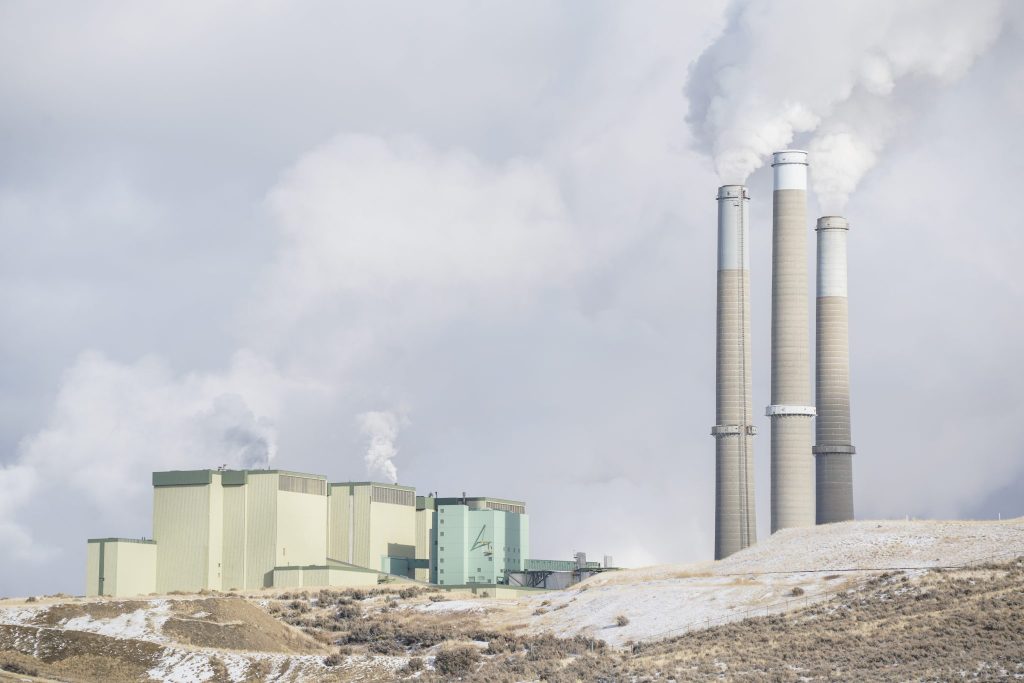
Eli Pace/Steamboat Pilot & Today archive
A new Colorado law aims to counter the Trump administration’s push to prevent the closure of coal-fired power plants by enacting new pollution and cost-reporting requirements.
Gov. Jared Polis signed House Bill 1226 on June 4, which was hailed by environmentalists and many Democrats in the legislature as a way to mitigate the fallout of recent federal orders requiring coal plants to remain open beyond their scheduled retirement dates.
“Colorado is creating a path for just transition that supports coal communities and local workers while reducing climate and air pollution,” Colorado Sierra Club Director Margaret Kran-Annexstein said in a statement. “These orders are disruptive to those goals, but are not powerless to plan and resist the Trump administration. With Gov. Polis’ signature, we are affirming that Colorado stands strong in its climate goals.”
The measure comes after the Craig Station Unit 1 coal plant in Moffat County was forced to stay open under a federal order issued on Dec. 30 — one day before the plant was scheduled to close. The order was issued under section 202(c) of the Federal Power Act, which allows the U.S. Department of Energy to keep power plants running during times of crisis, such as war or energy shortages.
Energy Secretary Chris Wright, in issuing the order, claimed the western U.S. is experiencing an energy “emergency” due to a “shortage of electric energy, a shortage of facilities for the generation of electric energy, and other causes.” The Trump administration has used similar justifications under the Federal Power Act to keep coal plants open in other states.
These orders last 90 days but can be extended until the Energy Department deems the emergency to be over. The federal government, in late March, extended its order for the Craig plant and will have a chance to extend it again at the end of June.
Under the bill signed by Polis, coal plants that are forced to stay open into the 2030s will need to install pollutant controls to limit emissions of nitrogen oxides and sulfur dioxide by the end of 2034.
The law also requires coal plant operators that are subject to federal orders to report the cost and energy output associated with staying open, and allows utility providers to receive low-interest, state-backed bonds to help pay for keeping their plants online. Proponents hope doing so will help protect ratepayers from shouldering higher energy costs. The plant’s owners have also warned that its members could “bear the full cost” of the plant staying open.
“With this law, we’re pushing back against federal overreach that increases costs for ratepayers and continues to burden communities with pollution,” Rep. Jenny Wilford, a Northglenn Democrat and one of the bill’s prime sponsors, said in a statement. “There is consensus among environmental organizations and the operators of the Craig Unit 1 power plant that forcing coal plants to stay online will increase utility costs for Coloradans. Colorado needs to plan for our own energy future, and this law helps protect ratepayers and bring us closer to our climate goals.”
The bill’s other sponsors were Democratic Rep. Meghan Froelich of Englewood, and Sens. Lisa Cutter of Littleton and Mike Weissman of Aurora.
While the vast majority of Democrats in the House and Senate voted for the bill, two lawmakers whose districts include Craig were opposed. Sen. Dylan Roberts of Frisco and Rep. Meghan Lukens of Steamboat Springs, both Democrats, voted against the bill due to what they said was a lack of outreach to their community.
“While I believe that Coloradans should be in charge of our state’s energy future, and not the federal government, I voted ‘no’ on HB26-1226 after feedback from my community, and because I wanted to see more engagement with coal communities and workers about the bill’s impact,” Lukens wrote in a text message statement last month.
Roberts, while speaking about the bill on the Senate floor last month, said he felt both the Trump administration and Colorado Democrats were using the Craig plant as a “political football.”
“We’re having a very difficult conversation in northwest Colorado, and jamming through policy like this, without engaging those folks, is not the most productive way to move forward,” Roberts said.
Multiple factors are driving Colorado’s coal plants to shut down in the next few years, including a need to adhere to state-mandated clean energy goals and a shift by utility providers to cheaper renewable energy and natural gas.
For Republicans, who were uniformly opposed to the bill, many criticized the state’s broader push to phase out coal in favor of cleaner forms of energy production, such as wind and solar.
“We’re pulling energy jobs out of the economy (and) we’re not able to provide enough energy for companies that want to come in and bring industry,” said Rep. Ty Winter, a Pueblo Republican whose district includes the Comanche Generating Station coal plant, during a debate in the House in April.
Winter called the Democrats’ bill a “knee-jerk reaction to some federal issues.”
The Trump administration’s Craig plant orders are also being challenged in federal court.
A coalition of environmental groups and Colorado Attorney General Phil Weiser filed separate lawsuits in March claiming that the Energy Department’s orders were “illegal” because no energy emergency exists.
In late April, two of the Craig plant’s owners, Tri-State Generation and Transmission Association and Platte River Power Authority, filed a joint lawsuit against the energy department seeking to overturn the federal orders.

X Games, Aspen Snowmass announce three-year deal to keep winter contest at Buttermilk
X Games and Aspen Snowmass announced a new three-year host agreement that will keep the contest at Buttermilk through the 2028/29 winter season.

Aspen One’s CEO Dave Tanner gives update on state of the business
The future of the skiing industry is a more somber one than many might think.