Aspen One’s CEO Dave Tanner gives update on state of the business
The reality reveals what he calls a somber trajectory for the ski industry

Austin Colbert/The Aspen Times
The future of the skiing industry is a more somber one than many might think.
That’s why CEO of Aspen One Dave Tanner is speaking at the Aspen City Council work session on Monday, highlighting the necessity of community support in order to address housing, transportation and more to help stabilize skier visitation going forward.
“We want understanding, we want dialogue, we’re trying to lead forward with transparency,” Tanner told The Aspen Times. “We want to share some real pressures out there, some real numbers and some thoughts on how we think we can collectively solve them. We’re doing this because we believe our fate and the fate of the community are intrinsically linked.”
Over the past three years with Tanner at the helm of Aspen One, the strategy he and the Crown family have implemented has successfully restructured the business, invested over a billion dollars to expand hospitality and the brand, in addition to providing better employee benefits and housing, and navigated a generational change of leadership with a commitment to continuity.
He credited the transformation of team capabilities and the right blend of talent as cornerstones of that continuity.
“We’ve intentionally upped the game on capabilities and talent in the organization,” he said. “We’re bringing more discipline and focus on the critical needs to de-risk the business, to elevate the business and ultimately to protect the business.”
He added, “Our evolution is showing the results we’re hoping for. While leadership transitions are never easy, they’ve been pretty seamless and we have pretty good continuity across the organization.”
Investments in on-mountain infrastructure — including lifts, snowmaking, restaurant upgrades, vehicle maintenance and more — have been paired with the continued expansion of hospitality beyond the 4% of lodging beds that Aspen One’s local hotels currently account for in the valley. Both the Limelight Boulder and Mammoth have opened on time and under budget, with Limelight New York and Charleston slated to open in the next couple of years. This pairing aims to continue supporting the Aspen Snowmass ski experience despite a recent low snow year and downward skier visitation trends.
“We had the best skiing in the Rockies this year despite the low snow,” Tanner said.
He confirmed that while the Colorado average for skier visitation was down 24%, the Aspen Snowmass area experienced less than a 24% drop.
Through the expansion of hospitality, improvement of corporate capabilities and operational and executional discipline to power evolution and growth, Aspen One’s Net Promoter Scores (a widely used metric that measures customer loyalty, satisfaction and brand perception) were flat year-over-year, including the past winter, which Tanner called “a huge win.” He added that employee engagement scores have improved.
“Whenever you’re going through this much change, you’ve got to keep an eye on those things,” he said.
With the company coming up on its 80th year this fall, and 80 years of operations in January 2027, with over 40 years of ownership under the Crowns, Tanner said Aspen One is continuing to do everything it can to be a steward of this asset.
“When Jim Crown hired me, that was the mission, to evolve this business, invest in this business, upgrade this business in order to protect it and to keep it competitive and to keep it thriving,” he said. “We’re not making changes for change’s sake … It’s actually stabilizing and investing in those areas.”
He said the pressures in the ski industry, not just in Aspen but throughout the West, are requiring continued evolution.
“At the end of the day, the ski business is pretty much a no-growth business with serious inflation issues,” he said. “And, frankly, pricing exhaustion, because pricing has gotten taken so much in the last 10 years, the consumer is starting to push back. So if you have that mix, what it does is it decreases the profitability of an organization, which decreases the incentive to invest into the organization, so what you need to do is find growth elsewhere. That’s why we’re investing in hospitality — we can then take those benefits and plow them back into our core business in Aspen.”
Tanner added, however, that with the expansion, retaining the orientation of the company’s ethos and values has been a priority.
“We do a really thoughtful and structured job of hiring people whose values align, making sure they spend time in the valley to understand the ethos, to put actual programming in place and connective tissue that is about amplifying what is amazing about Aspen and what’s amazing about our organization and the customer service and the innovation that exists,” he said. “Aspen is a unique place that brings together a kaleidoscope of perspectives in a world-class way.”
The problem is that the current capacity to house the employees who continue to dedicate their time to the spirit of the ski mountains does not adequately reflect the housing needs. According to Tanner, Aspen One owns 1,300 beds up and down the valley, but analysis and strategy show that they need to build 280 beds and 270 units by 2030 as a wave of employees who began work in the 1980s retire and those filling the gaps need places to live.
“That’s just to be able to keep the level of employees that we have in the valley today,” he said of those 2030 numbers. “That’s just replacing the employees that are going to be retiring. It’s a huge issue for us. If we can’t house our employees, we can’t run the mountains and all the services.”
He said that, given the size and immediacy of this housing problem, zoning flexibility and streamlined permitting are considerations needed to help solve the issue, in addition to the community’s support of proposed projects.
“We need the community’s help in this,” Tanner reiterated. “We’re the economic engine of the community. If we can’t house and staff our people, there will be a degradation in service and definitely pressure on the community.”
What’s happening in Aspen, in one click.
Sign up for our morning newsletter at AspenTimes.com/newsletter
Aspen One jobs comprise 28% of all Pitkin County jobs, he confirmed, with 2,500 “lives in the local community” and $20 million of annual spend on health programs to ensure dependents are taken care of. The company typically sees $50 million annually invested into the business, although last year saw $80 million, with about $70 million spent annually with local valley vendors.
Aspen One also provides 20,000 subsidized, discounted ski passes with a true value before discounts of $27 million and is part of the larger ski industry ecosystem that has a $2 billion economic impact overall and brings one and a half million visitors annually to the valley.
“If there’s pressure on us, there’s pressure on everyone,” Tanner said. “People assume our business is highly profitable … The reality is far more complicated. We have a high, fixed-cost business that’s capital intensive, that has climate exposure and inflation and pricing dynamics that compress the returns of the business that would surprise most people.”
He emphasized that to “do the right things for our employees, our communities,” Aspen One needs to face the structural headwinds in the ski industry that have accelerated in recent years, and that’s where the support of the community, of council and commissioners comes in.
“We need the Roaring Fork Valley community’s understanding and continued support, increased support, to manage through these headwinds,” Tanner said. “These are real issues. The entire ski industry is under pressure right now.”
According to him, despite being a bit better than Colorado’s average this past winter, Aspen’s skier visitation has still been down for three straight years, with little growth looking back over the past 20 years.
“Inflation and affordability — and they’re interlinked — have been an issue for the entire industry and are pressuring that visitation, and it’s especially acute for Aspen,” he said.
He noted that lift tickets, on-mountain dining and gear rentals — what Aspen One can control — account for roughly 20% of the cost of a family coming to Aspen today. Massive lodging inflation over the last seven years is becoming a notable driving deterrent.
“The cost of an all-in vacation to Aspen is about 50% higher than other ski resorts,” Tanner said. “Price increases have carried the industry for much of the last decade, but there are signs all over the place that the consumer is exhausted with that and is not going to tolerate the same level of price increase.”
On top of that, Aspen’s airport and traffic congestion have been big headwinds to a great visitor experience and have compounded the other issues, he said, testifying during the Board of County Commissioners meeting on May 27 to the importance of the airport modernization project to Aspen One as a company. In light of concerns around impacts to business in 2027, he told The Aspen Times that Aspen One’s analysis shows 50% of consumers who come to Aspen in the summer drive, and Aspen One is actively working with partners to connect Eagle, Grand Junction and Rifle to Aspen with regularity and consistency.
Aspen One is also currently budgeting for the year that begins Oct. 1 and crosses over with the 2027 airport closure, but Tanner said the granular details for adjusting operations haven’t yet been identified.
“Is it ideal? No. For one summer’s worth of pain for decades worth of livelihood, is it the right trade? Absolutely,” he said.
But even getting the airport completed and up to FAA standards won’t solve the traffic issues that persist and demand an innovative solution beyond current modalities, he added.
“People think it’s a visitation problem, a tourist problem. It’s not,” he said. “It’s a symptom of a housing and land use and infrastructure problem, and we need to acknowledge that. Traffic is getting worse, our visitation on the mountain is going down.”
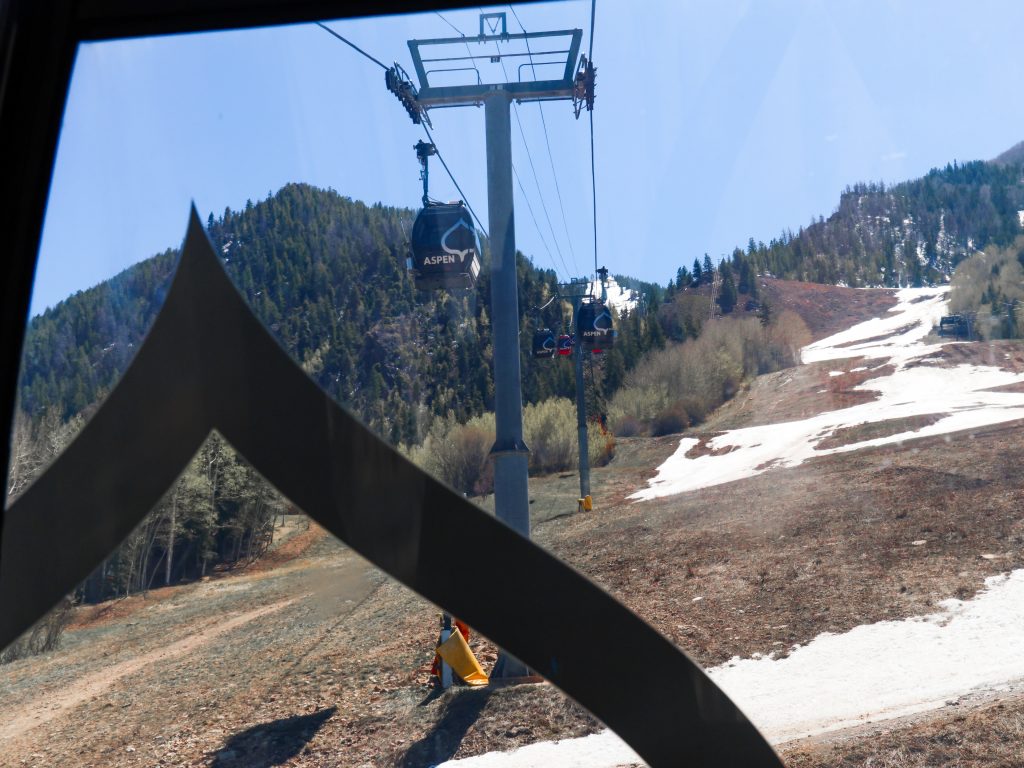
And climate continues to plague the ski industry with warming winters and unpredictability, effectively reducing winter by a month compared to 30 years ago, according to Tanner.
“Our analysis shows we’ll lose two more weeks by 2050,” he added.
While Aspen One is increasing investments in snowmaking and has pioneered new snow coverage technology use, he noted that those efforts to grow Aspen’s resilience to climate change exacerbate the profitability squeeze for the company.
“All of this together argues for a more somber trajectory for the ski side of our business, and hence for this community,” he said. “It’s not the juggernaut it was 10 years ago. But through our coordinated actions, we have the power to offset some of the issues and secure our livelihood. We need to work on this more collectively, is the message.”
He reiterated that the aim isn’t visitation growth — rather, it’s a stabilization in visitation in order to be able to maintain the Aspen ski experience and remain competitive as the best ski resort not just in North America but in the world. And to do that, community support of development within the company’s footprint to keep tourism flowing into Aspen is something Tanner stressed is a primary need.
Without it, he said, skier visitation declines due to long-term degradation in the Aspen experience and the community is what will ultimately occur. He emphasized that summer events and tourism won’t make up for a decline in skier visits.
“We need more partnerships, more coordination with the community to offset these big issues. Skier visitation is a foundational ask for us. We need a shared commitment from the community to protect and stabilize skier visitation. Everything else depends on it,” he said.
The question he poses to the community in light of the existing pressures and current pushback is: “Is Aspen going to continue to be a ski town?”
“Don’t resist our efforts or ignore our needs,” Tanner said. “We want to partner with the community on this. On housing, please work with us — we’re going to be good partners, we’re going to do right by the community. On transportation, get the airport done, do it with a transit mindset. Fix the Entrance to Aspen, and be open-minded on other transportation innovations, and think of things in a systemic fashion.”
He underscored the significance of what Aspen One’s teams have been able to accomplish through the change over the past few years, noting, “I can’t say enough about the spirit, the energy, the commitment, the discipline. Even in a year that was as horrible as last year’s visitation, people did an amazing job.”
Tanner’s efforts to increase company transparency and community understanding of the realities that ski towns are facing are not meant to be one-sided. The invitation for dialogue, suggestions for solutions and continued collaboration are driving not only Monday’s meeting but what the valley can expect in the future in order to ensure the area can continue to thrive, with annual updates planned to be given going forward on what’s working well and what’s not, rooted in what he called “honest, open conversation on the facts.”
“You can’t underestimate the importance and the power of a really strong relationship between our company and all the different counterparties and stakeholders in the community,” he said. “There is no us versus them. I do want to thank the community for their partnership, and I know that goes back generations. It is special what we have.”
The Aspen City Council work session for the Aspen One business update and discussion around shared interests will take place at 4 p.m. Monday at Aspen City Council Chambers, 427 Rio Grande Place. The link to join virtually can be found at aspen.gov/1225/Current-City-Webcast-Meetings-Agendas.
Aspen One’s CEO Dave Tanner gives update on state of the business
The future of the skiing industry is a more somber one than many might think.





Pitkin County breaks ground on McClure Pass Trail
Pitkin County Open Space and Trails has officially broken ground on McClure Pass Trail, a new natural-surface trail connection in the Crystal Valley from Highway 133 to the summit of McClure Pass.