Federal cyanide traps return to BLM lands, including Pitkin County

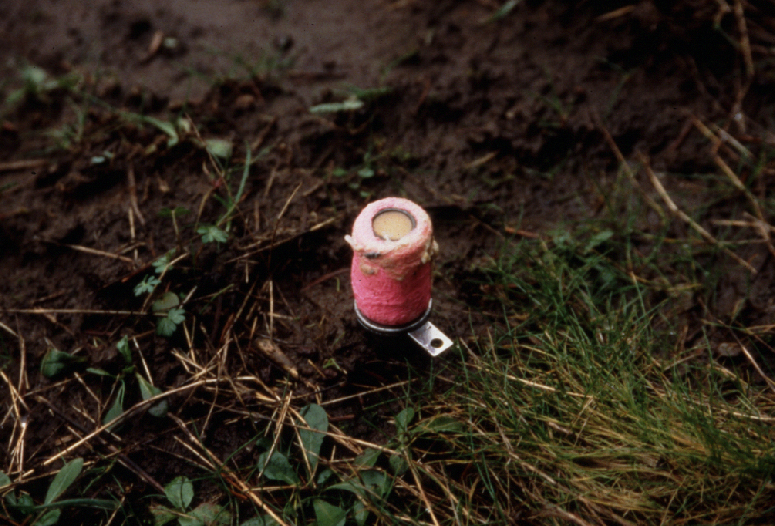
Brooks Fahy/Predator Defense
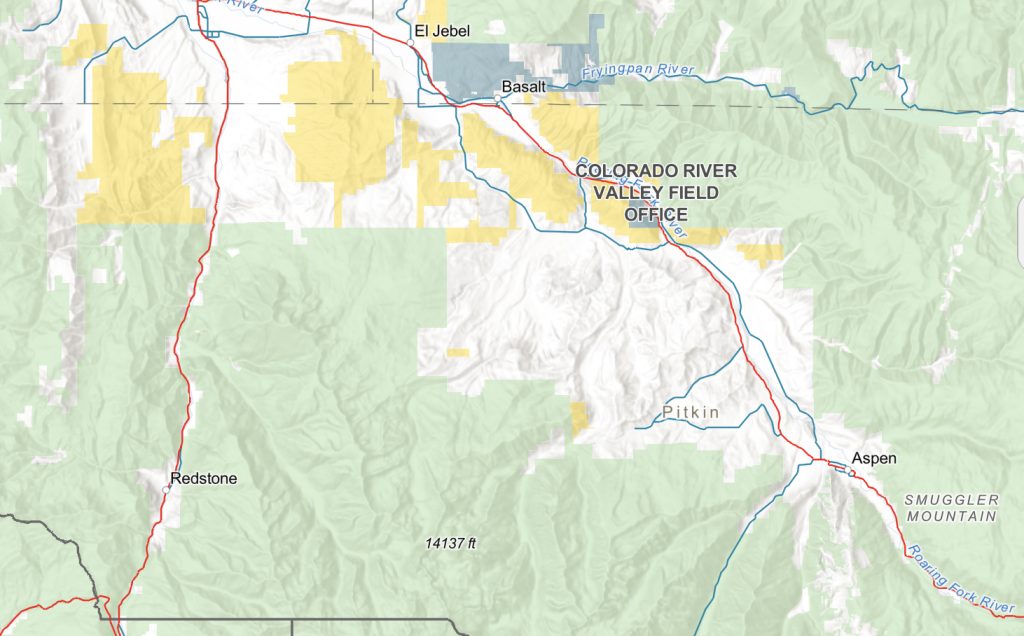
Within Pitkin County, there are 27,490 acres of Bureau of Land Management land, according to the BLM’s Colorado River Valley Field Office.
These are acres used for recreation and ranching purposes.
Quietly, back on April 14-15, 2026, a Memorandum of Understanding was signed between the U.S. Department of the Interior/BLM and the U.S. Department of Agriculture/Animal and Plant Health Inspection Service — Wildlife Services (not to be confused with U.S. Fish and Wildlife).
In the MOU, the national ban on M-44s — otherwise known as “cyanide bombs” — was lifted on BLM land.
“I have been watching the BLM website for the last year. We’ve heard rumors, whispers that this was going to happen,” said Brooks Fahy, executive director of Predator Defense, a non-profit based in Oregon that was largely responsible for the national M-44 ban on BLM lands in 2023. He was the first to obtain a copy of the April memo.
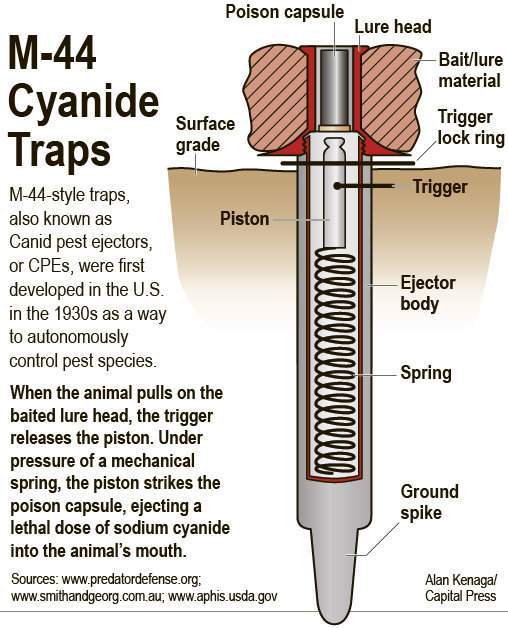
M-44s are spring-activated devices that eject deadly, oftentimes fatal, doses of sodium cyanide and are primarily used to kill coyotes but have also killed other non-target species, like wolves, bears, and foxes, among many others, including pet dogs. This chemical, according to the Environmental Protection Agency, is highly toxic and placed in Toxicity Category I, which indicates the greatest degree of acute toxicity for oral, dermal, and inhalation effects.
The MOU’s existence has not appeared on either the BLM’s or Wildlife Services’ websites, contrary to the usual protocol to update the public on changes in policy.
“This MOU is ominous,” Brooks said, who has worked closely with M-44 victims for over 30 years. “The release of this information should have been made available. You wouldn’t have had to dig for it.”
Seeking comment from the BLM regarding the lifting of the ban, a spokesperson replied with the following:
“An April 15, 2026, MOU between BLM and APHIS identifies restricted‑use pesticides — including M‑44 devices — as tools that may be considered under existing law and environmental review. The MOU does not itself authorize or expand use of M‑44s; any proposed application requires advance notification to BLM, compliance with NEPA and other statutes, and must conform to all laws and regulations. BLM will continue to evaluate proposals case‑by‑case and may prohibit or restrict such tools where warranted to protect public safety, pets, wildlife, and designated lands.”
When asked about how the public would be notified of any M-44 deployments, the spokesperson said, “Per BLM policy (6830 Animal Damage Control Manual), signs would be posted to provide adequate warning to the public of all areas where control devices are in use. Further, relevant NEPA documents and the animal damage control plan map would be made available by the appropriate BLM office so that this information is accessible to the public and BLM staff at all times.”
“(If) I had a dime for every time I heard that explanation, I’d be a rich man,” Brooks said. “They’ve been saying the same thing for over 30 years. … I have never heard of a case where the BLM discloses to the public where M-44s are placed.”
Most of the time, he said, BLM offices are clueless about the exact location. They might know about a general area but not the exact location. That information is only shared with the state Wildlife Services supervisor.
Multiple inquiry attempts were sent to Wildlife Services; the federal agency did not reply.
When The Aspen Times reached out to Pitkin County Open Space and Trails, it stated it does not have any comment at this time.
A spokesperson for Colorado Parks and Wildlife stated that “CRS 33-6-201 outlines the restrictions on the use of traps, poisons, and snares in the state of Colorado. This section of the state constitution establishes that it is ‘unlawful to take wildlife with any leghold trap, any instant kill body-gripping design trap, or by poison or snare in the state of Colorado’ and lays out exemptions to this.”
As far as safe recreation, the spokesperson stated that “CPW always suggests that recreators stay on established trails, keep animals leashed, and pay close attention to children that are with them. These suggestions are relevant whether on state-owned lands (such as state parks) or on federally owned public lands (such as BLM parcels, USFS units, and National Park sites).”
“We’re entering a time that’s even more dangerous than prior to the ban,” Brooks said. “People had been reassured that they were banned. It’s a very dangerous situation.”
M-44s have been banned once before. Former President Richard Nixon, under the first EPA director, William Ruckelshaus, signed an executive order to ban M-44s, as well as Compound 1080 (sodium fluoroacetate, which has no antidote), and strychnine. However, the ban was lifted during the Reagan administration.
“Within a few years in Oregon,” Brooks said, “I was seeing them all over the place. Literally.”
Legally, he said, Wildlife Services is required to put up signs on lands where M-44s are deployed.
But in his experience over the decades, in the vast majority of times, there has virtually never been signage.
“A lot of these BLM allotments, there may be half a dozen entries to one area,” he said. “Theoretically, every one of those gates is supposed to be posted. They never are. They might have the main gate posted. But even then, the postings have been known to blow away. Or animals or a cow will grab them and chew on them.”
Sam Sanders, a former Wildlife Services trapper, and Carter Niemeyer, a former Montana district supervisor for Wildlife Services, corroborated this signage policy, according to interviews in National Geographic and the documentary “Lethal Control,” respectively.
One former Wildlife Services trapper, Rex Shaddox, went further in the documentary “Exposed: USDA’s Secret War on Wildlife,” which was produced by Predator Defense in 2014.
He stated that a gate sign was to be placed on the entrances to lands, so anyone entering the area would know that M-44s were deployed there. But his supervisors told him to do otherwise.
“We were told that if we put that, then all we’re doing is advertising for the environmentalists and tree huggers and people like that to come in and mess with our units and to take pictures and to get us in trouble,” Shaddox stated. “So we were instructed to not put those signs on the gates, and we were told not to put the unit signs on the stake signs, so that way, they felt there’s a better chance of them missing the unit by not having the legal signage up than by having it up.”
Another directive Wildlife Services is required to follow is notifying local medical facilities. Out of the hundreds of calls Brooks has made over the decades, he has never found a single case where any medical facility, fire department, or EMS unit was notified of M-44s used in the area.
“For me, this is a very important issue. I’ve dedicated my life to banning these devices,” he said. “There are going to be other human poisonings — I have no doubt about this whatsoever. Lots and lots of dogs will be killed.”
Brooks has personally documented situations where M-44s were 2-3 feet off trails.
“Set, live, ready to kill anything,” he said. “If you’re out on BLM land mountain biking with your dog or even walking your dogs, once your dog pulls up on it, that’s it — your dog is going to be dying.”
M-44s are regulated through the EPA, he said, because sodium cyanide is a chemical under the Federal Insecticide, Fungicide, and Rodenticide Act. Wildlife Services is supposed to, by law, follow the use restrictions.
“They don’t,” he said. “This is an agency I’ve seen break the law literally hundreds and hundreds of times and seem to get away with it.”
Wildlife Services, he added, has been considered by the environmental conservation community for many years to be one of the most lawless federal agencies in existence.
Former U.S. Rep Peter DeFazio (D-OR) stated in “Exposed” that “Wildlife Services is one of the most opaque and least accountable agencies that I know of in the federal government outside of highly classified programs. … They’re very good at stonewalling, ignoring congressional inquiries. They are a world unto themselves — and that’s a world we’re not allowed to see.”
In 2017, DeFazio introduced legislation to ban M-44s on public land. The bill, colloquially known as “Canyon’s Law,” is based on a 14-year-old boy, Canyon Mansfield, and his dog Kasey, who together discovered an M-44 a few hundred feet behind his house on BLM land; there was no signage. His dog was killed by the sodium cyanide; Canyon survived but with lingering physical and mental issues.
The legislation has been reintroduced in Congress every other year since.
Sens. Michael Bennet and John Hickenlooper, as well as U.S. Rep. Jeff Hurd, were asked to comment on how they would each vote on this current legislation, which was reintroduced last year in June (S. 2179, H.R. 4180).
None replied.
For people who have children and dogs, Brooks recommends not going on BLM land anymore.
“Just to reiterate: This is a device that must be banned. There is no middle ground here. There is no compromise. We will continue to fight for a complete public lands ban,” he said.
“Is it going to take the death of a child to finally come to consciousness here? I’m afraid that answer might be ‘yes,’ but I hope not.”
Jonathan Bowers is the news editor for The Aspen Times. He can be reached at jbowers@aspentimes.com.

PHOTOS: Inaugural Snowmass Mountainside Music Festival sounds off on Fanny Hill
The free music festival in Snowmass Village was headlined by American Authors, Richy Mitch & The Coal Miners, and Pecos & The Rooftops.




Skier-focused hospitality brand launches in Aspen
A new hospitality brand, First Chair, has launched in Aspen as of June 1, with a focus on providing experiences for the diversity of skiers who travel to the area.