2 of Colorado’s wolf packs are showing potential signs of a skin parasite — can the state diagnose and treat it?
The concerns are one of three reasons that Colorado Parks and Wildlife is pulling back on killing wolves involved in livestock attacks

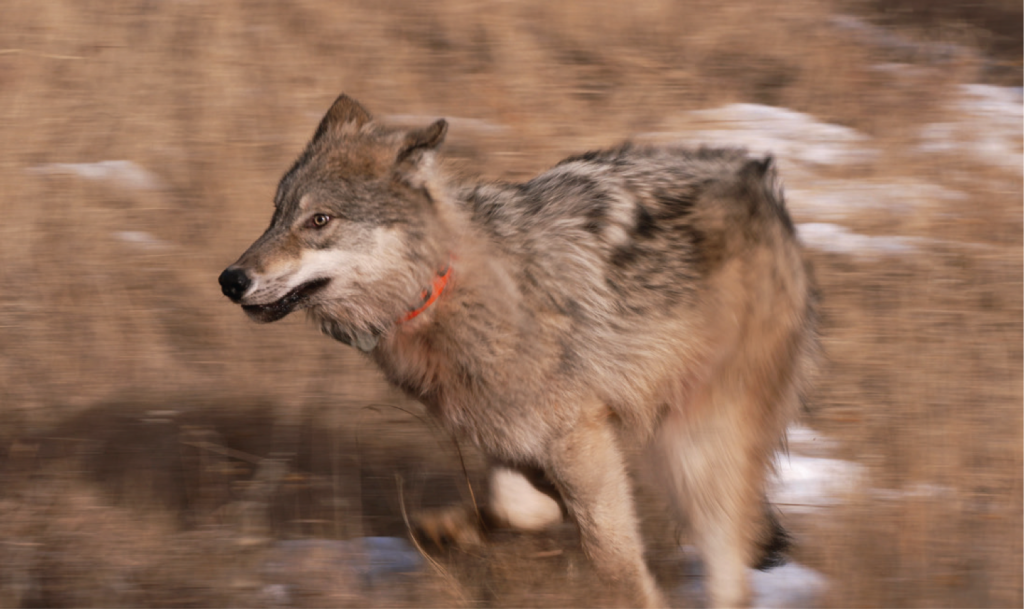
Colorado Parks and Wildlife/Courtesy photo
Colorado Parks and Wildlife is monitoring a potential skin parasite in two of its wolf packs located in the state’s northwest region.
The state wildlife agency provided an update on what the infection could be and whether treatment will be an option at its Wednesday, Nov. 4, commission meeting.
Parks and Wildlife Director Laura Clellan shared that the concerns stem from observed hair loss in several wolves and is one of three reasons it has decided to take a more “conservative” approach to killing wolves involved in conflict with livestock, as the presence of a parasite “could impact wolf survival this year.”
The state wildlife agency has been monitoring the hair loss on trail cameras, but Brian Dreher, Parks and Wildlife’s assistant director of its terrestrial wildlife branch, said that the “hair loss runs on a continuum.”
“What we’re observing — and I think we have an awful lot of hope that some of these animals and individuals are gonna be in a position where hair regrowth happens without treatment … — is it’s very individual-specific right now,” he said, adding that the agency wants to keep monitoring the wolves while being cognizant about not stacking additional pressure or stress on them.
Peach Van Wick, Colorado’s state wildlife veterinarian, said that from photos, “their skin condition does certainly look like it could be sarcoptic mange.”
Sarcoptic mange is endemic to Colorado and is caused by a microscopic mite that burrows in an animal’s skin, causing it to scratch to the point of hair loss. In turn, hair loss can impact the animal’s ability to keep warm during winter, according to the National Park Service, which observed the parasite in Yellowstone wolf packs around 2007.
The park service reported that the parasite spread to “nearly all packs in the northern region of the park” in the first few years, causing “fairly prevalent and severe infections.”
“Individual infections can last anywhere from months to years, and infection waxes and wanes within the population over time and seasons,” the federal agency wrote in a blog post citing a 2015 research study. “Furthermore, we now know the impacts of the mite on an individual wolf depend on the context. An infected wolf living in a large, healthy pack survives just as well as an uninfected wolf; however, as pack size decreases or the proportion of infected pack mates increases, infected individuals are much more likely to die.”
Getting an official diagnosis for Colorado’s wolves, however, would require the agency to “get those animals in hand, or at least some quality samples that we could confirm that this was, in fact, the parasite that we’re dealing with,” Van Wick added.
Dreher added that “at least one of these packs that we’re dealing with is very remote and very difficult, and now that we’ve moved into a different kind of phase of their annual life cycle, they don’t have the predictability that they did have coming into the summer.”
One option for capturing the wolves with observed hair loss is that the agency is nearing capture season, “where we’re gonna be capturing animals for either re-collars or new collars,” Dreher said.
“I think that will be something that we plan to actually really try and address is what we’re dealing with, and then also kind of how widespread it might be,” he added.
Once a diagnosis is made, both Van Wick and Dreher said a determination would need to be made on whether treatment is viable and intervention is necessary.
“Unfortunately, there are no drugs that are labeled for the treatment of sarcoptic mange in wolves, and so all of this would have to be done in an off-label manner, and so we would have to have discussions about the implications of those things,” Van Wick said.
CPW defends its pull back on killing wolves involved in livestock conflict
These disease concerns — alongside a low adult wolf survival rate and the agency’s lack of a source for wolves this upcoming winter after a forced pause in releases this past winter — caused the agency to announce on Sept. 30, it would be pulling back on killing wolves involved in repeated conflict.
“This doesn’t mean that the option for lethal removal is off the table,” Clellan said Wednesday. “We’ll continue to prioritize our non lethal conflict minimization, and explore all the tools and techniques, and our support of both producers and wolves. With lethal removal remaining as an option if deemed absolutely necessary.”
Colorado Parks and Wildlife reported the state had at least 45 wolves as of Sept. 24. This includes 20 wolf pups that were born to four reproducing packs this spring: the Piney Ridge Pack in Eagle County, the One Ear Pack in Jackson County, the Three Creeks Pack in Rio Blanco County and the Copper Creek Pack in Pitkin County. While the breeding adults in the King Mountain Pack were killed this year — one in a collaring operation and the other reportedly by a ranch hand — the four wolves born to the pack in 2025 are still roaming their Routt County territory as a group.
The state wildlife agency has killed four yearling wolves from the packs in Pitkin, Rio Blanco and Jackson counties this year, following repeated attacks on livestock by the animals.
Parks and Wildlife made these decisions based on the authority granted by the U.S. Fish and Wildlife Service and guided by a management directive, which indicates it will consider euthanizing a wolf involved in at least three confirmed attacks on livestock within 30 days as long as producers have attempted to mitigate conflict with all viable nonlethal tools.
It has released reports on the specifics of each killing this year.
Now, as the agency pulls back on the directive, it will be looking to set new guidance before the end of March 2027.
“The administrative directive that we paused does have criteria, and what we realized was that we needed to adjust that so that we can consider biological information as well,” Clellan said.
While Parks and Wildlife’s stated goal in killing wolves attacking livestock is to change the pack behavior, its ability to do so has been questioned by both wildlife advocates and livestock producers. On Wednesday, Ray Aberle, deputy director of Parks and Wildlife’s lands unit, acknowledged the inherent challenge in this.
“It’s really hard to change behaviors, even when you’re catching them in the act of doing that,” Aberle said, adding that while sometimes there is an “immediate behavior change,” other times it takes longer to see a shift.
“We do know that by removing an animal, we are reducing caloric demands within that pack,” Aberle said. “…There is some good research and studies out there that show, at a certain size, really just based on caloric demand, we’re gonna have more conflict. The Northern Rockies have a lot of data on that.”
Aberle acknowledged, however, that “the science out there on lethal removals is all over the place.” While Parks and Wildlife is working to build a body of knowledge on this, he said it could take time.
“We continue to need to look at, and we’re working on getting, the science behind lethal removals and response, especially given our unique conditions in Colorado, based on landscape, numbers of livestock, numbers of human users and recreationalists — all those things are different than other states too,” he said.





Aspen Snowmass records highest snow totals of any Colorado ski resort
Aspen Snowmass reported up to 8 inches in 24 hours as of Thursday morning across all four mountains, the highest snow totals of any Colorado ski resort following Wednesday night’s storm.