Aspen adds 14 new public EV charging spaces

Grace West Follow
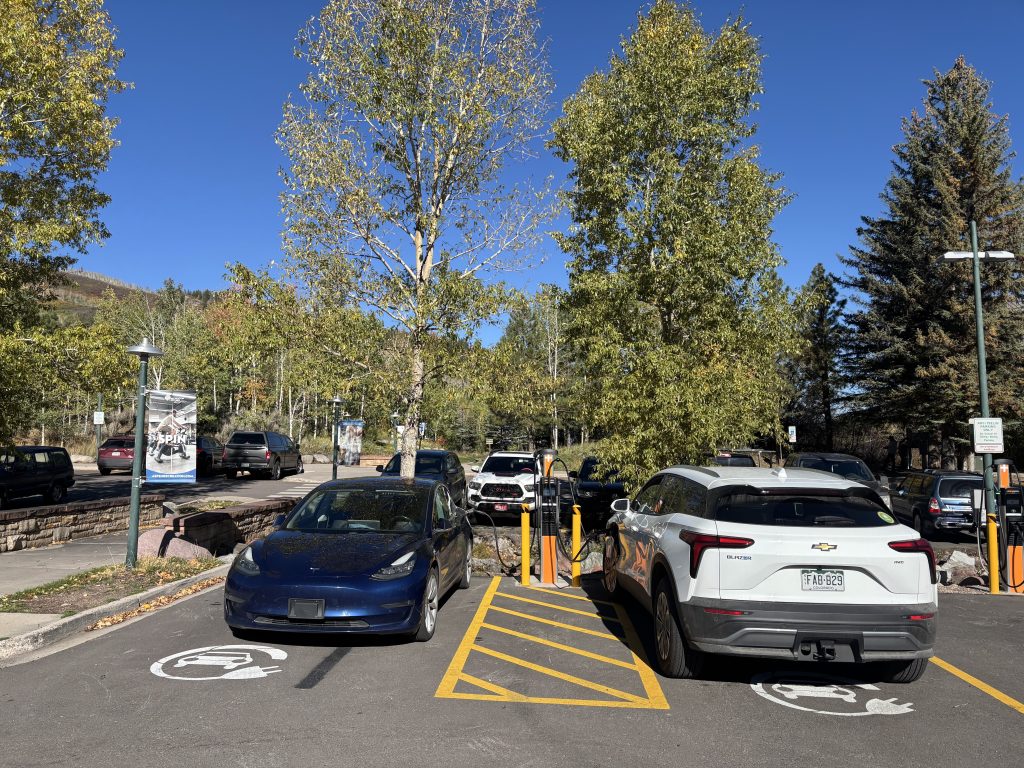
Tim Karfs/Courtesy photo
The city of Aspen has introduced seven new dual-port Level 2 electric vehicle charging stations, creating a total of 14 new public charging spaces to meet the city’s Public EV Charging Infrastructure Master Plan goal.
“For the city, investing in public charging is about ensuring that the benefits of electric vehicles, including lower operating costs and zero tailpipe emissions, are accessible to more people in our community,” said Aspen’s Sustainability Programs Administrator Tim Karfs. “It’s also a demonstrable part of Aspen’s strategy to reduce community greenhouse gas emissions.”
The charging stations are at several locations throughout the city — two charging stations are located at the Aspen Recreation Center, two at the Aspen Golf Club/Nordic Center, two at Truscott and one at the Red Brick Center.
Stations at the Aspen Recreation Center are currently available for use, while others will be available sometime next week, according to Karfs.
“Aspen has expanded its network from 12 charging plugs in 2021 to 38 with the completion of the recent projects at the ARC, Golf Course, Truscott and the Red Brick,” Karfs said. “That meets the goal of 35 to 45 plugs established in the city’s 2021 EV charging Master Plan.”
Each new location also includes a van-accessible charging space to support broader access, a recent city newsletter confirms.
Karfs added that public charging is especially important for residents and visitors that don’t have access to home charging, particularly at multi-family housing facilities.
“Installing chargers at multi-family properties can be complicated by HOA requirements, limited or assigned parking, electrical infrastructure constraints and the challenge of allocating charging costs among residents,” he said. “The city offers technical expertise, and CORE and Holy Cross Energy offer local rebates and grants that can help support multi-family EV charging projects.”
According to him, the city aims to be strategic with where public chargers are installed, focusing on locations where they can provide the greatest community benefit — that includes locations with proximity to multi-family and affordable housing, workplaces, public transportation and city facilities. The city also considers available electrical infrastructure and coordinated installations with other city utility or resurfacing projects to “reduce construction costs and avoid duplicative work,” he added.
EV adoption continues to grow locally, with Karfs confirming that the most recent city analysis estimates that EVs represent approximately 6% of registered vehicles within the Aspen Electric service territory, where there are now more than 4,400 registered EVs across Pitkin, Eagle and Garfield counties.
The newsletter adds that several Aspen charging locations exceed 60% utilization during peak seasons, though 20% utilization is generally considered a benchmark for high-performing charging stations.
Karfs also noted that EV chargers at South Spring Street stand out — 69% of the times when an EV driver is visiting that station to charge during peak times in peak months, it’s already in use.
“It’s hard to fully understand exactly what drives that demand, but its location near the downtown core, proximity to businesses and workplaces and near multifamily housing are all positive factors,” he said, stressing, “Location matters.”
The city currently tracks the amount of electricity delivered through its public charging network and uses that data to estimate the amount of gasoline use and associated greenhouse gas emissions avoided as a result. He told The Aspen Times that in 2025, the network delivered 231,310 kilowatts per hour of electricity, which staff estimates displaced the equivalent of about 20,860 gallons of gasoline.
“With transportation accounting for 23% of Aspen’s community greenhouse gas emissions, expanding EV use is an essential strategy in meeting our climate goals,” he said.
Transportation is the second-largest source of Aspen’s community-wide greenhouse gas emissions (23%), behind commercial and residential buildings (47%).
Aspen City Council Member John Doyle said that he “feels really strongly” about the city’s efforts of implementing more EV chargers to reduce greenhouse gas emissions. He recently gave up his 25-year-old pickup truck for an electric vehicle.
He added that he was considering putting in a home charger where he lives, but due to the convenience of Aspen’s EV charging stations, he ultimately deemed that idea as unnecessary.
“it just makes me happy to see that we are taking steps to do our part to lessen the effects of climate change,” Doyle said.
The city’s newsletter adds that the newest charger installation project “reflects years of planning and collaboration among city departments including Environmental Health and Sustainability, Engineering, Parking, Parks and Recreation and Aspen Utilities. Partnerships with Holy Cross Energy and Aspen/Pitkin County Housing Authority were also pivotal in rolling out the new EV chargers.”
The Environmental Health and Sustainability and Engineering departments will present the outcomes of the public EV charging program Aspen City Council sometime in December and get direction on the next phase, according to Karfs.
Aspen adds 14 new public EV charging spaces
The city of Aspen has introduced seven new dual-port Level 2 electric vehicle charging stations, creating a total of 14 new public charging spaces to meet the city’s Public EV Charging Infrastructure Master Plan goal of 38 charging spaces.



Aspen amends no overnight parking rule in downtown
The city of Aspen is reducing the no overnight parking timeframe in the commercial core by an hour this winter, in an attempt to help support local businesses and those who recreate early.