Colorado Parks and Wildlife kills member of One Ear wolf pack after attacks on cattle in Grand, Jackson counties
The situation met the agency’s chronic depredation directive after the wolf was tied to four attacks between June 29 and Aug. 1

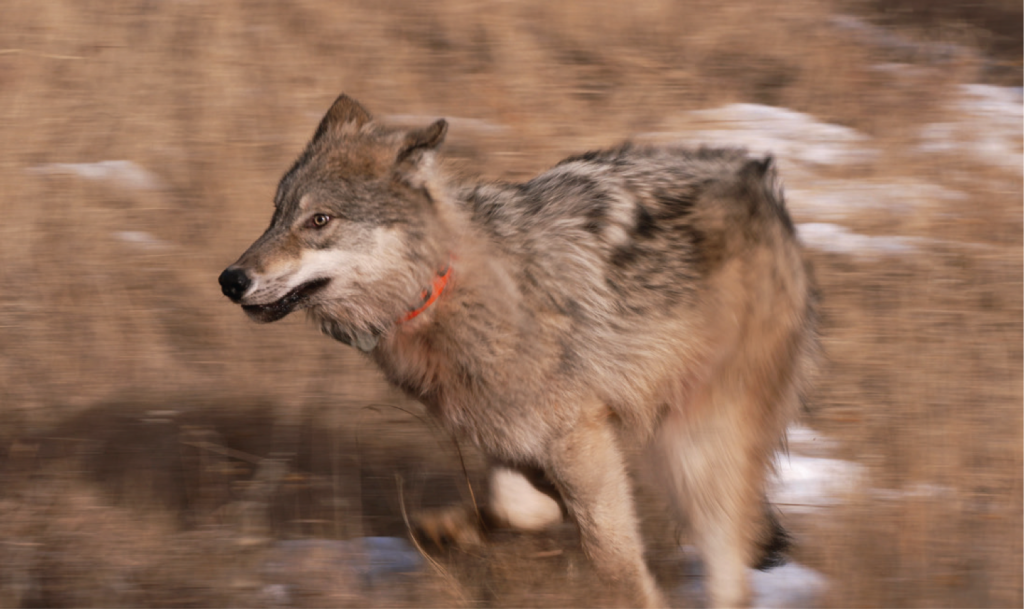
Colorado Parks and Wildlife/Courtesy photo
Colorado Parks and Wildlife killed an uncollared male wolf belonging to the One Ear Pack on Aug. 4 in Grand County.
The state wildlife agency said in a Wednesday news release that the wolf was killed after it was tied to four attacks on calves from June 29 to Aug. 1 in Jackson and Grand counties.
The authority to kill wolves in Colorado, despite their federally protected status, is granted by its special 10j rule with the U.S. Fish and Wildlife Service.
Parks and Wildlife’s decision to euthanize a chronically depredating wolf — defined as three or more depredation events in 30 days — is also guided by an agency management directive. If the definition is met, impacted producers have utilized appropriate nonlethal deterrence methods, and lethal removal is likely to change pack behavior, the agency can kill the responsible animal or animals.
“The decision to lethally remove a wolf is a very difficult one and a number of factors must be taken into consideration,” said Parks and Wildlife Director Laura Clellan in the news release. “Unfortunately after a thorough review, the determination of chronic depredation was made in this case. Our staff will continue to work diligently with willing producers to deploy all reasonable non-lethal tools and methods in order to minimize the need for removals.”
This is the third wolf that Parks and Wildlife has killed due to livestock conflict since it began its wolf reintroduction in December 2023.
The agency killed a yearling from the Copper Creek Pack in May 2025 in Pitkin County after the pack was connected to a series of livestock attacks as well as an uncollared wolf from the same litter that had been separated from the pack and was tied to at least 22 sheep attacks between July 2025 and June 2026.
According to the news release, Parks and Wildlife decided to kill the wolf from the One Ear Pack after the pack was tied to four attacks involving four calves. This included a June 29 attack in Jackson County as well as July 26, July 31 and Aug. 1 attacks in Grand County.
The agency said that the affected producers had previously completed site assessments — where Parks and Wildlife gives site-specific recommendations for viable, reasonable and effective ways to minimize conflict between livestock and wolves — as well as pursued other non-lethal conflict minimization efforts. The news release reported that range riders had been deployed to the impacted areas in addition to use of scare devices and active human presence to try and deter conflict.
Luke Perkins, public information officer for Parks and Wildlife, said the agency’s “goal with the removal is the adjustment of pack behavior.”
Parks and Wildlife’s chronic depredation management directive recommends an incremental approach, where, after killing one pack member, the agency enters an evaluation period to determine whether the pack’s behavior shifts away from predating on livestock. If it does not, the agency can remove more members of the pack.
The wildlife agency said it will release additional details on the lethal removal in a final report.
The wolf was an uncollared member of the One Ear Pack, which formed in Jackson County in spring 2025 and had an estimated four yearlings at the end of March. The pack’s territory spans from the Colorado border with Wyoming to south of Colorado Highway 40 in Routt and Grand counties, according to the agency’s 2025-26 annual wolf report.
The pack was one of four wolf packs in Colorado that had additional pups — lthough the exact number is unknown — this spring. These new births could bring Colorado’s wolf population close to 50.
According to Parks and Wildlife’s online depredation tracker, confirmed attacks on livestock by wolves have ramped up in the summer months.
Between Jan. 24 and April 23, the agency confirmed four wolf attacks involving one calf, one cow, one dog and 11 sheep. Since June 10, the agency has confirmed 13 attacks — nine of which were in July — involving eight calves, two cows, five ewe and two lambs. These events took place in Grand, Pitkin, Rio Blanco, Moffat, Eagle, Routt and Jackson counties — five of which have wolf packs.