Colorado Parks and Wildlife resumes weekly testing for invasive species in Colorado River
The river is considered infested with zebra mussels from its confluence with the Eagle River to where it flows into Utah

R. Gonzales/Colorado Parks and Wildlife
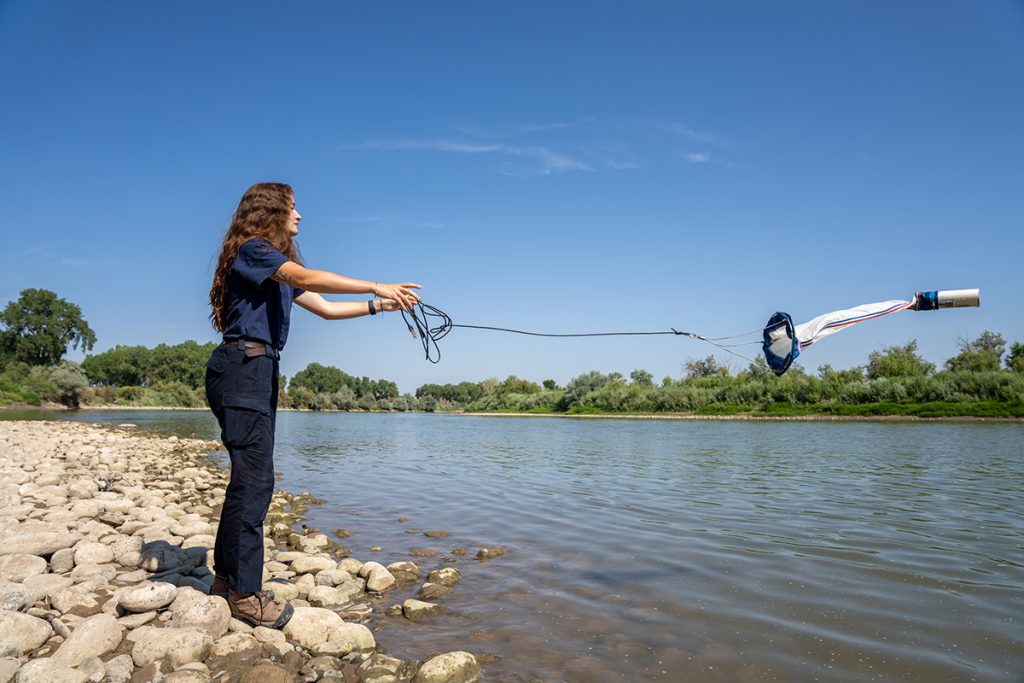
With six bodies of water in Colorado now considered infested with zebra mussels, Colorado Parks and Wildlife is kicking off weekly sampling of the Colorado River system.
The invasive aquatic species — which poses a significant threat to water infrastructure and ecosystems — was first detected in the state in 2022 at Highline Lake near Grand Junction, and in the Colorado River in 2024. After ramping up sampling efforts last summer, the state wildlife agency found zebra mussels across the river system.
This year, Parks and Wildlife is planning to conduct weekly samplings in the Colorado River and on its shoreline from Granby to the Colorado border with Utah, according to a Wednesday, May 13 news release.
The agency also announced an expansion of its partnership with River Corps, an AmeriCorps program operated by nonprofit River Science, to increase its monitoring capacity on the river. Three River Corps members are joining the Parks and Wildlife Aquatic Nuisance Species staff, two of whom will be part of the Colorado River monitoring effort. The state wildlife agency also works with the U.S. Fish and Wildlife Service on sampling.
Zebra mussels reproduce rapidly and in large quantities. A single adult can produce up to 30,000 veligers — the species’ free-floating larvae — in a single spawning event and, spawning year-round, up to 1 million in a year. As they multiply, they root and anchor to surfaces, which, with their large numbers, can clog and damage infrastructure as well as threaten entire food chains.
Parks and Wildlife has detected both adults and veligers in Western Slope waterways along the Colorado River, prompting it to declare the following bodies of water as infested:
- Highline Lake at Highline Lake State Park
- Mack Mesa Lake at Highline Lake State Park
- West and East Lake at the Wildlife Area Section of James M. Robb-Colorado River State Park
- Colorado River from the confluence of the Eagle River to the Colorado-Utah border
- Red Rocks Lake at the Fruita Section of James M. Robb-Colorado River State Park
- Grand River Park in New Castle
This list does not include infestations in private lakes. While Parks and Wildlife publicly reported one of these infestations in July at a private lake in western Eagle County — which some agency staff have speculated could be the source of the species in the Colorado River system — its Wednesday news release reported it has identified “several privately owned bodies of water infested with zebra mussels.”
It added that it anticipates it will discover more as it ramps up sampling of private bodies of water in the Grand Valley.
The state wildlife agency has not found zebra mussels in the Colorado River between its headwaters in Grand County and its confluence with the Eagle River, nor in the Eagle or Roaring Fork rivers.
In 2025, Parks and Wildlife conducted weekly sampling efforts along the same stretch of the Colorado River that it plans to test this year. In total, agency staff sampled 227 standing and 41 flowing waters and processed just over 2,200 samples at its Denver lab. This included a single-day sampling effort in October, where over 200 miles of river were tested.
Complete eradication of zebra mussels from water systems has proven nearly impossible in Colorado and other states — not only because they can spread rapidly, but also because it is difficult to target a single invasive species without affecting the entire river and aquatic ecosystem — making prevention and detection paramount to Colorado Parks and Wildlife’s efforts with the aquatic nuisance species.
In 2025, Parks and Wildlife staff conducted 438,272 inspections and decontaminated 30,039 what the agency called “high-risk boats.” These inspections uncovered 136 watercraft that had invasive mussels, according to the agency. The agency inspected over 36,000 boats at Highline Lake in Grand Junction, where zebra mussels have been established since 2022.
Sixteen of these resulted in the detection of the invasive species prior to boat launch. Fifteen of these had traveled from Lake Powell and one from Michigan — both of which have established populations of zebra mussels.
This summer, Parks and Wildlife plans to increase its education efforts targeting water users between Palisade and Loma, sharing how to prevent the spread of aquatic nuisance species, like zebra mussels, by properly cleaning, draining and drying your boating and fishing gear after use.
“Despite these additional detections, it remains critical for the continued protection of Colorado’s aquatic resources and infrastructure to fully understand the distribution of zebra mussels in western Colorado,” said Robert Walters, Parks and Wildlife’s invasive species program manager, in the release. “We can only achieve this with the assistance and participation of the public.”
Aspen City Council moves forward with design phase for Smuggler Bridge replacement
Aspen’s Smuggler Bridge on Power Plant Road is nearing the end of its lifecycle. Because of that, Aspen City Council unanimously approved a replacement design phase presented on Tuesday by Engineering Operations LLC, granting $558,681 to fund the design.




Sale, repair bikes not allowed in Aspen’s Right of Way
The city of Aspen’s Community Development and Engineering staff will communicate this spring to bike shops that for sale and repair fleets are not allowed in the Right of Way.