Aspen School District receives $5 million funding award for geothermal energy project

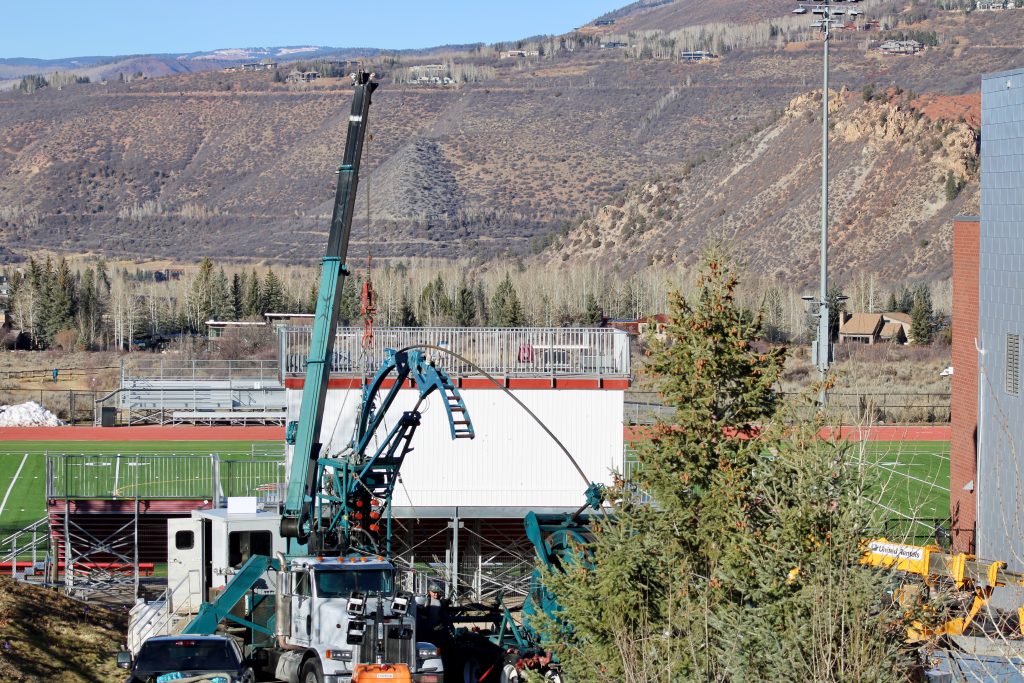
CLEER/Courtesy photo
The Aspen School District has received a $5 million funding award for a geothermal energy project aimed at reducing greenhouse-gas emissions and promoting energy autonomy, along with leaving a legacy for future generations.
The funding award follows a grant submission by ASD with support from its geothermal partner Clean Energy Economy for the Region and its engineering teams — McKinstry and the GreyEdge Group — according to a press release.
A total of $12.4 million in funding awards was announced on Wednesday in a joint press release from the Colorado Energy Office and Governor Jared Polis, supporting seven geothermal projects across the state that include heating and cooling as well as electricity development.
“Aspen School District is installing the first section of a thermal energy network that will connect and provide heating and cooling to three instructional, administrative, and athletic buildings — totaling over 400,000 square feet of conditioned space,” the joint release reads.
The funding comes from the Geothermal Energy Grant Program and Geothermal Energy Tax Credit Offering, enabling recipients to proceed with installation of thermal energy networks and deliver efficient heating and cooling to buildings, in addition to implementing studies and test wells for geothermal electricity.
“We have very large pollution reduction goals at the state level,” Geothermal Energy Tax Credit Offering Program Manager Lille Haecker said. “In order to meet those goals and create a net-zero economy for Colorado by 2050, energy autonomy in mountain towns is a critical aspect of that … The innovative nature and … size of the (Aspen School District) system is very impressive at creating energy autonomy in a mountain town. It’s something the state would like to prioritize.”
ASD has proposed installing geothermal heat pumps to harness the below-ground temperature of the Earth in order to “provide significantly decarbonized heating and cooling to the campus by shifting most HVAC systems to highly efficient ground source heat pumps connected to a central loop and borefield … By switching fuel to electricity as the main energy source, the district can stabilize long term energy and operational costs while reducing fossil fuel use.”
What’s happening in Aspen, in one click.
Sign up for daily or weekly newsletters AspenTimes.com/newsletter
A recent feasibility study looking at preliminary measurements, running a thermal conductivity test, assessing the viability on campus where a borefield could be located and how many holes it would take and more was funded by a $50,000 grant from Aspen’s Community Office for Resource Efficiency and a $78,400 Geothermal Energy Grant Program from the Colorado Energy Office.
The study has provided a better understanding of the scope and direction of the project, according to Lauren M. Suhrbier, director of Strategic Development for Clean Energy Economy for the Region.
“We’re still in the design phase,” Suhrbier said. “We have a long road ahead of us, but all indications are good.”
She emphasized that large infrastructure projects like this only come around every few decades, underscoring the importance of committing to getting it right.
The district has partnered with construction engineering company McKinstry, who’s Action for Impact strategy focuses on “renewing buildings for today’s conditions while balancing the needs of our built and natural environments by drawing on experience from more than $1 billion in energy projects nationwide,” according to Ashley Brasovan, senior account executive at McKinstry.
Brasovan added, “This project reflects McKinstry’s mission to create a better built environment by helping Aspen School District transition to a cleaner, more resilient geothermal system that supports student health, reduces emissions and stabilizes long-term energy costs. As Colorado’s climate grows hotter and drier, many schools need solutions like enhanced ventilation for smoke mitigation and cooling for offsetting rising temperatures to maintain the learning environment.”
The project in its entirety is anticipated to cost $20-35 million depending on how the project is scoped moving forward, according to Brasovan. Additional funding will come from a 30-40% federal tax credit, energy savings through an energy performance contract and a district-wide bond measure passed by voters in 2025.
ASD Director of Operations Joe Waneka called the grant a “critical catalyst” in order to move forward with the executive of the high-performance thermal energy network.
Brasovan added, “The $5 million will really help move the needle for the financials.”
Waneka confirmed that the $5 million will go toward the design phase and will include looking at the mechanical scope of the project. He anticipated it will take six to seven months to complete the design, after which they will issue a Request for Proposal for a drilling rig for the spring of 2027 or 2028, depending on coordination with ASD athletic improvements also scheduled to occur.
The next phase will also include soil testing during the final design this summer, according to Brasovan, to make sure there are no hazardous materials in the ground.
“We’re very mindful of any kind of environmental impact,” Waneka said, although he noted that there is currently no notable environmental impact expected.
While there will be a certain level of glycol — a toxic compound often used as antifreeze — within the underground temperature loop, Suhrbier, Waneka and Brasovan all confirmed it will be completely contained and present no risk.
“We do not want any leaks in the system,” Suhrbier said. “That is top priority.”
The mechanical equipment that would be installed is anticipated to last 15 to 20 years, with the underground equipment anticipated to last even longer — roughly 80 years.
“We’re trying to really take a more holistic approach and be thoughtful and sustainable,” Waneka said. “I personally have slowed the process down to make sure we do it right the first time.”
Brasovan added that a large focus is on improving the learning environment with better temperature control and ventilation.
The geothermal system will also be quieter and more durable, with the ability, Suhrbier said, to improve indoor air quality for students “for decades to come.”
The anticipated project construction will be aimed at having minimal impact on school operations, occurring mostly in the summertime on non-student days.
“That’s my pledge to the district, to minimize any impact,” Waneka said.
For him, this project is about even more than improving the Aspen School District’s sustainability and day-to-day experience for students and staff. It’s about leaving a legacy for the Aspen School District.
“It’s a really cool opportunity,” he said, “and I’m proud to say that if we get this off the ground — which we will — then we can be a shining beacon for the nation.”

Aspen’s 2026 Shortsfest announces winners
The 35th Aspen Shortsfest has announced its winning films.


Nearly 2,000 ski instructors have joined lawsuit against Vail Resorts so far; opt-in deadline is Wednesday
Consent forms filed in federal court on Friday show that nearly 2,000 ski and snowboard instructors have joined a collective action against Vail Resorts, alleging Fair Labor Standards Act lawsuit against the company.