Aspen School District to study sustainable heating, cooling

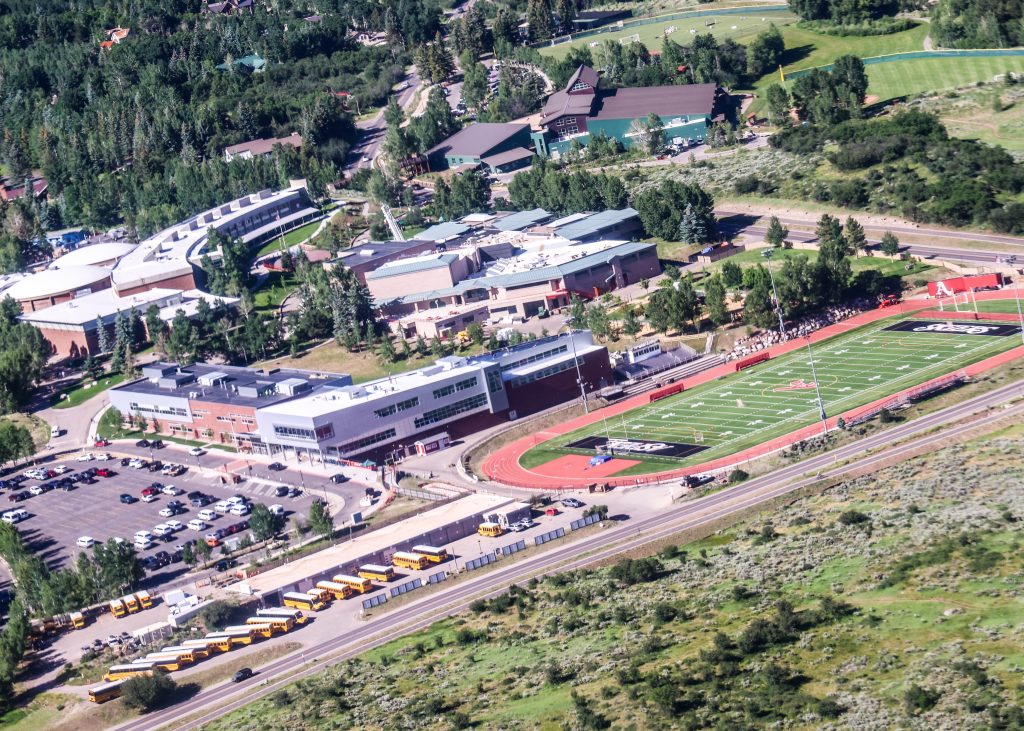
Austin Colbert/The Aspen Times
Editor’s note: This story as been updated to clarify that the Aspen School District received a $78,400 grant from the state government to help pay for the feasibility study. The article incorrectly stated the grant was $74,000.
The Aspen School District is on the verge of drilling 1,000 feet into the earth.
That’s to test the feasibility of installing geothermal heat pumps, a highly efficient heating and cooling system which would allow the district to harness the below-ground temperature of the earth to heat and cool its buildings.
“I want to push the envelope a little bit,” said project lead Joe Waneka, Aspen School District’s director of operations and facilities. “And that’s why we’re trying to use geothermal.”
Geothermal heat pumps send the liquid compound Glycol far below the earth’s surface. The Glycol absorbs the heat of the earth before transporting the heat to the heat pumps on the surface. The pumps then distribute the heat to buildings.
The heat pumps perform efficiently because the earth far below the surface provides a consistent temperature from which to draw heat, as opposed to air-sourced pumps that draw heat from fluctuating air temperatures. The geothermal pumps also transport existing heat, rather than making new heat by burning fossil fuels, like traditional gas heating systems.
But for the district to install geothermal heat pumps, everything depends on the feasibility study at the end of this month. The study will test the earth’s heat conductivity and gauge how easily boreholes can be drilled. If the ground below the school district isn’t suitable, the project will come to a halt.
Once construction company McKinstry attempts to drill the six-inch wide, 1,000-foot hole on school property, it will then pump Glycol to the bottom of the hole to gauge the heat conductivity of the ground — or the extent to which the earth can efficiently change the temperature of the Glycol — if all goes to plan.
“We might not get past 200 feet of drilling, we might be sitting on a plate of granite,” Waneka said, “or the conductivity sucks.”
But if the contractors can drill to their desired depth and the earth is adequately conductive, the school district will move forward with the geothermal heating system, which would be estimated 88% to 90% more efficient than its current gas and electric powered heating and cooling system, according to Waneka. If all goes to plan, he estimated the district would start drilling bore holes for the system in the spring of 2027.
The feasibility study, and maybe the project itself, will not rely on taxpayer dollars. The district was awarded a $50,000 grant from the Community Office of Resource Efficiency (CORE) and a $78,400 grant from the state government to pay for the feasibility study, which Waneka anticipates will cost between $92,000 and $98,000.
If the study goes well and the district decides to use geothermal heat pumps as its primary source for heating, he estimated the district would drill 180 to 220 holes, 1,000 to 500 feet deep. The number of holes depends on the depth at which the contractors determine is the most suitable to transport heat. The shallower they drill, the more holes they will need; the deeper they drill, the fewer.
Though hesitant to give a cost prediction, he estimated the project would cost between $28 million and $30 million — $35 million on the high end.
“I’m definitely putting the cart before the horse, so be careful,” he said of making a prediction this early.
The district could expect to get 40% of the project cost covered through a federal tax credit under the Inflation Reduction Act, signed into law under President Joe Biden in 2022 to, in part, invest in clean energy. The district also plans to pay for the project using grants “and any other private-public partnerships we can develop,” Waneka said.
If geothermal pumps are successfully installed as the district’s primary source of heating and cooling, it can expect to save $860,000 per year on gas and electric bills, paying 90% less than it does currently, he said. Down the line, the district might also pursue “tri-gen” production — an advanced geothermal heating and cooling process that also generates electricity.
“If we can go all the way to that tri-gen production where we create electricity, then we get money back on excess power that we sell,” he said.
Aspen School District Superintendent Tharyn Mulberry said pursuing geothermal systems will help the district reduce its carbon footprint in the valley and could potentially provide the district with income, depending on how the feasibility study goes.
Skyler Stark-Ragsdale can be reached at 970-429-9152 or email him at sstark-ragsdale@aspentimes.com.