Aspen Snowmass pioneers snow coverage in Colorado
The patented technology will help reduce water and energy demand at the beginning of the winter season

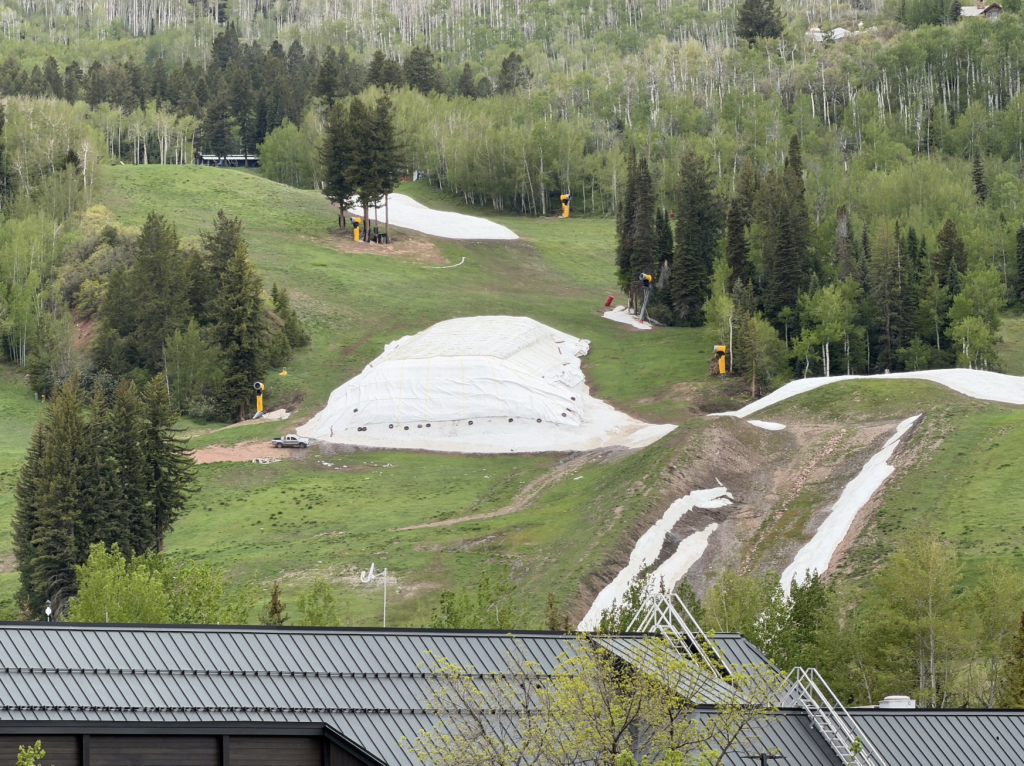
Aspen Snowmass/Courtesy photo
Aspen Snowmass has become the first location in Colorado to utilize Snow Secure insulation mats as part of a pilot program aiming to cover snow from the past winter in order to use it to bolster early season snowpack for the upcoming winter.
The patented technology has been applied to terrain parks on both Buttermilk and Snowmass Mountain, effectively covering 3.5 million gallons of primarily man-made snow water equivalent and keeping it insulated throughout the summer to prevent it from melting. As of Tuesday morning, Senior Vice President of Sustainability at Aspen One Chris Miller told The Aspen Times that the temperature under the blanket at Buttermilk was 32.6 degrees Fahrenheit.
“This very much is a sustainability story,” Miller said. “It’s enough snow to hopefully give us a good early season start. In order for us to continue to ensure the world-class experience we offer locals and guests, it will require a host of tools in this climate resilient toolbox.”
He noted that covering the snow that was made during the 2025/26 winter season will reduce the amount of snow that will need to be made in the early part of the 2026/27 season, meaning the amount of water to make new snow and energy to blow that snow will also be notably reduced.
“Man-made snow is both the man-made snow and the embodied energy that was required in order to make that snow,” he said. “That energy is typically lost if that man-made snow melts away. We’re retaining the energy that was required to make that snow last season and reusing it in the second season. Without this technology, that’s not possible.”
The pilot project to cover and manage snow has been in the works for over a year as a way to make Aspen Snowmass more resilient in the face of warming winters and more unpredictable climate.
“It is not one single technology or thing that is going to solve this problem,” Miller said. “It will require a series of tools that allow us to be more resilient.”
According to Antti Lauslahti, CEO of Snow Secure, the insulation mats, which are enhanced with integrated rain covers to also prevent melting, only lose about 3 to 4 1/2 feet of snow over the course of a summer. Lauslahti noted that pilot programs for the insulation mats typically begin around the size of a high school basketball arena, starting the summer with around 14,000 cubic meters of snow and ending in autumn with about 10,000 cubic meters.
“You don’t lose very much snow,” Lauslahti said. “Heat load is the biggest enemy of the snow storage.”
But even with temperatures hitting 100 degrees Fahrenheit some days, Snow Secure has seen insulation pads maintain a stable temperature of 35-37 degrees Fahrenheit throughout the summer.
Lauslahti confirmed that Aspen is the first location in Colorado to utilize Snow Secure’s patented technology, following three locations in Canada, Idaho and Wisconsin.
“Why we like Aspen is that the team is super professional,” he said. “How they have worked with us to develop the first pilot is really amazing and I’m really proud to work with them. They want to dig deep. I personally smile when I hear all their questions because it means they really care and really want to understand.”
What’s happening in Aspen, in one click.
Sign up for our morning newsletter at AspenTimes.com/newsletter
Snow Secure’s portfolio is growing quickly, he added, and the company is in discussion with 80 total ski resorts across North America, with 15 beginning to use the technology. The company has already run about 150 pilot programs.
Snow Secure has calculated that insulation mats last at least 10 years — the longest-running use is a program in Finland that is currently in its eighth year. Miller added this means the mats can be re-deployed year after year if the pilot is successful.
“We anticipate that this will be successful,” he said. “This is about climate resilience. It’s about building these tools and systems into our toolbox before we need them.”
According to him, it’s not just about addressing warming temperatures over the next 20 to 30 years but addressing the increasing unpredictability and variability of climate while reducing the energy and water footprints of early season snowmaking needs.
“It really is about Aspen Snowmass leaning in as innovators in our industry,” he said. “The idea here is to use this tool to build resilience, particularly into the early part of the season. It gives us more confidence that we will be able to open on time and we will have the conditions that our guests expect.”