Willoughby: How life in Colorado transformed in just a few years
Tim Willoughby Follow
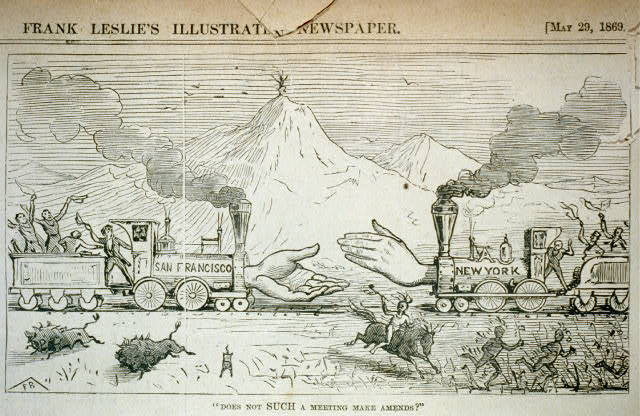
Library of Congress/Courtesy image
We all saw the photograph of the completion of the transcontinental railroad and the laying of the golden spike at Promontory Point in Utah in 1869 in our history books. That was the final section built from Sacramento to Omaha. Imagine what that meant to those living at the time. Knowing more specifics from the point of view of those who lived in Colorado at the time helps define what it really meant.
The opening, reported in the Denver papers, was exciting, but there was a major problem: It did not go through Colorado. Discussion beginning in 1870 was about connecting lines. There were several variables, but primarily, there was a battle between two railroad companies — the Union Pacific that was the transcontinental line and the Kansas Pacific Railroad Company — over who would have the mail contract. Since most of the land belonged to the federal government, it was also a political decision; Colorado was not a state yet.
A short line was constructed in 1870 by the Denver Pacific Railway and Telegraph Company from Cheyenne, Wyoming, to Denver to connect with the Union Pacific line. My great-grandfather, who had come to Denver for the gold rush, got the contract to build the depot for Evans, a stop on the way.
The line opened for service to Denver in June. A train with 40 passengers arrived at 7 p.m. to a welcoming crowd. The Rocky Mountain News commented, “We are now brought into close connections with the valley of the Mississippi and the Atlantic and Pacific sections, and a new era of progress and prosperity opens before us.”
But having an east-west line through Colorado was still a dream, and many in Denver favored the Kansas Pacific Railroad since it would go through Kansas City rather than Omaha.
The D&RG, that eventually connected to Aspen, had another idea and began work connecting Pueblo and Denver and intending to head south to connect to the transcontinental line in Ogden, Utah, but ownership battles slowed progress. It also was a narrow-gauge line.
The Union Pacific and Kansas Pacific formed a partnership, and in 1875, most viewed it as a monopoly and potential Colorado traffic was the issue. The Atchison Topeka and Santa Fe Railroad was the competitor.
Politics set aside, there was a great article in 1876 in the Omaha paper, noting that a 60-year-old man came for depot opening, and when the train came, he said that was the first train he had ever seen. That was a common occurrence. One decade resulted in a revolution.
The battles continued into 1878, but in Colorado, lines were not happening. The Denver paper posed the construction question: Will lines go to Denver? It wrote, “At any rate we will not borrow trouble but hope for the best results from a new alliance of the Union Pacific and the Kansas Pacific interests in Colorado. The eastern or western tourist might visit the wonders or the mines of Colorado.”
There seemed to be one problem after another, but in 1880, a new problem emerged: the building of the Panama Canal. That would, as they saw it, compete with all transcontinental lines reducing interest in investing in their building. But it didn’t. In 1869, San Francisco to New York on the transcontinental railroad was seven days. At that time, it was 89 days if you sailed around South America, and the canal cut it in half. Railroad, by 1876, was down to under three and a half days.
Two railroads connected Aspen in 1887, along with other towns and mining towns. Like the arrival in Denver in 1870, it meant that Aspen was “accessible.” But the transcontinental connection was not the primary celebratory accomplishment. Many of the early residents of Aspen had entered Colorado before 1870, slowly coming across the plains in wagons. They had already had the transcontinental life-changing moment. Before 1887, they had ridden horses or taken stages to Denver to take trains to the coasts.
The 1887 connection was viewed commercially, taking a train to Denver to catch a transcontinental train was secondary to getting loads of ore to the Leadville smelters. A busy 17 years of railroad building transformed their lives in unimaginable ways.
Tim Willoughby’s family story parallels Aspen’s. He began sharing folklore while teaching at Aspen Country Day School and Colorado Mountain College. Now a tourist in his native town, he views it with historical perspective. Reach him at redmtn2@comcast.net.

La Greca: Let’s make a plan — helping kids move through change
Transitions are hard because children live very much in the present moment.