Spring housing market off to a slow start for mountain-town listings as winter slump lingers
Spring has arrived, but ski town housing markets are lagging behind as rising mortgage rates fuel buyer uncertainty

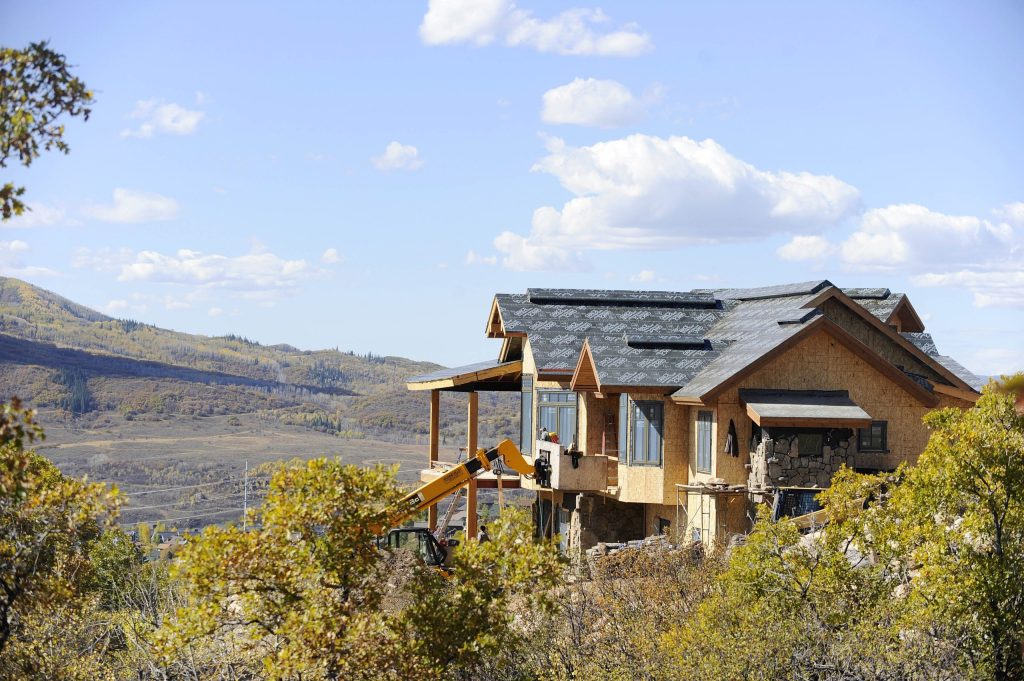
Matt Stensland/Steamboat Pilot
Still recovering from a lackluster winter for snowfall and tourism, home listings across ski town housing markets are off to a slow start during one of the year’s most critical selling seasons.
Spring is notorious for being one of the busiest seasons for home listings, largely driven by an increase in buyer demand. As snow begins to melt off homes and owners move their units from the winter rental market to the seller market, the season can often act as the perfect intersection between an increase in listings and a summoning of potential buyers looking to close the deal on a new home before a lengthy summer vacation or the start of school in the fall.
“Late spring is a popular time for bringing homes on the market in Routt County as buyers often want to see what the property looks like without snow on the ground,” Marci Valicenti, broker associate with The Group Real Estate in Steamboat Springs, said in an email. “Multi-family properties come on the market at all times of the year, but owners of ski-properties will often wait until after ski season to list after capitalizing on the winter rentals.”
On top of buyers having more listings to choose from and sunny views of the homes — which can matter a lot when the price tag is in the upper hundreds of thousands — Strategic sellers can also benefit financially during the spring market. Homes listed around late May and early June have been shown to sell for 2% more, according to an analysis published by national real estate company Zillow.
Following a slower winter market, rising economic uncertainty and spiking mortgage rates, however, real estate agents say this year’s spring market could face more uncertainty.
Colorado approaches a balancing market
In its monthly Market Trends Housing Report, the Colorado Association of Realtors reported the state is seeing steady sales, stable pricing and rising inventory — a common indicator that the spring season is in full swing.
Statewide, March brought roughly 12,800 new listings, up 0.8% from the same time last year, and 9,540 pending sales, up 7.2%. Sold listings were just over 7,460, an increase of 2.7% from March 2025. The median sales price also saw modest improvements, falling just under 1% to $545,000.
These characteristics can be encouraging for aspiring homebuyers, who during the spring can sometimes find more opportunities for negotiation and concessions.
Active inventory for March 2026, however, is sitting slightly lower than what the state saw last year for both single-family homes and condos — down 1.6% for a total of 25,367 overall. This pushed months supply of inventory down 2.8% from a year ago to 3.5 months.
Ski markets recover from a challenging winter
Rural ski resort markets on Colorado’s Western Slope, however, show a slightly different picture thanks to an especially challenging winter season for the real estate market.
One glaring culprit is the record-low snowfall that fell across Colorado’s Western Slope, leading to lower tourism for several mountain resort destinations. Dana Cottrell, incoming president of Altitude Realtors in Summit County, said lower tourism can contribute to weaker buyer activity, since fewer eyes on available homes means less inquiries from aspiring homeowners.
Mike Budd, a real estate broker associate with Berkshire Hathaway HomeServices Colorado Properties, said in the report that the heightened uncertainty from reduced tourism has only added “one of the most dramatic and challenging periods” Vail’s housing market has experienced in the past 50 years.
“The snowpack and visitations were down significantly which impacted the economy and presents a major impact for the valley due to drought and significant shortfalls of reserves in the reservoirs moving into spring and summer months. The impact on small businesses could create significant failures,” Budd said. “Spring and summer markets are a difficult situation to forecast at this point.”
Although Vail’s closed and pending sales all saw increases compared to last spring, new listings in March are down 4.2% from last year, with fewer people putting homes on the market during the first month of spring. Still, overall inventory of active listings remains 6.9% higher than March 2025.
In Steamboat Springs, new first-quarter listings for single and multi-family homes are down roughly 20% compared to the first quarter of 2025. April so far has seen 15 single-family homes come on the market in 15 days, lagging behind April 2025’s inventory of 52 homes, Valicenti said.
Active inventory for March looked slightly better, with 54 single-family homes at the end of March 2025 compared to 68 in 2026.
Buyer activity typically peaks during the summer months in Routt County, Valicenti explained. A lackluster season in 2025, however, caused summer activity to emerge late in the year — which could happen again in mountain towns.
“With 2026 already seeing unconventional weather patterns, it remains to be seen if real estate activity will follow its traditional seasonal cycle and peak this summer,” Valicenti said.
Some markets, like Aspen, have two “high seasons” for inventory, mainly spring and fall. Currently in a shoulder season, April and May mark months where “property owners get energized to move into the market and make their moves,” according to Brenda Wild, Aspen broker and owner of Berkshire Hathaway HomeServices.
This year, however, has presented an anomaly for the housing market. New residential listings in Aspen are down 28.4% from last year, a steeper dip compared to the 10.2% decrease from 2024 to 2025.
“Inventory tends to rise prior to the height of the summer and winter seasons to capture the resort/second home buyer,” Wild said in an email. “A steady decline for the past two years in spring listings is not normal for our market. It is reflecting some key factors in the national real estate market that are impacting and slowing down activity in listings.”
Homeowners with low interest rates, Wild said, might be more hesitant to let go of their current holding. Proposals to increase capital gains tax exemption thresholds have also pushed some property owners to hold off on selling for the time being.
Even with lower listings, Aspen buyers are staying active. Showings to pending sales are up 61.5% year-to-date compared to 2025, which was down 13.3% compared to 2024, Wild said.
Cottrell said she’s seen more residential listings pop up in Summit County heading into spring, though not as many as last year. New single-family home listings were down 11% for March compared to last year, or 3% for multi-family homes.
What has kept her optimistic about the market, she said, is the amount of interested buyers she’s heard from this early into spring.
“It’s like, ‘Wow, I had no idea that many people are out looking in April,'” Cottrell said. “I thought we were just going to trickle into the spring … but there are definitely people out there looking. Whether they’re actually buying, we’ll find out.”
She added that growing interest from buyers makes her hopeful that residential inventory could still see a boom during the warmer months, since inventory has consistently fallen under what was typical before the pandemic.
“That’s very, very promising to me to see that, because that’s not always the case,” Cottrell said. “So I feel very optimistic for the spring. I feel like we’re going to start to see more inventory. … It’s just a matter of buyers being out there.”
What about home prices?
Median prices for single-family homes in Summit County have consistently gone down over the last three months, Cottrell said. Comparatively, condos and townhomes have held steady.
“That’s telling me that more people are buying lower-priced houses than the big, big expensive ones,” Cottrell said. “But it’s hard to say what’s going to happen because we are going to start to see more inventory.”
The average price for a single-family home in Summit County was down 3% year-over-year in March, falling to $2.59 million. Meanwhile, the average price for multi-family homes have gone up 9% to over $940,000.
In Vail, March’s average sales price for a home fell 3.7% from 2025, with modest gains in sales activity. Steamboat Springs has also seen declining single-family median prices, which fell 21.4% to $1.57 million over the same period.
Economic uncertainties dampen outlook
Economic uncertainties like rising mortgage could dampen the outlook for buyer activity.
The national average on a 30-year fixed-rate mortgage is 6.34% as of April 17, according to Bankrate. Despite reaching a four-week low, rates are considerably higher than they were in February, when they briefly fell below 6%.
Now, the Federal National Mortgage Association is predicting that mortgage rates will remain above 6% throughout 2026, contrary to its original forecast.
The Mortgage Bankers Association’s latest weekly survey said purchase applications were 7% below the same week a year earlier, according to Matthew Starr, the owner and managing broker of Astralis Real Estate in Rifle.
“Across much of the Western Slope, where financed first-home buyers are a meaningful part of the market, a move back into the mid-6% range matters,” Starr said in an email. “Buyers are likely to be more cautious, take longer to make decisions, focus more heavily on negotiation, and be less willing to stretch on their monthly payment.”
Higher rates usually don’t stop cash buyers or equity-rich buyers, Starr added, though they do make financed buyers more selective.
“In that environment, sellers can still benefit from the spring increase in inventory, but they have to price and position their properties more carefully. Most buyers are looking at the monthly payment first,” Starr said.
While the ongoing war in Iran is certainly fueling economic uncertainty and impacting prices for other goods like gasoline, it can’t be fully to blame for rising mortgage rates. Urban Institute’s February chartbook shows that the 30-year fixed rate had already reached 6.09% before the conflict began, made up of a 4.14% 10-year Treasury yield and a 1.95% mortgage spread.
“That indicates mortgage rates are being shaped by broader mortgage-market pricing, not just geopolitical headlines,” Starr said.
Starr continued: “The Iran conflict is better understood as a catalyst than a sole cause. It likely pushed energy prices and inflation expectations higher, but mortgage rates also reflect sticky inflation, a cautious Federal Reserve, and a bond market that is repricing risk.”
Cottrell said that, while mortgage rates are not often the most important factor behind deciding when to buy a home, it does impact how long they’re willing to wait on the sidelines.
“I do think there’s an element of people saying, ‘Oh, we don’t have 3% mortgages anymore.’ I feel like that was quite the psychological hoop to jump through, to be able to say, ‘All right, I’m in the sixes and that’s normal,” Cottrell said. “I have a bunch of people that I showed many houses to last summer, and they just couldn’t pull the trigger.”

Local chefs expand Willits lunch offerings with Pan-Asian street food
Crispy rice cakes and pork belly bao buns are coming to the Willits area with the opening of Seoul Kitchen, the latest venture from Executive Chefs Greg Topper and Mike Ziemer of Aspen Elevated Catering.





Nearly 2,000 ski instructors have joined lawsuit against Vail Resorts so far; opt-in deadline is Wednesday
Consent forms filed in federal court on Friday show that nearly 2,000 ski and snowboard instructors have joined a collective action against Vail Resorts, alleging Fair Labor Standards Act lawsuit against the company.