Willoughby: Snow removal 1930-50s
Tim Willoughby Follow
Willoughby Collection/Courtesy photo
We usually do not think about road snow removal except when we are driving in bad storms or something has gone wrong with the routine plowing. In the 1940s and early 1950s, there were fewer roads that were kept open in the winter and more limitations and challenges.
When my mother was a young girl, before there were many cars, the streets were not plowed. Horse drawn sleighs conveyed people and materials around town. Her grandfather was a teamster, and sometimes, when there was a big storm, he would arrive before she had to go to school with a horse and small plow and displace the snow as she walked.
A major limitation, in the 1930s-early 1950s, were city and county budgets. The city had gone into debt from excessive spending around 1905 and was still paying off that debt. When my grandfather was mayor, he was a master of tight budgets looking for ways to cut spending. He was the manager of the Midnight Mine, and it had four-wheel drive trucks and bulldozers, something the city did not always have. After major storms, he would send my father with the equipment to town to plow the streets.
The county had miles of roads but not equipment or staff. It contracted with Flogaus Lumber Company for much of the plowing. Like the Midnight, Flogaus had four-wheel drive trucks to transport its lumber from their mill in Lenado. They added a plow in the winter and plowed the county’s roads. Rural residents often had to wait for Flogaus to plow, as he had too many miles to plow. A second company, L.R. Eaton, had a contract for a few years. The county acquired trucks and, in 1950, bought a large “wing” snowplow that cost them $1,900 ($19,000 in today’s dollars).
One of the major problems in the city was that locals didn’t drive as much in the winter and they did not move their parked cars. That slowed the plowing and left banks of snow after the car owner shoveled and drove out. The business section of town was the most difficult to keep clear of snow, mostly due to parked cars but also because the city had to plow narrow alleys, too, with little room for the snow to be pushed to the side. Unlike today, snow was not scooped up and hauled away.
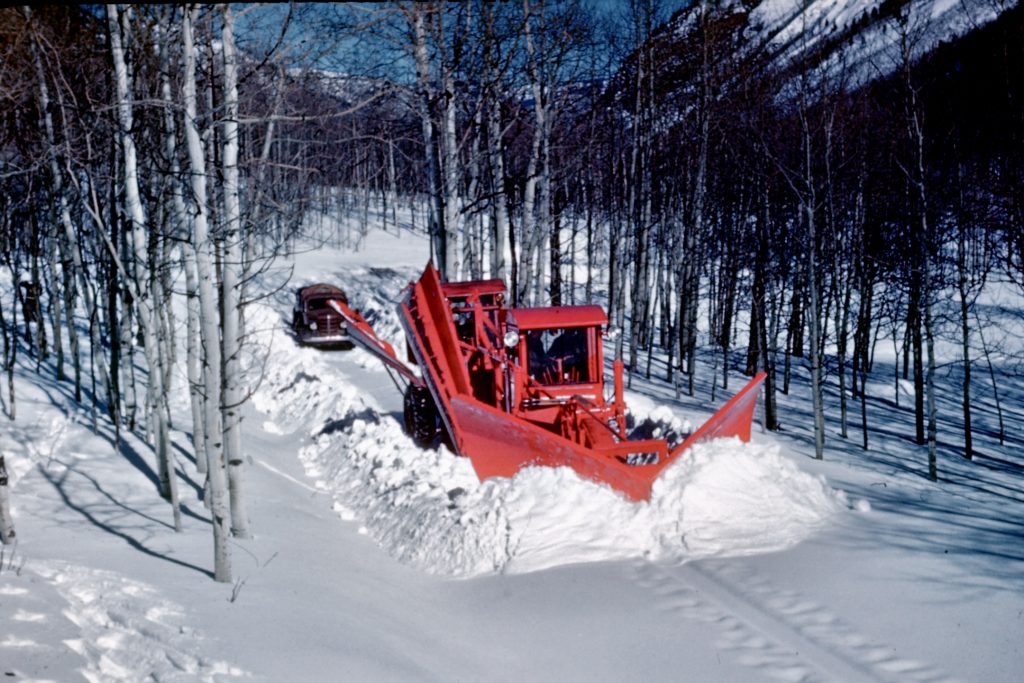
The city solved many of their problems in 1952 with the purchase of the grader/snowplow you see pictured. They splurged — it cost $15,000 ($139,000 in today’s dollars). They had to spread the payment over two years to squeeze it into their budget.
Austen-Western introduced innovations into graders in the late 1930s. Aspen bought what was labeled a model 99; 99s were all-wheel drive, perfect for snowplowing. Their other innovation was both the front and back wheels could be turned, enabling much sharper turning, helpful in smaller spaces like Aspen’s alleys.
They also introduced innovations for snowplowing that they called scarifiers. You could have a wide snowplow that went under the vehicle frame around its middle, so the traction of the front-wheel-drive wheels could keep it in line. Then, in addition, or as a substitute, you could get their vee plow (as you see in the photo), a high, sharp V-shaped plow, especially good in deep snow. And, they had “wings,” a 10-foot extension blade for a wider swath, great for doing a whole street or half a street in one plow.
The grader/plow arrived in November, and a couple of days later, it tackled an early storm of 6 inches. There were few city “improvements” that garnered the level of enthusiasm that locals had when they saw that plow in action.
Tim Willoughby’s family story parallels Aspen’s. He began sharing folklore while teaching at Aspen Country Day School and Colorado Mountain College. Now a tourist in his native town, he views it with historical perspective. Reach him at redmtn2@comcast.net.




Aspen Snowmass records highest snow totals of any Colorado ski resort
Aspen Snowmass reported up to 8 inches in 24 hours as of Thursday morning across all four mountains, the highest snow totals of any Colorado ski resort following Wednesday night’s storm.