Willoughby: Galena Street 1950s, part two
Tim Willoughby Follow
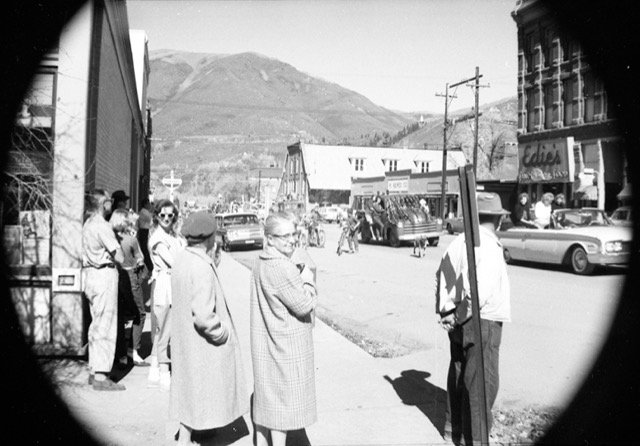
Aspen Flyer Collection/Aspen Historical Society
In part one, I presented my 8- to 12-year-old memories of Galena Street, finishing with Tomkin’s Hardware. The next building on that side of the street, then and now, is the Aspen Building.
Since I lived across the street from the Aspen Building, I glimpsed it every time I looked out our living room windows in the Cowehoven Building. The stairway entry for the people who rented apartments was directly across the street. You could rent one for $75 a month, included utilities.
There were two businesses on the ground floor on the Galena Street side: Jiffy Cleaners and the Valley Kilns. The Cleaners was always busy. My interest was in the Kilns windows where they displayed their pretty clay windchimes.
The next block, between Hyman and Hopkins, was the location of some of Aspen’s busiest commercial buildings. The busiest of all was the Elks Building because, at that time, the corner space housed the post office. Everyone in town headed there almost daily to check their mail. Our box was #22, and my mother sent me often to pick up our mail. During that period, the post office built a new building a block east of there, and Tom’s Market moved into the Elks Building location. Aspen locals generally held business loyalties, so even though Tom’s was 100 feet from our home, our groceries were purchased at Beck and Bishop in the Wheeler.
The other ground floor space housed Edie’s Restaurant, my favorite because they sold green rivers to drink and served custard ice cream, vanilla or chocolate or both. They had stools with no backs surrounding the counter with red revolving seats and a jute box with current hits blaring away.
The second floor of the Elks housed the Elks, but since my parents were not members, I didn’t go there.
The rest of the block housed Kalmas Clothing, providing most of the apparel families bought in Aspen. My major memory was from going with my mother before school began each year, shopping for shoes, shirts and pants.
The other side of the street on that block had another busy business, Aspen Drug. Few businesses were open on Sundays then, but Aspen Drug opened for part of the day for its pharmacy, as locals picked up their Sunday newspapers there.
Adjoining Aspen Drug was Newton’s Abbey Bar popular with locals and visitors too. In the ’60s, it opened the basement offering musical entertainment.
On the other side of the alley was the Brand Building. The ground floor on the Galena side had only one tenant then: Stan’s Body Shop. I frequently passed by on my way to or from school. It was a busy, noisy place. The second floor had a large room that, when my parents were in high school, they attended dances there. In the ’50s, dance lessons were provided there, and the Aspen Arts Associates rented studio space. Many organizations held meetings there.
The last block, between Hopkins and Main, was not as busy as the others. On the west side, much of the block was taken up with an old, run-down building that was used for storage. At the corner was the Conoco station. It advertised with a phrase, “Drive in please, drive out pleased.” I took advantage of their tire air pumps for my bicycle.
The other side of the block was St. Mary’s property and the house where the priest, Father Bosch, lived. I spent time there with him being tutored in Latin (the reading of it only) to be an altar boy.
The busiest building was the Armory Hall converted into City Hall. The large space with a high ceiling, used as a gym and a performance hall in previous times, became the garage/storage/shop for city trucks. City offices were on two stories on the Galena front side of the building. My mother worked for the water department, and often, I checked in with her on my way home after school.
On the other side of Main, Galena dead ends. The Court House covers that end of the block. The Sherriff, Lorain Herwick and his family, lived in the basement where the cells were located. Mrs. Herwick fed the prisoners. I spent some time there playing with their son, Pat.
Galena Street — four of the busiest blocks in town in the 1950s, especially if you were a young boy.
Tim Willoughby’s family story parallels Aspen’s. He began sharing folklore while teaching at Aspen Country Day School and Colorado Mountain College. Now a tourist in his native town, he views it with historical perspective. Reach him at redmtn2@comcast.net.




Pitkin County breaks ground on McClure Pass Trail
Pitkin County Open Space and Trails has officially broken ground on McClure Pass Trail, a new natural-surface trail connection in the Crystal Valley from Highway 133 to the summit of McClure Pass.