Saddle Sore: History lives on
Tony Vagneur Follow

Tony Vagneur/Courtesy photo
A lovely afternoon, blue sky overhead, a light breeze stirring the leaves, and I had a meeting scheduled with Amy Honey, vice-president of Education and Programming at the Aspen Historical Society. We had a Sunday history outreach program coming up that needed a little attention beforehand.
Unlike me, Amy has a real job, one that can change directions without much warning. Our 3 p.m. meeting was pushed back until “around five,” and instead of meeting in the office, we decided to walk over to the Resnick Center for Herbert Bayer Studies and catch the last hour of a new Bayer exhibit, discussing our business strategy along the way. Excellent way to finish off the day!
Growing up in Aspen, one sometimes failed to appreciate the importance of people who arrived while we were still children or teenagers too occupied with our own lives to absorb the contributions of newcomers.
My knowledge of Herbert Bayer was fairly simple. He created the famous “blue eyebrows” over the second-story windows of the Hotel Jerome, admired and criticized in roughly equal measure. He also designed portions of the landscaping around the Aspen Institute and Aspen Meadows, areas that fascinated us kids, who spent a fair amount of time riding bicycles, exploring and performing questionable gymnastics on those soft expanses of green lawn. And, of course, there was the marble sculpture nearby.
So yes, I knew who Herbert Bayer was. Or at least I thought I did.
Outside my wall of ignorance existed an incredible collection of art, much of it created while Bayer lived in Aspen. The more I looked, the more I realized how little I actually knew about him.
He seemed incapable of limiting himself to a single form of expression. Paintings, sculpture, architecture, graphic design, landscaping — his imagination wandered wherever it pleased. Looking at the collection, I found myself wondering where such ideas originate. How does a person look at a blank canvas, a piece of stone or an open stretch of ground and envision something entirely new?
Perhaps it is not so different from gardening. A gardener plants seeds and waits to see what emerges. An artist begins with an idea, often no more substantial than a seed itself, and somehow coaxes it into existence. The miracle, it seems to me, is not the finished work, but the creative spark that starts it all.
Sunday, Amy got to the Farm Collaborative at Cozy Point Ranch a couple of hours before I did. She was there to make bread and teach kids and adults how to make butter. I’d churned enough vats as a youngster that I begged off that endeavor.
One of our hosts and guides, Liz Wing, had things well under control, and before long, we were enjoying a wonderful lunch: garden salad, polenta, chicken, chocolate chip cookies and more. Good food is hardly surprising at a farm known for its farm-to-table connections and its annual feast celebrating the same.
The afternoon was devoted to tours of the farm, led by Jennifer Payne, whose task is to further develop the agricultural ground and create conditions more favorable for growth and long-term sustainability. We followed the gentle course of Brush Creek as it winds through the valley, taking note of the healthy native vegetation flourishing along its banks.
Jennifer understands that water is life. One of her projects involves creating a meandering waterway through portions of the property, allowing moisture to spread across a wider area rather than rushing downstream. The result resembles a giant corkscrew laid gently across the landscape, slowing the water and encouraging it to soak into the earth where it can do the most good.
Under greenhouse-like canopies, rows of seeds were beginning to push through the soil, tiny green shoots announcing the beginning of another growing season. Amy brought photographs of Cozy Point from the days when it was primarily a cattle and sheep operation, along with images of the gardens and farming efforts that helped sustain it. Saddle your horse or grab a hoe and get to work.
Historically speaking, Cozy Point Ranch has a soft spot in my heart. Many friends, some from an older generation, have lived there over the years, but my favorite story involves the Deane family, who called the ranch home before moving on to establish the T Lazy 7 Ranch.
A young Buck Deane recalled sitting in the big, white, two-story ranch house — lost to fire several decades ago — waiting for his older brother Tony to come galloping up the hill from the one-room Woody Creek School each afternoon, so they could listen to “The Lone Ranger” on the radio.
That simple image — a boy watching for his brother, a horse climbing the hill and a radio program worth racing home for — seems to capture the spirit of the place as well as anything. History lives on not only in buildings and photographs but in stories handed from one generation to the next.
Tony Vagneur writes here on Saturdays and welcomes your comments at ajv@sopris.net.
Tony Vagneur writes here on Saturdays and welcomes your comments at ajv@sopris.net.




New Aspen Airport terminal design leaves room for gondola
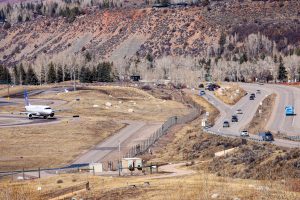
The new Aspen/Pitkin County Airport terminal design is proposing less passenger holding space, less parking and less employee amenities, but is including space for a proposed gondola system from Brush Creek Park and Ride to Aspen.