Roaring Fork Valley is ‘better prepared than we’ve ever been’ for wildfire
Local governments, fire departments and more are geared up for wildfire season

Colin Suszynski/The Aspen Times
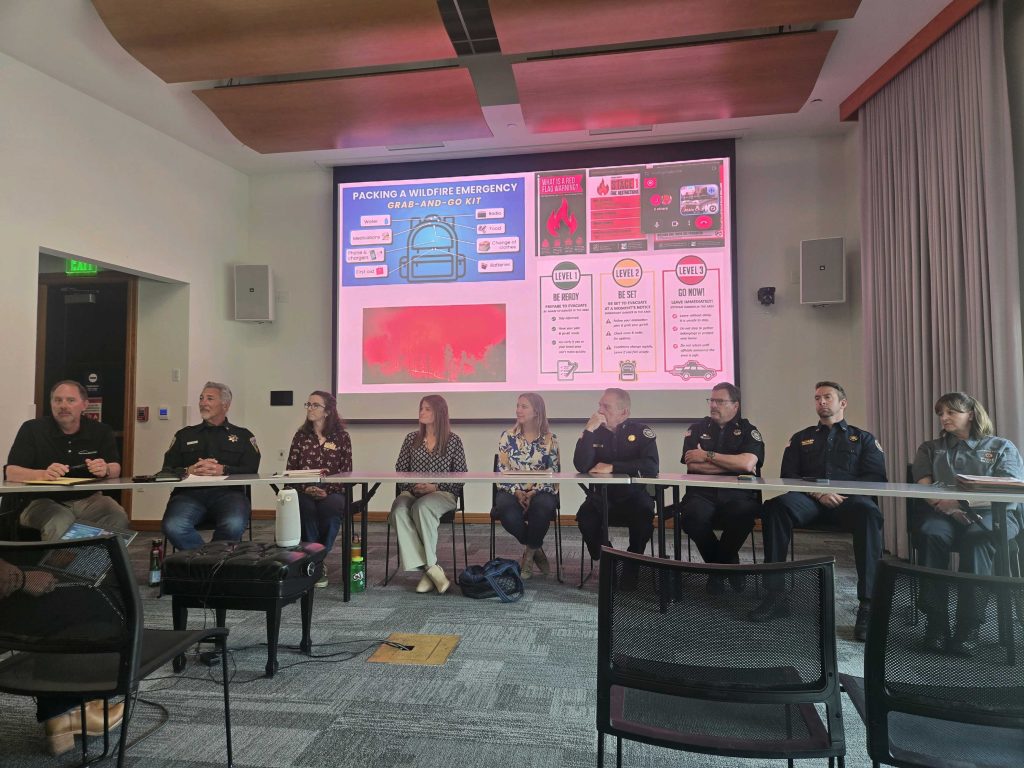
Wildfire conditions are not looking good, according to a panel on wildfire preparedness in the Roaring Fork Valley on Thursday.
The combination of record-breaking low snowpack and record-breaking high temperatures is exacerbating conditions for fires to break out in the Roaring Fork Valley, Service Hydrologist for the National Weather Service Erin Walter said. In particular, she emphasized an increased potential of significant wildland fire in western Colorado this June and July.
But due to the valley’s general elevated wildfire risk and this winter season’s particularities, various fire departments, governing bodies and law enforcement offices in the valley have already been collaborating to ensure that the communities are resilient and prepared for what could come.
“Our partnerships that we have throughout the valley and throughout the Western Slope, and throughout the state, are incredible,” Jake Andersen, fire chief at the Aspen Fire Protection District, said. “We’re better prepared than we’ve ever been.”
Thursday’s panel touched on the broad ways that the Roaring Fork Valley is already prepared to address wildfire or is becoming prepared, from informational campaigns and utility management to preemptive staging of firefighting resources and the deployment of new firefighting and fire prevention technology.
One of the primary ways the city, county and various fire fighting districts are focusing their efforts is in home hardening and planning in order to prevent fire from jumping from a wildland setting to an urban setting through ember ignition.
Home hardening has been a topic of various local governments lately, after the state of Colorado asked that local governing bodies update their fire resiliency code by “hardening” or reducing the chances a home will catch fire when exposed to embers.
Many of the local governing bodies in the valley already had baseline of home hardness requirements that met or exceeded the needs put in place by the state, with features like a buffer zone between structures as well as vegetation and landscaping requirements that dictate where trees should be spaced.
New modeling capabilities already deployed in Marble and in the process of being used to assess Aspen can also find specific areas where the wildland-urban interface is particularly susceptible, helping to make area- and structure-specific recommendations for improvement.
“(The model) is the only scientifically validated model that can accurately understand how fire moves from home to home,” said Angie Davlyn, program manager at the Roaring Fork Valley Wildfire Collaborative. “(The model) is almost 90% accurate, which is outstanding.”
Beyond home hardening, local firefighting districts have plans and tools in place to address potential ignition in the community. According to Andersen, almost all of the Roaring Fork Valley is currently being watched by Pano AI cameras that can detect smoke and alert fire fighters before ignitions get out of hand.
In addition to technological resources, the fire protection districts are strategically staging trucks and firefighters to ensure that the initial attack response is swift and effective, ideally stopping a smaller fire before it even becomes a wildfire. Prescribed burns like last year’s Sunnyside burn have also been reducing fuels, with more planned this year.
“There’s a lot that’s been done,” Andersen said. “We’re just trying to scale up now to try to keep pace with the wildfire problem that has just been outrunning us.”
The Pitkin County Sheriff’s Office will be working with the fire departments to remind, educate and enforce fire restrictions when necessary. According to Pitkin County Sheriff Michael Buglione, a backcountry community response officer position that was created in 2025 proved highly effective in its first year.
“(The officer) did a knockout job,” Buglione said. “We’re going to campsites where people tend to leave on Sunday … and there is a smoldering fire. They’re going to be out there to educate people, or they’re going to put the fire out.”
If a wildfire does pose a threat to communities in the Roaring Fork Valley, the county has updated its emergency response planning to make communication easier and clearer with potential evacuees. They will continue to utilize local alert systems and have settled on a simple messaging system that will prepare people to evacuate in addition to ensuring quick evacuation when necessary.
“We’re actually working with Aspen (police department) here next week, and we’re going to do an exercise to work with those frontline leaders, sergeants, battalion chiefs — people like that — who are on the street,” Chris Breitbach, Pitkin County emergency manager, said. “They’re the ones that are going to be working in that unified company with police and fire to make those decisions.”
While the winter’s water storage is a cause for concern going into the summer, local officials emphasized that the Roaring Fork Valley was dedicating broad, collaborative resources toward the problem.
“Fires are going to burn,” Andersen said. “(We are) making our communities resilient, so that we limit the entry points into the built environment where fire is going to impact people and the places where we live.”






Aspen to see new e-bike fees at Maroon Bells this summer
A new $5 amenity fee will be required of all visitors entering the Maroon Bells Scenic Area on e-bikes this season.