High Points: Over the rainbows
High Points
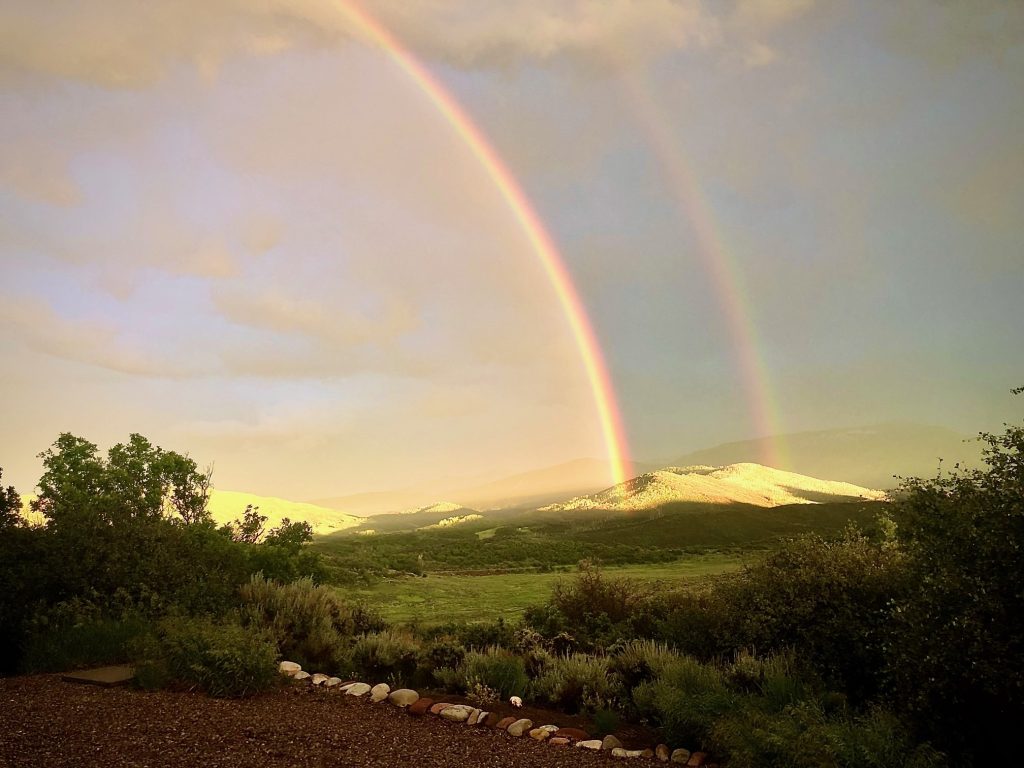
Courtesy photo
You can’t buy ’em, and you can’t sell ’em. You can’t touch ’em, and you can’t smell ’em. You can’t plan for them, and you can’t reschedule them. They are simply gifts of nature.
If you were out and about earlier this week in the Roaring Fork Valley when the rains came in the late afternoon, you may have seen some of the many rainbows that graced our skies. The dance between the setting sun, the rain, and the darkening clouds created the perfect canvas for some of the most magical and colorful rainbows seen in quite some time. We can thank the monsoon flow from the Gulf of Mexico that brought us the soaking rains and the thunder and lightning for the multi-hued and vibrant displays of color.
Rainbows are not “things” or “objects.” Rather they are an optical occurrence or phenomenon that is created when sunlight, atmospheric conditions, and a viewer’s eyes all align in just the right space at just the right time. It is a serendipitous confluence that allows us to see a half circle, or very rarely, a full circle, of color.
The rainbows this week were seen by those looking to the east when the sun dropped below the clouds in the west. The water droplets that hung in the air as it rained had streams of sunlight passing through them. Sunlight has many wavelengths of color and, as it passes through the water, the drops act as prisms to bend the light, creating a visual spectrum of colors. The colors are seen according to the length of the wave projected, with violet having the shortest wavelength and red the longest. The result is that red will always be on top of the arc of the rainbow while violet will always appear at the bottom.
There are seven colors to a rainbow, and they always appear in the same order, though they do often meld together. From top to bottom, these are red, orange, yellow, green, blue, indigo, and the aforementioned violet. In only the most vivid of rainbows can you perceive all of the colors individually, and they tend to melt together leaving a trio of red, yellow, and blue light. But this week, I could swear that the entire spectrum was delineated in some of these beauties. By the way, some remember the order of the spectrum in a rainbow by using the acronym ROYGBIV. Get it?
There are many myths about rainbows, as one would expect of something so visually powerful but so ephemeral. The “Pot of Gold” at the end of the Rainbow is an old Irish legend about leprechauns who hid their gold where the rainbows end. As I live in Old Snowmass and my rainbows often begin and end on Wildcat Ranch, I fully subscribe to the theory.
And of course, there is the yearning in the Harold Arlen song, “Over the Rainbow” sung by Judy Garland in the 1939 film “The Wizard of Oz.” Updated by Israel Kamakawiwo’ole, or IZ as he was known, the ukulele version is a certain tear-jerker as it cries out for another place and another time where “dreams that you dare to dream really do come true.”
We may be over the rainbows for a while now with the upcoming forecast projecting sunny skies. But soon, the monsoons with return. Look east at the sunset, and look for the ROYGBV rainbow.
It’ll light up your life.