Inside the Colorado mountain effort that will help Artemis astronauts land on the moon
From technology to the High Country Landscape, the High Altitude Army National Guard Training Site in Gypsum has helped 25 NASA astronauts prepare for Artemis missions

Michael DeMocker/NASA
When Apollo 11 approached the moon on July 20, 1969, its planned landing zone in the Sea of Tranquility was unexpectedly cluttered with large boulders. The hazards prompted Mission Commander Neil Armstrong to take control of the lunar module, evade the rocky field, navigate to safer ground and land with only 25 seconds of fuel remaining.
For Armstrong, his successful landing, despite the unforeseen challenges, was due to his training on Earth, according to Ben Honey, the deputy manager for NASA’s human landing systems.
Now, as NASA prepares to send humans back into deep space as part of the Artemis program, the agency’s training philosophy is rooted in similar goals and challenges, but it is also leveraging new places and technologies to train its astronauts — including in Colorado’s northwest mountains.
“The problem of landing on the moon with humans and doing it safely hasn’t changed that much from Apollo,” Honey said. “You want to give your pilot and commander and whoever else is on the vehicle the power and knowledge to interact with the vehicle, interact with the environment and to control their fate if something unexpected happens.”
Armstrong’s 1969 landing was made possible by hours spent in Houston doing in-flight training and using a lunar landing training vehicle, he noted.
“That was how they solved the problem back then,” he said. “Today, technology has advanced decades, and we have things like HAATS (High Altitude Army National Guard Aviation Training Site) set up where we don’t have to go build our own capabilities. We can leverage capabilities for experts that are out there, like Ethan (Jacobs) and his team, to teach our astronauts how to control a vertical descent into challenging terrain under all kinds of extreme conditions.”
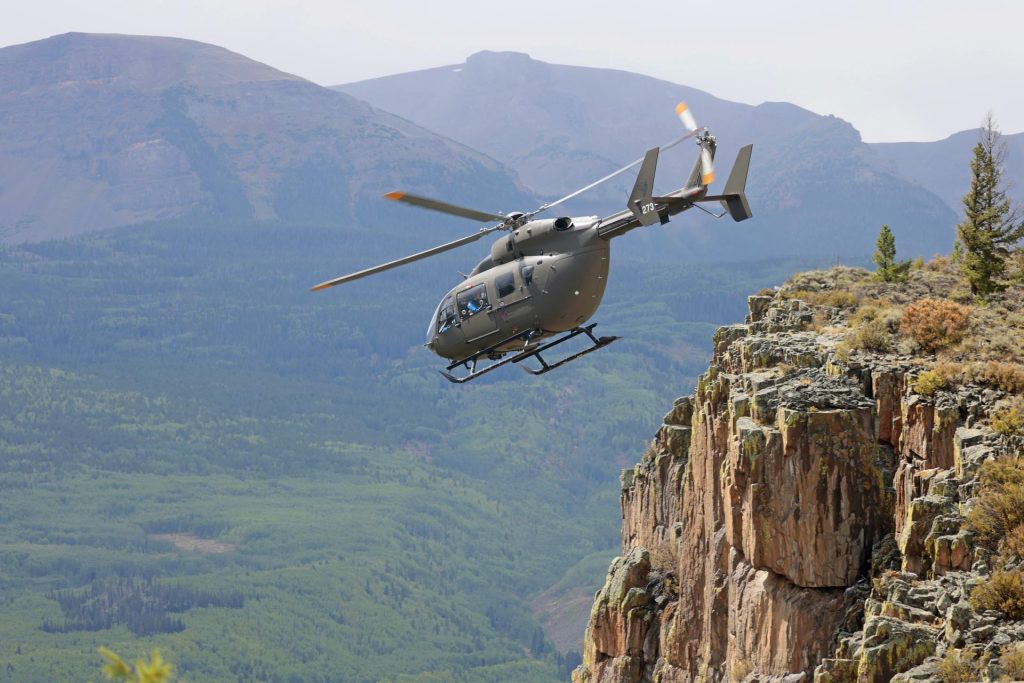
Jacobs is an instructor at the training site where, as of May 2026, 25 NASA astronauts and one European Space Agency astronaut have completed a two-week training course developed between the Colorado National Guard and NASA.
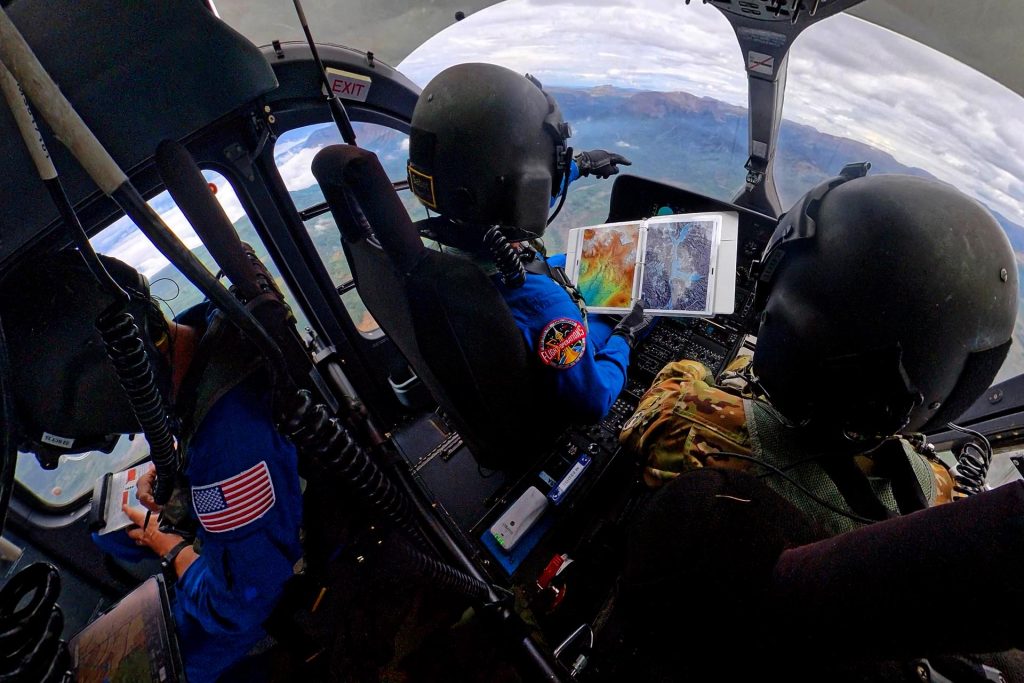
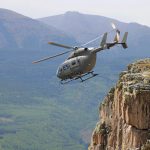
The Colorado National Guard built the High Altitude Army National Guard Aviation Training Site in Gypsum over 40 years ago following the Vietnam War. It was part of an effort to train military helicopter pilots how to maneuver through mountainous terrain and high altitudes.
In 2021, NASA approached the Colorado National Guard to develop a course that prepares the Artemis astronauts to use the human landing system built by SpaceX and Blue Origin for the Artemis missions. It gives them a real-world environment to practice vertical flight skills, in addition to the ground and simulation training they do in Ohio and Texas.
“The overall goal is just precision,” Jacobs said. “How to head and fly a machine from a point in space to a point on the ground, as confined as we can make it, where the precision, plus or minus a foot, where we’re actually getting the landing gear to touch down at.”
According to Honey, the majority of the astronauts have either flown a plane or never flown at all when they start their training. In an airplane, the vehicle is facing forward, making landing and navigating different from both a helicopter and lunar lander.
“Flying a lunar lander, when you have a rocket shooting out of the bottom of your vehicle, you have to tilt your angle, just like a helicopter,” Honey said.
The HAATS course fits within the early development of astronauts’ skills and training and is layered with classroom and simulation training.
“NASA and Flight Ops really value executing your training in a real-life scenario,” Honey said. “The more we can add layers of realism, with an aircraft, for example … (With HAATS,) we’re adding a layer of risk: You’re in a real aircraft that allows you to do what we call cockpit resource management with the other people in the vehicle and solve problems together, like you would in a real space flight.”
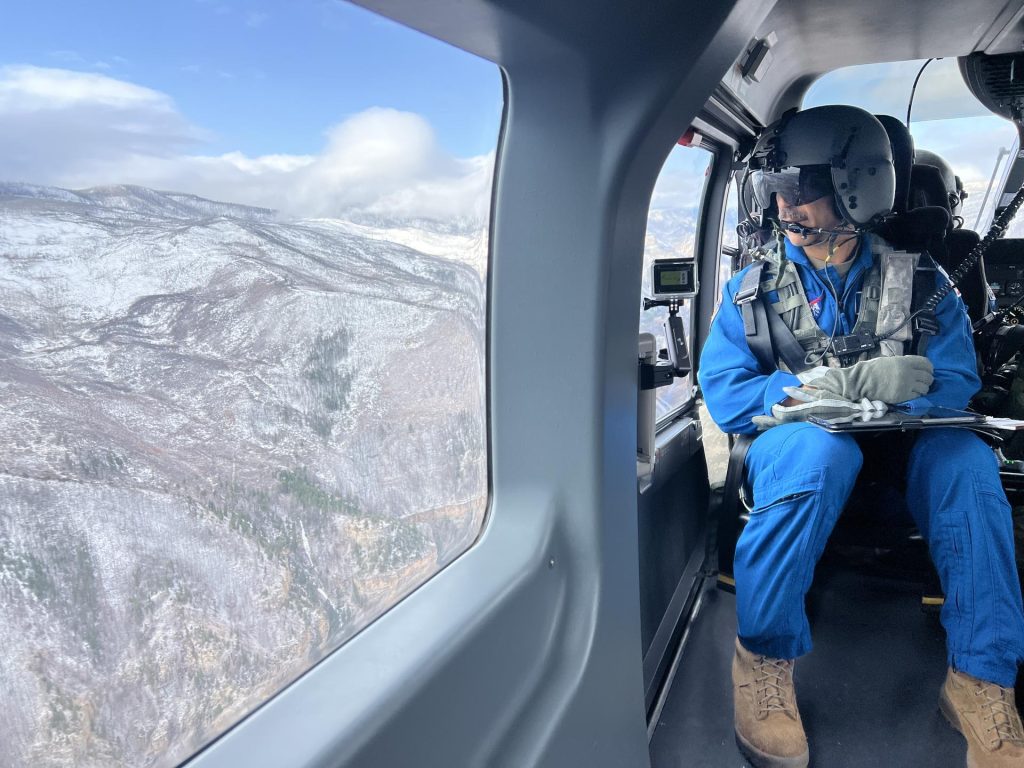
Having the training in Colorado’s high country serves a purpose as well.
With the thin air and varied landscapes around Gypsum, the mountains and surrounding area offer visual illusions and flight conditions similar to those on the moon, making the region a perfect place for astronauts to practice lunar landing and flight procedures using helicopters.
“Being in Colorado means that if we choose to go and do a HAATS course with Ethan in the winter at night, now suddenly, it basically looks like the moon. Everything is white, you’ve got these long shadows, you can’t tell how big anything is. It’s exactly like Neil Armstrong trying to land in a field of boulders, and you can’t tell whether the boulder is a foot tall or 20 feet tall,” Honey said. “It’s actually a lot more similar than people may realize to a lunar environment.”
The course is also used year-round by NASA and offers seasonal conditions that mimic lunar landings. When landing on the moon, the spacecraft could kick up lunar dust and make it difficult to see the surface. In Colorado, dusty or snowy conditions can cause similar visual obstructions.
The two-week training kicks off with a week of foundational training, while the second week is more specific to the lunar landing environment. Their time is spent both in flight — with daily flights progressively building toward more challenging landing zones — and in the classroom.
“What we teach NASA versus what we teach our traditional students is very similar,” Jacobs said. “We took a program that we already had in existence and just tailored it specific to NASA, but it covers a lot of the same stuff, such as visual illusions associated with mountain flying, energy management, crew coordination and what we call degraded visual environments, where you see those dust clouds or snow clouds formed when we’re coming into land.”
The training has continued to evolve the more astronauts they train, he said, likening it to a lab environment.
“Every time we do this, we identify some that, either there’s a new teaching point or a new rabbit trail we have to chase down,” he said. “I’ve learned a ton about space flight in general.”
Getting astronauts back to deep space

For NASA, the Artemis missions represent an “effort to go back to deep space” and to “learn things about the building blocks of the solar system and life itself on Earth that we don’t know,” Honey said.
“Artemis II was the first time NASA — or anyone on Earth, really — has sent humans to deep space since 1972 after Apollo 17 splashed down, and we’ve been working on technologies to make humans able to live and work in space and explore further, for decades,” he said.
“We’ve kind of hit a point where a lot of the technology is mature and we need to build new landers, new space suits, new rovers to now go to new places such as the lunar south poles, and do some really exciting science that we never got to do 50 to 60 years ago,” he added.
The training in Eagle County exemplifies another way the space program is evolving, he added.
“What’s exciting to me about partnerships like this is how we’re able to take the complexity of space flight and remoteness of it and bring it home to Earth,” Honey said, adding that while NASA has not flown to the moon for 60 years, organizations have, in that time, developed new skills and technology around flying helicopters, using military aircraft for emergencies, developing autonomous software and more.
“(Artemis is) stitching all this new stuff together,” he said. “This new partnership, new enterprise, looks nothing like what Apollo was in terms of how it’s architected. We’re working together as a team to leverage all those capabilities and do it in a way that’s efficient, on time and uses the taxpayer dollars in a way that’s a good benefit.”
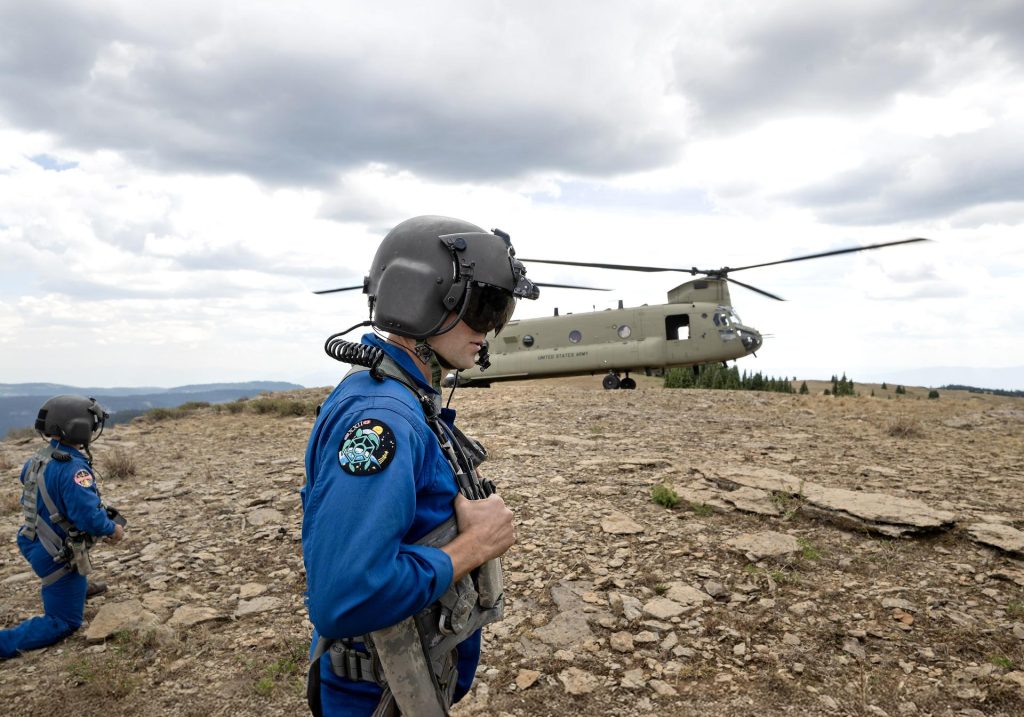
And while autonomous technology has come a long way, the training in Gypsum prepares them for the human element of space travel.
“You want to have control of your own destiny as the pilot,” Honey said. “Helicopter flight is a great analog for that, because these aircraft, a lot of them also have autonomous capabilities.”
At the same time, however, they have limits, so HAATS helps train to understand those limits and know when to intervene, he added. “We’re going to have the same challenge with these new spacecraft. … You have to be smart both in the autonomous, as well as the manual flying.”
Beyond Colorado National Guard’s work with NASA, Jacobs said there are also many partnerships that build the foundation for the training.
“We’ve been operating for 40 years, and that’s all been done with land use agreements with the (U.S.) Forest Service and the (Bureau of Land Management), and HAATS has been stewards of those resources; we’re out there in our backyard, monitoring what’s going on,” he said.
“That includes the firefighting that we do on the side, and then the search and rescue that we also do on the side,” he said, adding that records show they’ve saved over 560 lives through partnerships Mountain Rescue Aspen and Vail Mountain Rescue Group.
This, Honey remarked, is “what makes this so American to me.”
“America’s going back to the moon. We just did with Artemis 2. Artemis is gonna keep building on that complexity,” he said. “That’s all built on so many little things happening, like mountain rescue in Colorado near Vail. It’s so cool that that’s a piece of that overall enterprise … It’s a taxpayer-funded objective to do science and explore, and we draw on all these other pieces of what it is to be a melting pot of states, so that rural Colorado contributes directly to our ability to safely land Americans on the moon.”
Aspen Valley Health recertified as Level III Trauma Center
Aspen Valley Health announced Monday its recertification as a Level III Trauma Center from the Colorado Department of Public Health and Environment.


Aspen family donates land near Independence Pass for permanent protection
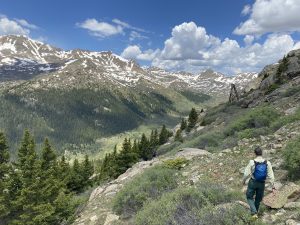
Two years ago, former Aspen City Manager Amy Margerum Berg donated 235 acres on the slopes of Mount Champion to the east of Independence Pass in memory of her late husband, Charles “Chuck” McLean, with the aim of protecting it from any future development.