Aspen Music Festival and School: 75 years of crisp, classic sounds
Highlights of Aspen Music Festival and School since 1949
Kimberly Nicoletti Follow

Alex Irvin/Courtesy photo
Throughout its 75 years, Aspen Music Festival and School (AMFS) has garnered a reputation as one of the top classical music festivals in the nation. While plenty of mountain towns host summer music festivals, AMFS is the largest classical teaching festival in the world, drawing about 500 students, 120 faculty members, and 120 principal guest artists annually from 40 different countries, says Alan Fletcher, president and CEO of AMFS.
“Three to five of the top festivals compete with us, but we are bigger than all of them combined,” he says. “Another key is that we put every student on stage every week for eight weeks, and we put top professional players on stage next to the students. … Year after year, students say, ‘No one cares about us the way the people in Aspen do.'”
The festival includes hundreds of classical music events, from concerts by four orchestras to recitals, chamber music, operas, lectures, family programs, and more. Young artists study orchestral instruments or opera, piano, conducting, composition, classical guitar, and more through a combination of one-on-one instruction and professional performance experience.
Here’s a concise timeline of milestones, but, as Fletcher points out, “a lot of people have contributed to making this super-interesting thing that they probably thought was a one-off — and then everybody had such a great time that it developed legs, and now we’re on its 75th anniversary.”
Timeline
Editor’s note: Each photo illustrates the general theme of each timeline entry, but due to the nature of historical photos and archives, actual dates of the photos may differ from timeline dates.
1940s
1949: Goethe Bicentennial Convocation and Music Festival comes to Aspen with the Minneapolis Symphony and notable individual performers.
“Walter (Paepcke) announced that he was going to open up this little town called Aspen, Colorado, a place where people could gather for intellectual discussions, scenery, and music,” says James Hume, a Chicago lawyer and verbal chronicler of the festival, in “A Tent in the Meadow: An Intimate Historical Perspective,” by Bruce Berger. “He didn’t expect to have more than a few prominent musicians at first, but maybe it would gather momentum.”
1950s
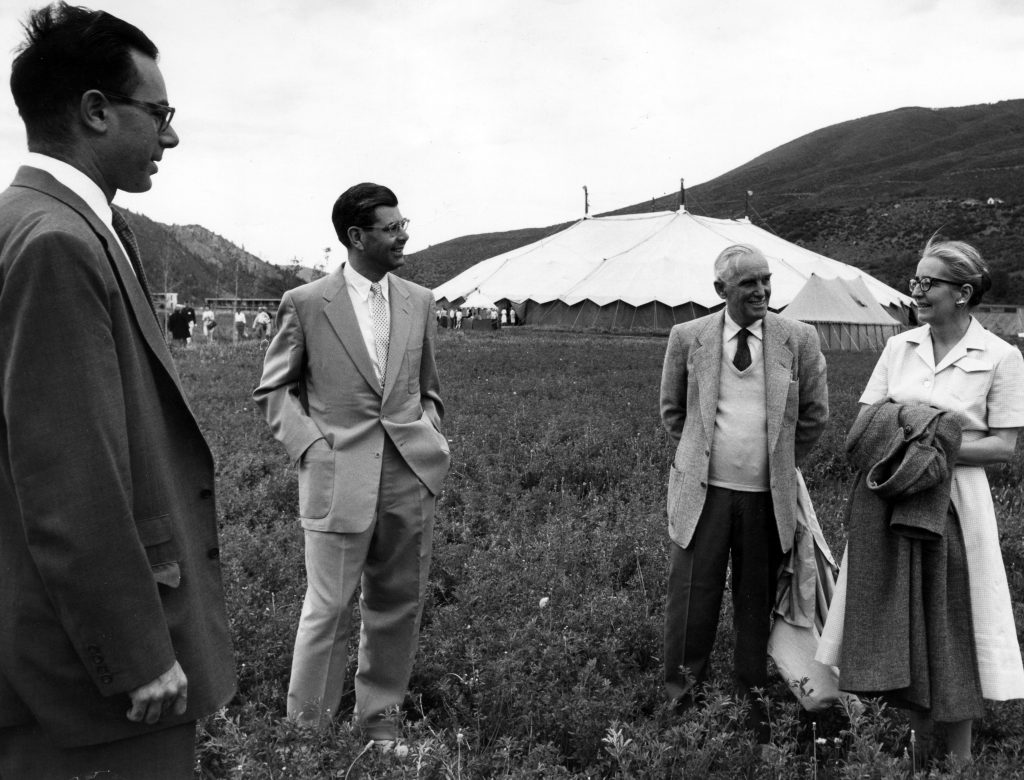
1950: Professional musicians brought their students with them. Composer Igor Stravinsky is the first to conduct his own works at the festival. At first, the festival was mainly a chamber festival with a great orchestra.
“Paepcke’s concept was to keep the season select, ‘with only the best musicians, to do the things that aren’t box office, that you can’t find in cities. We shouldn’t compete with the big orchestras and operas; we should stick with what we can do,'” according to “A Tent in the Meadow.”
1951: The presence of students leads to a spontaneous formation of an orchestra, a program for contemporary composers begins, and the festival incorporates a school with 183 students paying $280 in tuition for the eight-week program.
“In the early years, students scrambled to find places to practice, while faculty found creative places to live. While bassist Stuart Sankey rented a room at the Hotel Jerome for $80 a month, cellist Claus Adam stayed in cabin with dirt floors and no running water. ‘We sat on nail kegs, cooked out every night, and hauled a grand piano in a trailer over the Divide,'” says flutist Albert Tipton in “A Tent in the Meadow.”
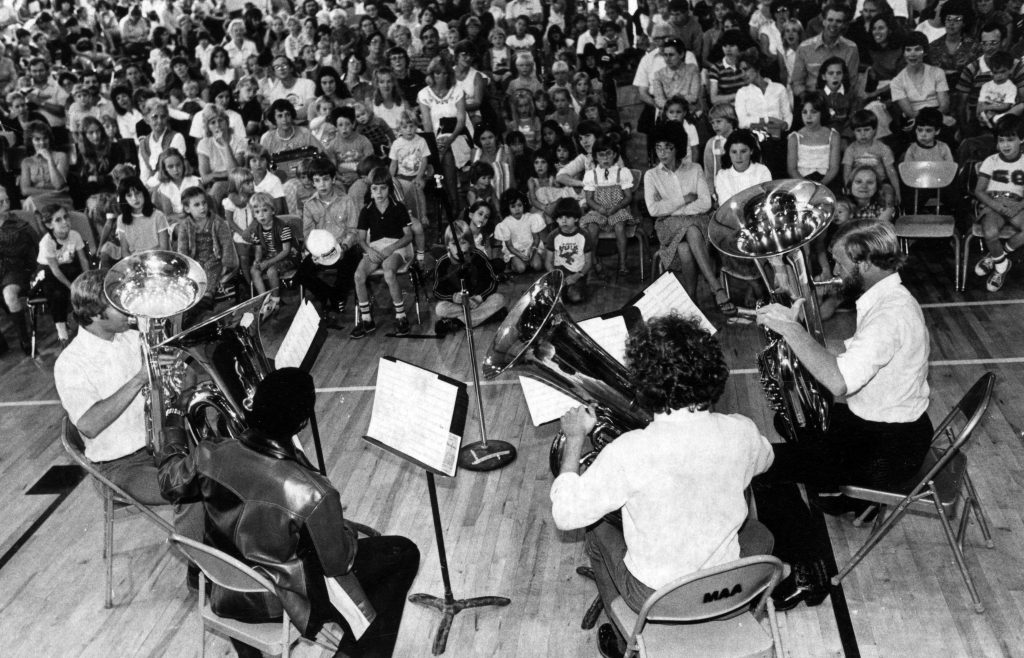
1953: Forrestt Miller debuts his signature event, Uncle Forrestt concert for children, in the elementary school gym. It cost 25 cents. One of the musicians it featured was violinist Sarah Chang at age 6.
1954: Musicians gain majority vote within the festival after tensions between musicians and directors, who each held different visions, came to a head.
1960s
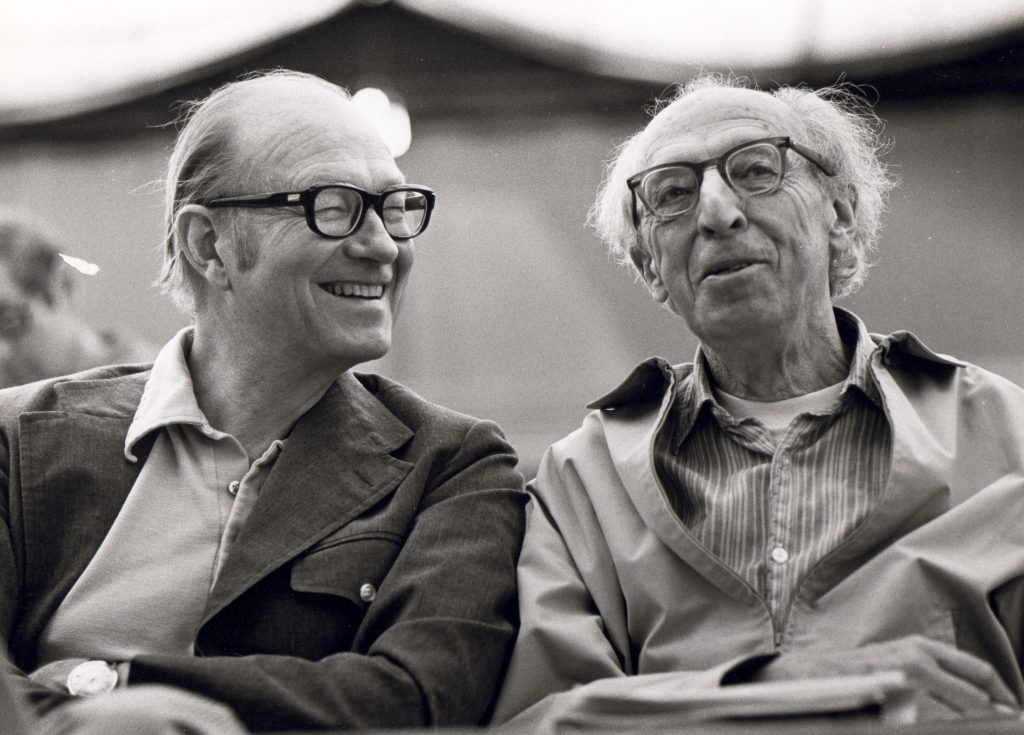
1962: Festival Administrator and Dean Norman Singer resigns; Juilliard faculty Gordon Hardy becomes dean, and James M. Cain becomes executive director.
“Throughout his tenure, Hardy acted on the principle that the students were at the core and that the rest of the festival was unfolded from the school,” according to “A Tent in the Meadow.”
“Gordon Hardy was hands-on. He knew every student. A lot of that growth was his,” Willoughby says.
1964: Robert O. and Barbara Anderson donate the music school campus, the festival’s first actual property.
“This self-confident move expressed a reversal from the early years when the festival deliberately avoided owning anything, not knowing whether it would survive and not wanting the financial liability, a wariness expressed by Courtlandt Barnes’ remark, ‘We just want a tent we can roll up and put in our garage,'” according to “A Tent in the Meadow.”
“That was a big change. Before that, students were housed downtown. When you walked down the sidewalk, you heard them everywhere. The campus was a nice, quiet place for them to practice. The campus made the students more able to be together than before. It also enabled the festival to enlarge,” Willoughby says.
1965: The tent designed by Eero Saarinen — who also designed St. Louis’ Gateway Arch and other landmarks worldwide — is replaced with the Bayer-Benedict Tent, designed by architect Herbert Bayer. It increased seating from 900 to 1,750, with padded benches. In those days, neither of the structures had official names; the tents were mostly called the Aspen Amphitheater, until 1993 when it was dedicated as the Bayer-Benedict Tent. The tent was scheduled from 8 a.m. to midnight “and may be the busiest concert hall in the United States during its period of operation,” according to “A Tent in the Meadow.”
“It was a lot more comfortable inside. Before, the wind would actually lift the tent up a few inches, and then it would come down with this crashing noise. I don’t know why the festival people didn’t know that storms in Aspen are always between 4 and 6 o’clock, when they scheduled the performances,” Willoughby says, poking a little fun. “This was a symbol that the music festival was becoming a permanent fixture.”
1968: Hardy secures the festival’s first major grant, creating the Aspen Chamber Symphony, which showcased young talent with students 30 and younger.
“This was a young orchestra, and that was very exciting because it was a refreshing thing,” Willoughby says.
1970s
1970: Festival adds an annual theme, like Beethoven and his contemporaries, love and death, music from specific countries and much more.
“For a brief period, the season ended with three-day, all-day marathons of all-Mozart (1991) and all Beethoven (1992) programming with an all-day Brahms Bash (1993). Not many composers can sustain this kind of ‘all-ness,’ and the marathons were dropped when the obvious composers had been exhausted,” but the themes remained, according to “A Tent in the Meadow.”
1970-90: Jorge Mester becomes the long-term music director. Prior to this, no one had served more than six years. Mester first came to Aspen in 1955 as a chamber music student with the Juilliard Quartet. He became the Aspen Chamber Symphony’s principal conductor in 1968 and knew the festival inside-out.
“In Aspen, he had a reputation among musicians for being meticulously prepared for rehearsals — for having studied, poured over, and mastered scores by the time he expected others to begin their first readings of them,” states “A Tent in the Meadow.”
1971: Juilliard faculty member and violin teacher Dorothy DeLay joins faculty. The year prior to her arrival in Aspen, the school had 500 students; by 1975, it had attracted 750 students.
“The presence of great teachers of music is what really sets us apart,” Fletcher says, adding that this summer, week six pays tribute to DeLay. “She was a legendary teacher.”
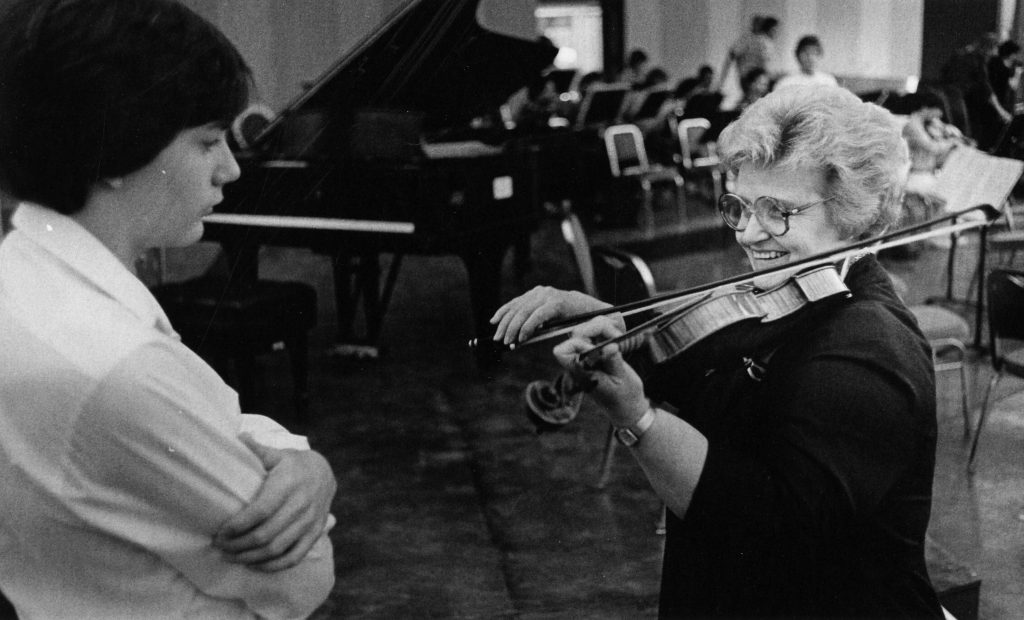
1977: Hardy’s wife, Lillian, gives him an ultimatum: Stop being dean of Aspen or leave Juilliard. He left Juilliard and stayed with AMFS until 1989. He was “very significant” in terms of fundraising, Willoughby says.
1980s
1980: Aspen Festival Orchestra is bused to the tundra up Independence Pass to be filmed by helicopter playing in a mountain meadow for a John Denver television special. To protect their valuable instruments, they played fakes; sound was added in the studio.
1989: Robert Harth becomes festival president and CEO. He focused on the students and supported building the Joan and Irving Harris Concert Hall, saying, “We shouldn’t be an organization that folds up its tent every year.”
“His father was a conductor, and his mother was the concert mistress of the festival. He was a kid in middle school when I met him; he mowed the lawn and would sell snacks and doughnuts to the orchestral during rehearsals and intermission. He was an enterpriser. Harth knew the festival inside and out. He knew all these people, and he knew Aspen. He understood the festival — what was good and what was worth keeping,” Willoughby says.
1990s
1990: Lawrence Foster, an Aspen alumnus who had studied piano, replaces Mester after 20 years as the musical director.
1991: George Tsontakis founds Contemporary Ensemble, and the festival acquires the deed to the tent meadow rather than renting it for $1 a year. Additionally, the first real breakthrough to make the festival affordable to students comes through the Marolt Ranch Dormitory, designed by Teague. It houses 300 students at the south end of the city-owned Marolt Park and includes a dining room with indoor and outdoor seating. “(Before that), it was so hard to find students housing, and that was one of the festival’s limiting factors,” Willoughby says.
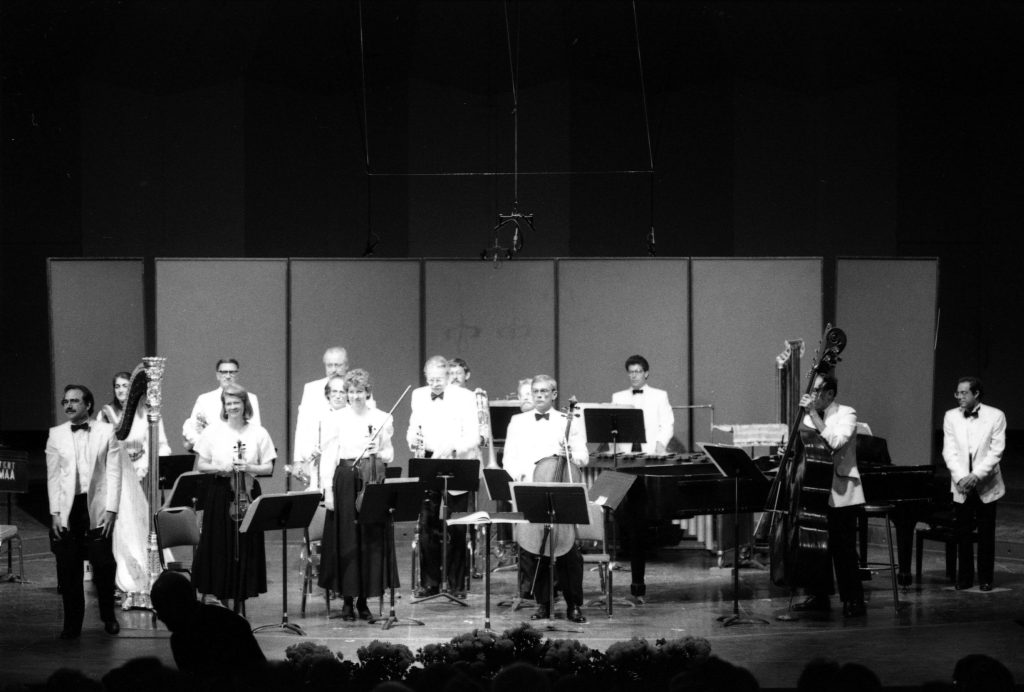
1993: Opening gala concert in the 500-seat Harris Hall, which cost $7 million. Festival organizers asked Emerson String Quartet, which had been a fixture of the festival since its first professional appearance in 1983 up until its farewell tour last year, to play the first notes in Harris Hall, before even the seats had been installed. The quartet showed up on stage, as the board of directors and members waited with bated breath. Just as they were about to walk onstage, then-celloist David Finckel hatched a prank to start the Mozart piece with their bows a quarter-of-an-inch off the strings. The quartet took the stage, looked out to the small, elite audience full of expectant faces, and started moving their bows, mimicking playing — with absolutely no sound.
“You could see everyone’s expression going from expectation to absolute horror, and then realizing it was a joke,” violinist Philip Setzer says, adding that the quartet then played with their bows on the strings, “and it sounded beautiful.” The Denver Post referred to the hall as “the Carnegie of the West.”
1996: David Zinman is named music director and becomes a major part of festival’s future.
1998: City of Aspen builds housing on the Burlingame Ranch to accommodate another 200 students.
Late 1990s: An endowment from the family and friends of David A. Karetsky guarantees free lawn seating outside the tent — a rarity at music festivals.
“Generations of people in Aspen have loved coming here. They’ve brought their kids to the lawn, and then they’ve thought, ‘Ok, we can bring them into the tent.’ Then a generation passes, and those kids are bringing their kids to the festival. It has really become part of the legacy of Aspen,” Fletcher says.
“You can have a picnic, and you can have a very great signature Aspen experience without ever having to worry about it, and that was definitely a gift of that Karetsky endowment,” Willoughby says.
2000s
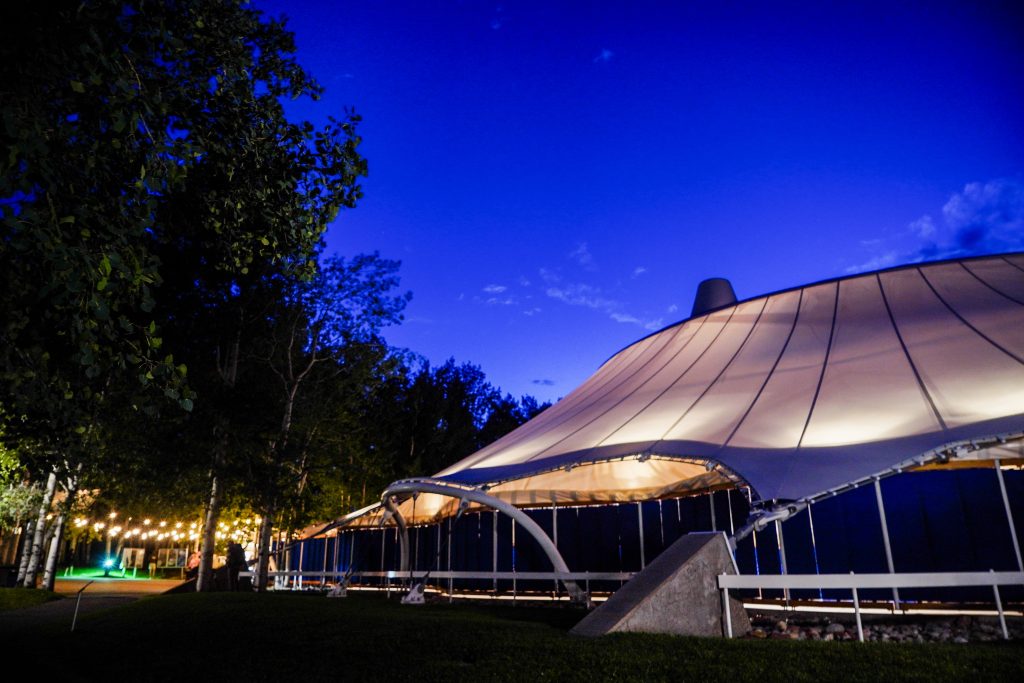
2000: The Michael Klein Music Tent, originally named the Benedict Music Tent when it opened in 2000, dramatically improves acoustics and professional backstage facilities. Teague designed it to retain the relaxed atmosphere of the tent with bench seating, translucent building material and a feeling of openness. It accommodates 200 more people and buffers sound from outside. “It’s a magnificent structure. It dramatically increased the acoustics. They dug the structure much deeper into the earth, based on the design of ancient Greek amphitheaters. It really helped the festival,” Willoughby says, adding that it also increased warmth during cold morning rehearsals and evening performances and that “a lot of people still remember the leaks that sometimes came pouring down on the performers on stage in the old tent.”
“The summer festival has steeped so long in sagebrush and canvas that, as one resident put it, the Music Tent is as much a symbol of Aspen as the Eiffel Tower is a symbol of Paris,” according to “A Tent in the Meadow.”
2006: As one of the nation’s most accomplished music administrators and respected composers, Fletcher becomes president and CEO.
2010s
2011: Robert Spano becomes music director.
“He is one of the great American conductors and teachers, so it’s the combination that’s important to us. He loves music so much, and he loves people. It’s the whole feeling that we want in Aspen,” Fletcher says.
2016: The AMFS fully completes its $75 million, 105,000-square-foot Bucksbaum Campus, the center of its teaching activities with three rehearsal halls, numerous teaching studios and practice rooms, a percussion building, administrative offices, and a glass-enclosed cafeteria. Designed by Teague, the roof lines mirror the shapes of surround mountains and hug the contours of ponds and the creek.
“The Bucksbaum Campus is another milestone of permanence for us,” Fletcher says. “It is acoustically wonderful, and it conveys to our students how important we think they are.”
2020s
2021: Aspen Opera Theater and VocalARTS program, under the co-artistic direction of Renée Fleming and Patrick Summers, debuts.
A version of this story appears in the latest Summer in Aspen Snowmass Magazine. To read more magazine stories, go to aspentimes.com/magazines.
Aspen Public Art calls for costume creations prior to first Mall Fest parade
Aspen Mall’s first Mall Fest 50 Parade will hit the streets June 27, with Aspen Public Art inviting residents and visitors of all ages to start preparing costumes now.