‘Wow, what is that? That’s cool!’ — A tale of how snowboarding arrived in Aspen


Growing up Aspen/Courtesy photo
Back in 1989, the not-in-my-backyard phone calls to keep snowboarders off Aspen Mountain (Ajax) came in strong:
“I think Ajax should continue to not let them on the mountain. Be different. Be that one area where they cannot go. They’ve got three areas here, Buttermilk, Snowmass, and Highlands that they can play on. They can go down to Sunlight. Let them do it there.”
“The snowboarders should not be allowed on Aspen Mountain. All it will do is increase the injuries.”
“I’m opposed to Burton boarders skiing on Aspen Mountain. We don’t ski on their waves, so why do they surf on our snow? And the reason they snowboard is because they can’t ski. The reason we don’t snowboard is because snowboarding sucks.”
The Aspen Daily News at the time had a phone tip line that people could call into, voice their complaints (and some praise), with “10 of 37 callers supporting the shredding of Aspen Mountain,” according to its story from Feb. 27 of that year.
The unidentified complaints from the story continued:
“Please don’t let snowboarders on Aspen Mountain. It would ruin it.”
“I think we’ve got to keep those fa****s over on Highlands where they belong. The rump rangers can go crazy on that mountain without trashing up Ajax, as well. I say keep the butt brothers at Highlands and no dice on Ajax.”
“I say no to snowboarders because the terrain just isn’t fit. The environment is way too fragile. What would we do with all those shredders up there?”
Just five years prior on Feb. 2, 1984, The Aspen Times (weekly then) ran the first article on this up-and-coming new trend, “For skiers who would rather be surfing, or skateboarders who would like to apply their skills to the slopes.”
As the story goes, two local teenage brothers — Mark and Andy Collen — had become the only area distributors of snowboards, Burton specifically. From attempting “to make their own out of plywood with limited success (the garage is full of prototypes)” to using their mom’s wholesale license to help build their budding business, handing out business cards — “the Snowboard Brothers of Aspen” — to potential buyers, the bug had caught, and they were there from the start.

The Aspen Times recently caught up with Andy to reflect back 40 years ago to when “skiboards,” as they were also known back then, began to blaze their trail locally on the four mountains.
On Christmas Day in 1983, he and Mark’s father had gifted them with Burton boards. According to the Times, “The two had known of snowboards for years but had never been able to find them in any store, even in Denver.”
“We opened them up,” Andy recently said, “and we were like, ‘Oh, my God — these are fantastic! Everybody’s gonna want one.'”
His mom brought up the idea of using her license to help them out.
“Let me call them and see,” he remembers saying to her. “Jake Burton answers the phone, and I told him, ‘I’m 16, and I want to sell boards. I got my mom’s wholesale license. Would you take it?’ And he’s like, ‘You’re in Aspen?’ and I’m like, ‘Yeah!’ and he’s like, ‘Of course!'”
The Backhill, as Andy describes it, had a water ski-type binding on the front with a nylon clip that would wrap around the back of your heel. The rear binding was a rubber strap; this would later change to somewhat match the front binding.
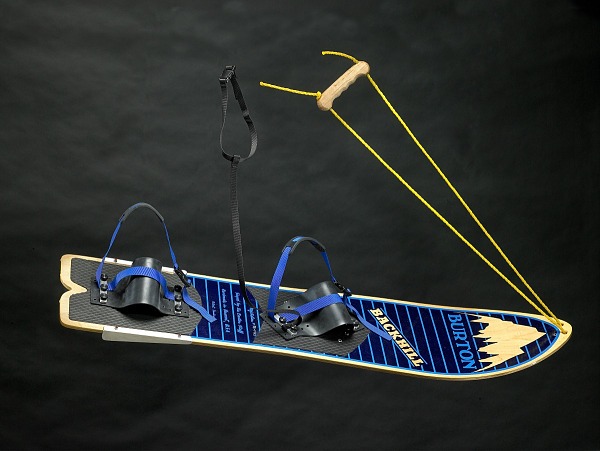
“And so your foot was on if the strap was tight,” he said, “so you’re constantly adjusting your strap.”
Metal fins below, along a concave back end; wood edges instead of metal; and a front-end rope with handle rounded out the board components, he summarized.
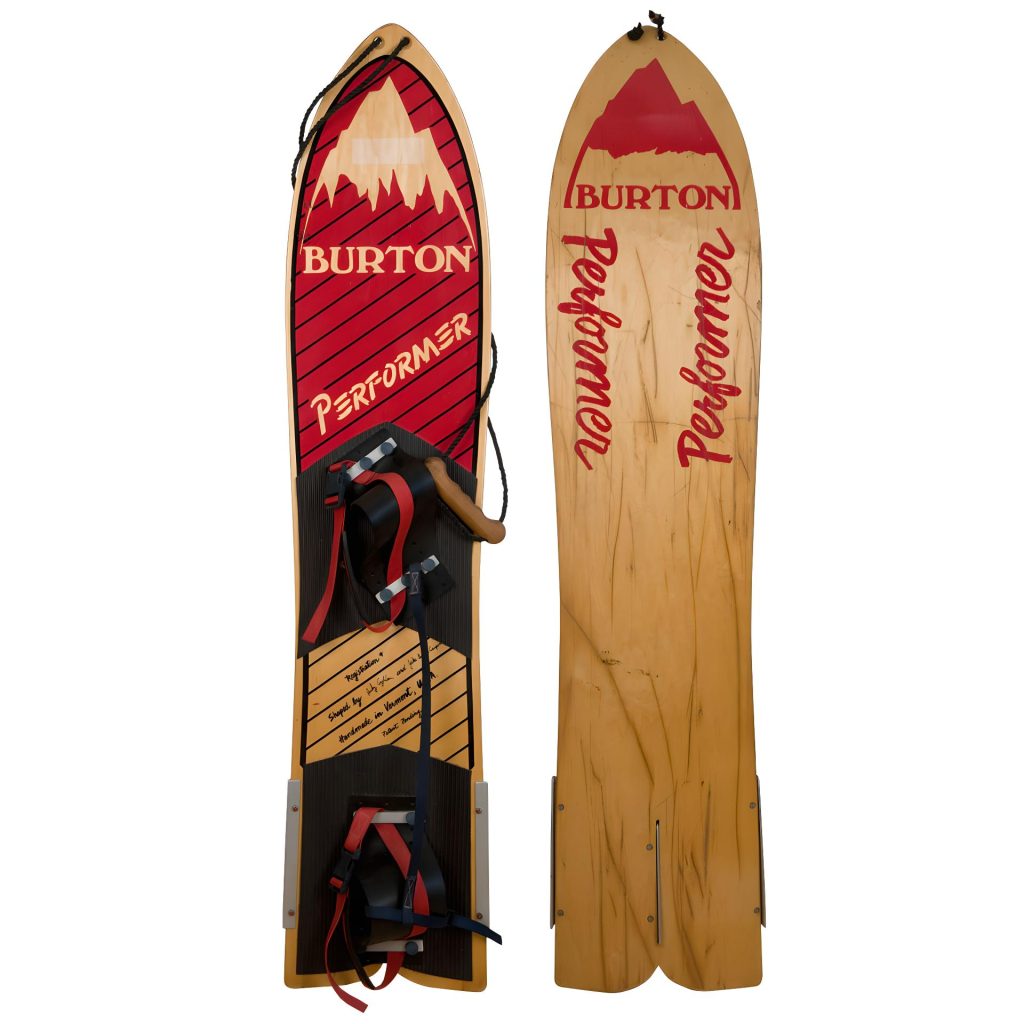
A slightly more expensive board had just been released, as well, he said.
“The Performer was the board that changed Burton,” he said. “And then after that, they started to really go with the P-tex base and the metal edges and all that kind of stuff.”
When he reflected back on the big difference between snowboarding then versus now, the stiffness of a snowboarder’s ankles is what made the difference and less so the bindings — or nearly lack thereof.
“The stiffness of your ankles had to pick up the board and cut it across the mountain,” he said. “So if you’re snowboarding all day long, your calves are dead trying to cut across the mountain, was almost impossible.
“Borders back then had to really have some leg strength to do it,” he continued. With how bindings are now, “they can kind of twist around, and it’s really just shifting your weight around. … (Back then) was a lot of work; your legs really were shaking when you’re on a slope.”
And, before technology caught up with boots, what did he and his friends wear to ride? “Sorels,” he laughed.
At the time, SkiCo owned three of the four area mountains: Aspen Mountain, Buttermilk, and Snowmass.
When Andy went to ride on one of SkiCo’s mountains, the issue for it was insurance, and he was turned away, he said.
But, Highlands, he said, was privately-owned by Whipple Van Ness “Whip” Jones, “who lived just up the street from where I lived.”
“He was one of those little cantankerous local guys that kind of did things his way,” Andy said. “He was more the local guy, not catering to all the tourists as much. And so it was more of a local mountain.”
After he showed Whip how the board was designed and how it would only travel a short distance if it comes off, he was let on the mountain.
When lifties saw the snowboards, they were excited, said Andy. “We got tons of ‘Wow — what is that? That’s cool!'”
There’d be skiers underneath the lift, yelling up at them, just as excited. He and his brother would then hand out their business cards.
As the snowboard craze took off, competing interests on the mountains came into play, according to an Aspen Times story from Jan. 10, 1985.
“On the one hand are scowling insurance companies; on the other, eager enthusiasts of a potentially popular winter sport,” the story read. “In the middle are the local ski areas, scratching their heads and puzzling over the situation.”
Ski areas were forced to decide what to do. Highlands, due to its insurance company, “had to disinvite snowboarders,” according to the article, and any reconsideration of that stance was placed “on the backburner.”
For SkiCo’s insurance companies, an “uninsured accident could set the company back millions of dollars,” according to the story.
“I don’t know whether the (Aspen) Ski Company is coming out and saying it or not,” said Highland’s Marketing Director Bill Brehmer at the time, “but you bet your bottom dollar that their concern is liability.”
SkiCo began to study snowboards’ compatibility with skiing, as the company’s insurance company, according to Jack Brendlinger, SkiCo’s then-director of public relations, “told us that as far as they’re concerned, we are covered.”
What changed SkiCo’s mind was “purely popularity,” said Andy.
“They were definitely against it,” he said. “The only reason they allowed it was because it was a firestorm … . Half the family is boarding, half the family is skiing. So, they had to adopt that, they had to just go with it.”
Buttermilk was the trial area. The area’s Ski Patrol Director Jons Milnor explained that SkiCo “is weighing the issue carefully because it wants to arrive at a decision it can stick with. A decision in favor of snowboards would mark a philosophical rethinking of the nature of a ski area and can’t be taken lightly,” according to the Jan. 10 article.
Questions from the article being considered included: “How will skiboarders get through lift lines? Will they slow up the lifts to get on and off? Will they present a danger to others on the mountain? And what about if a run is too hard and they chicken out — will they trudge down the hill, leaving hazardous boot holes all the way?”
“I mean you have just decades and decades with skiing, and then you see this snowboard,” said Andy. “I think the culture of Aspen was inviting to it. I think the business money folks were a little worried. … (SkiCo) didn’t want to ruffle the feathers, and so they felt like the snowboarders were a little bit more rough around the edges.”
A couple weeks later, Buttermilk lifted its snowboard ban.
In 1988, Snowmass also lifted its ban.
“If we tout ourselves as a family resort, we can’t forget that even though most of us don’t want to deal with it, teenagers are still part of families, and a lot of teenagers like snowboards,” said Snowmass Mountain Manager Jon Reveal in the March 19 story from Aspen Daily News. “One of the things the industry has to look at is that a lot of young people have grown up with one foot in back of the other, on a skateboard or a surfboard.
“People skiing downhill used to be thought of as really crazy because most people used skis to get uphill, so that those were really the crazy people who were skiing downhill,” he continued. “Now we have a whole new group of young crazies doing a whole new kind of skiing.”
Aspen Mountain, the final SkiCo hold-out, finally lifted its snowboard ban on April 1, 2001.
“Hey, I’d be lying if I didn’t say it was overdue,” said Jake Burton to The Denver Post. “But you have to respect a company that doesn’t let pride get in the way of a sound decision.”
As for Andy and his brother’s business back then, the enterprise was pretty short-lived, running about three years, he said. After his brother moved, Andy and his best friend took over.
“We’d go up with some boards and sell one or two or something like that,” he said. “I wish I would have stayed on it because it became such a huge thing.”
Jonathan Bowers is the news editor for The Aspen Times. He can be reached at jbowers@aspentimes.com.