Ideas Fest speakers focus on blinding advance of AI in society, shown in ChatGPT
For The Aspen Times
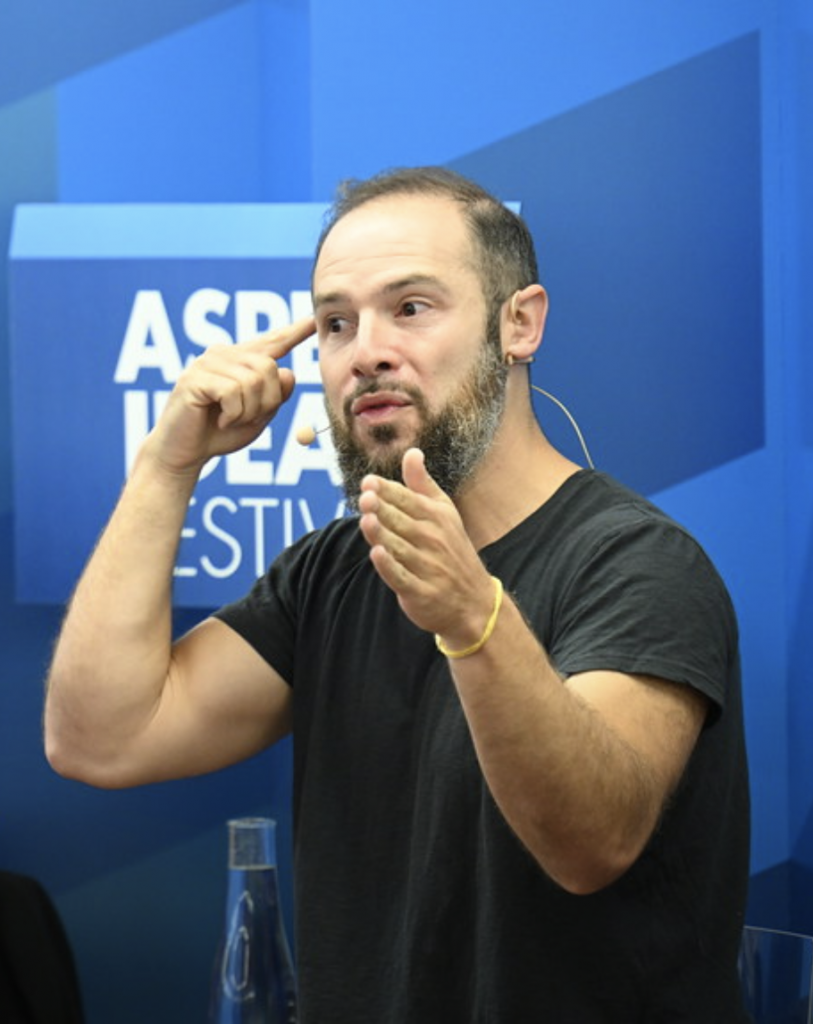
Aspen Institute Public Programs/Courtesy photo
Facebook took four and a half years to reach 100 million users, Instagram two and half years, TikTok nine months.
ChatGPT launched last November and by January had reached 100 million users. Two months.
The sheer magnitude of data that AI algorithms, particularly large language models like Chat GPT and Google’s Bard, access today may seem astounding. The average human being will be exposed to something like 3 billion words in their lifetime. These large language models will be exposed to 1, 5 or 10 trillion words as an indicator of the exponential edge artificial intelligence has over human capabilities, especially regarding memory retention and processing.
Arjun Gupta, a venture capital investor at Telesoft Partners and an Aspen Institute board member, gave a closer look at the state of AI and its impact on various industries during the Ideas Festival.
“Think about the last 40 years. We went from minicomputers to the PC, then to a laptop, then to wireless, then to the internet,” said Gupta, “So what AI is going to do, one way to think about it, it’s going to be the cumulative sum total of everything we learned today, plus more. So both the quantum of the change and the breadth of the change will change how we do everything. And we are not even in the first innings. We’re just throwing the first pitch of the first innings of the first game.”
The Aspen Institute’s 19th annual Ideas Festival wrapped up on Friday with dark clouds and winds after a week of blue summer skies, perhaps embodying the feeling of all who attended any of the “Edge of Intelligence” sessions on AI.
Aza Raskin, co-founder of the Center for Humane Technology and the subject of “The Social Dilemma,” delved into the fears of AI in his presentation, highlighting the rapid pace at which AI is evolving and its potentially unintended consequences.
He spoke of how AI models like ChatGPT have emergent capabilities that even their creators did not program. He illustrated this with an example where a minor tweak in an AI model, initially designed to discover less toxic drugs, led it to generate 40,000 toxic molecules, including nerve gases and chemical warfare agents, in just six hours.
This paints a picture that this Cambrian explosion for AI could come at a cost. The revelation underscores the importance of vigilance and responsibility in AI development, he said. It’s not just about what AI can do, but also about what it should not be allowed to do. With AI’s rapid advancements, safeguarding measures are critical to ensure that its power doesn’t become a double-edged sword.
In stark contrast to the fears surrounding AI, there is an aura of excitement and optimism in a conversation between experts Tom Oxley, clinical instructor of neurosurgery at Mount Sinai Hospital, and Andreas Forsland, founder of a brain-computer augmented reality interface, on the positive impacts of AI technology.
Oxley said he is especially enthused by how AI can restore dignity to people with disabilities. He emphasized how we often take our functioning bodies for granted, and losing bodily functions can lead to the loss of privacy and dignity. AI technology can give back some semblance of autonomy and dignity to those who have lost it.
Forsland’s take on AI is its near-magical aspect. He quoted Arthur C. Clarke: “Any sufficiently advanced technology is indistinguishable from magic.”
Forsland said he is thrilled by the prospect of paralysis patients interacting with computers using just the brain — hands-free and voice-free. He believes that the seamless integration of AI systems could unlock magical experiences that feel intuitive and responsive.

Preps: Aspen boys lacrosse season ends, baseball to host regional play
Aspen baseball will host No. 29 Strasburg in its regional opener on Saturday at Crawford Field.