As Colorado reevaluates when to kill wolves involved in livestock conflict, how do other Western states handle it
Colorado Parks and Wildlife is suspending its previous approach to killing wolves involved in repeated livestock attacks; where might it look for guidance on how to change

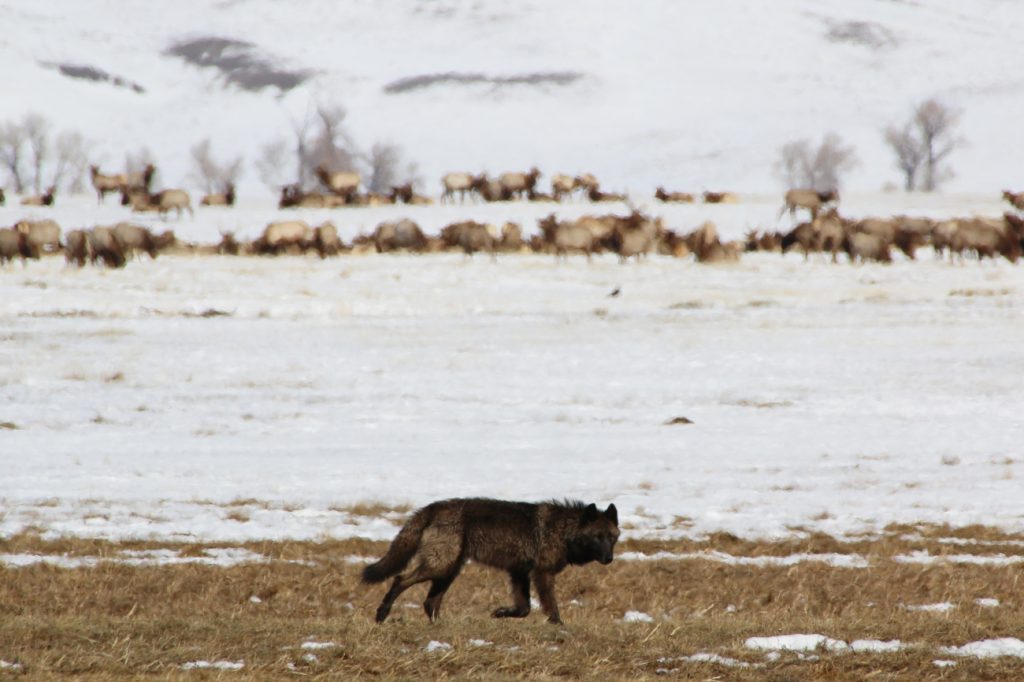
Kari Cieszkiewicz/U.S. Fish and Wildlife Service
At the end of September, Colorado Parks and Wildlife said it was taking a step back from its current approach to killing wolves involved in livestock attacks as the state’s gray wolf population faces threats from politics, disease and more.
Across the West, state wildlife agencies take a variety of approaches when it comes to addressing instances of repeated livestock attacks by wolves.
Often, these goals are driven by the status of wolf recovery in the state.
For example, in states like Montana and Idaho, where wolves have been delisted from the federal Endangered Species Act, the state’s population targets are met and hunting of gray wolves is legal; these euthanizations are determined on a more case-by-case basis and the states have fewer specific guidelines or producer requirements.
States like Washington and Oregon, however, take an approach more similar to what Colorado has done — defining how many wolf attacks on livestock must occur in a given timeframe for the agency to consider euthanization. In these three states, the determinations are also driven by whether or not the producer has deployed certain nonlethal tools to mitigate conflict.
All of five of these western states — Montana, Idaho, Washington, Oregon and Colorado — have laws that allow gray wolves caught in the act of attacking livestock to be killed by landowners and producers.
Many agencies report that the stated goal of these euthanizations is to change the wolf pack’s behavior, encouraging them to move away from feeding on livestock and toward natural prey like deer and elk. The efficacy of it as a management tool to deter this behavior has been called into question by some recent studies, including a 2026 report from the University of Wisconsin-Madison.
What was Colorado’s approach and why is it changing?
When Colorado first began its voter-mandated reintroduction of gray wolves, its management plan did not define “chronic depredation,” a term used in wildlife management to define when a predator is repeatedly injuring or killing livestock. The plan gave the agency latitude to determine on a case-by-case basis whether a wolf or pack was “chronically depredating.”
However, following pressure from the state’s producers, the state adopted a definition in December 2024, and with it, a set of guidelines for when it would consider killing wolves.
This defined “chronic depredation” as a wolf or wolves connected to three or more confirmed depredation events within a 30-day period.
The management directive said that once this definition was met, the agency would consider whether to kill a wolf involved based primarily on whether the affected producers attempted “all viable options” to mitigate conflict non-lethally, whether wolves were lured or baited and the likelihood that the attacks would continue.
Parks and Wildlife has killed six wolves under the guidance of this directive — one in 2025, and five this year. This included four between Aug. 4 and Sept. 9, an increase that sparked concerns about the agency’s chronic depredation approach and the efficacy of these euthanizations.
Ultimately, it was a concern for wolf survival that Parks and Wildlife cited as its rationale for reviewing its protocols.
The agency said that as of Sept. 24, its 45-wolf population was nearly half pups, sparking concerns as western states typically see only 50-60% of pups survive the winter. Additionally, its survival rate for adult wolves in the last full biological year was 61%, below the 75% rate typical for western wolf populations, and it reported potential disease concerns in two of its five wolf packs. Facing political challenges, Colorado has also struggled to source wolves from other states, a key tenet of its plan to build a self-sustaining population of the species, as mandated by voters.
The decision was applauded by wildlife and wolf advocates who had been calling for an outright ban on the killing of wolves, but criticized by livestock producers and stockgrower associations who want to see the agency uphold its current practice.
Parks and Wildlife said that it will temporarily halt using its current guidelines around lethal removals, making determinations around euthanizations on a case-by-case basis. The agency marked its plans to revisit the chronic management directive and make changes by April 2027.
Other Western states, which have had wolf populations for much longer, take varying approaches — with both similarities and differences to Colorado.
A measured approach in Washington and Oregon
Washington and Oregon take a similar approach to determining whether or not to kill wolves attacking livestock.
Gray wolves in both states began to recover naturally in both states, as wolves trickled in on their own from nearby states and provinces in Canada in the early 2000s. Recent reports from the states’ wildlife agencies estimate Washington’s wolf population at around 270 wolves and 49 packs and Oregon’s at around 230 wolves and 30 packs.
As gray wolves recovered, the species was delisted from the federal Endangered Species Act in the eastern portions of both Washington and Oregon. As such, in both states, wolf management is split with the U.S. Fish and Wildlife Service depending on where the animals are protected. In Washington, the Confederated Colville Tribes also manage wolves on their land in the delisted region.
In its management area, the Washington Department of Fish and Wildlife will consider killing a wolf or wolves if there have been three confirmed attacks in 30 days or four within a 10-month “rolling window of time.”
In 2025, the Washington agency considered lethal removal seven times in 2025, authorized it in three wolf packs and killed four wolves as a result, according to its annual report. Two wolves were also killed after being caught in the act of attacking livestock.
The Oregon Department of Fish and Wildlife defines “chronic depredation” as a minimum of two confirmed attacks on livestock by wolves in a nine-month period.
In 2025, in eastern Oregon, 18 wolves or packs met this definition, according to its annual report. The Oregon wildlife agency killed 20 wolves in these cases. Three wolves were also killed by producers who caught the animals in the act. In 2025, the U.S. Fish and Wildlife Service also killed an entire pack — six animals — from the eastern part of Oregon after being connected to the death or injury of 25 cattle and following over a year of efforts to mitigate and prevent further attacks.
While both Washington and Oregon have parameters like Colorado — including evaluating whether there were attractants luring wolves near livestock and whether non-lethal tools were attempted — they do have slightly different guidelines and approaches.
Washington publishes press releases when it is considering killing a wolf or wolves that meet these definitions, when it makes its determination and when it kills a wolf or concludes its effort. The state also specifies that producers must have been using at least two proactive tools to mitigate conflict in “a sufficient amount of time prior” to the wolf attacks.
Oregon warns that even if two attacks occur in nine months, it may not kill a wolf automatically, adding that it will evaluate the situation, including whether attractants are present and nonlethal attempts to mitigate conflict were made, as well as looking at severity, number, time and distance between attacks and more.
A case-by-case evaluation in Montana and Idaho
Idaho and Montana offer different approaches. In both states, wolves are delisted from the federal Endangered Species Act and hunting — legal with a license in both — serves as the No. 1 cause of death for the predators. In both states, wolves can be killed by landowners with a special permit, legal hunting license or if the wild animal is caught in the act of attacking livestock.
According to the Idaho Capital Sun, the state’s wolf population is around 1,129 wolves as of 2026. It’s a number that is above its population goals, giving the state wildlife agency a different approach to killing wolves involved in conflict.
In its gray wolf management plan for 2023-2028, the Idaho Department of Fish and Game states that “although the voluntary use of nonlethal deterrents may be advantageous to producers,” so long as the wolf population remains above its objective, the wildlife agency “will favor lethal removal” as the means of reducing conflict between livestock and wolves.
In Idaho, the U.S. Department of Agriculture’s Wildlife Service investigates depredations of wolves on livestock. Data from the state agency’s 5-year plan shows that between 2015 and 2022, Wildlife Services killed between 30 and 95 wolves a year. During the same time frame, between 231 and 462 wolves were killed by hunters.
Idaho’s wolf plan does not stipulate a numbers-based approach to deciding whether or not to kill wolves involved in conflict with livestock, adding that it will kill wolves “as needed to address both individual depredations and overall population goals.” Non-lethal tools, the Idaho wildlife agency adds, are “not a prerequisite for lethal removal.”
Montana Fish, Wildlife & Parks estimates the state has 725-1,094 wolves and 155-181 packs, according to its 2025 report to the state legislature. Its wolf management plan, recently updated in 2025, reports that “nonlethal management strategies are actively promoted to prevent conflict … but over time or in certain situations, lethal measures may be necessary.”
In 2025, 43 wolves were killed in Montana to “reduce the potential” for further livestock attacks — 37 killed by Wildlife Services and six by private citizens “when wolves were seen as a threat to livestock.” In the 2025-26 harvest season, 247 wolves were killed by hunters or trappers with permits in Montana.
Several Montana state laws authorize and regulate the killing of wolves involved in livestock conflict, but generally speaking, the wildlife agency has the latitude to kill “problem wolves” — defined as a wolf or pack “with a history of livestock predation” — as long as the state’s objective for breeding pairs is met.
Montana’s 2025 plan does state that Wildlife Services is authorized to kill “any offending individuals after a first offense when wounded or dead livestock are present,” and the evidence clearly indicates wolves were responsible. It adds that the pack’s conflict history, pack size and reproductive status as well as the physical setting, are all considered when deciding how to handle wolf-livestock conflict.
“In sum, the ultimate goal is to identify, target and remove offending wolves as close in space and time as possible to the depredation incident, should lethal removal be warranted,” it stipulates.





Shuttles between Aspen and Eagle airports could start this winter
While Aspen has never been the easiest place to get to, the upcoming Aspen/Pitkin County Airport closure — from April to November 2027— is about to make it even harder.