Brush Creek parking capacity doubled
Construction spurs unhoused, transient workers study

Josie Taris/the Aspen Times
It’s the Roaring Fork Valley’s unofficial metric for identifying locals: What people call the transit lot off Highway 82 between Aspen and Snowmass.
Old timers call it by its unofficial name, the Intercept Lot. Calling it by its official name, the Brush Creek Park & Ride, flags you as a seasonal worker, tourist, or someone so new to town you might as well be transitional.
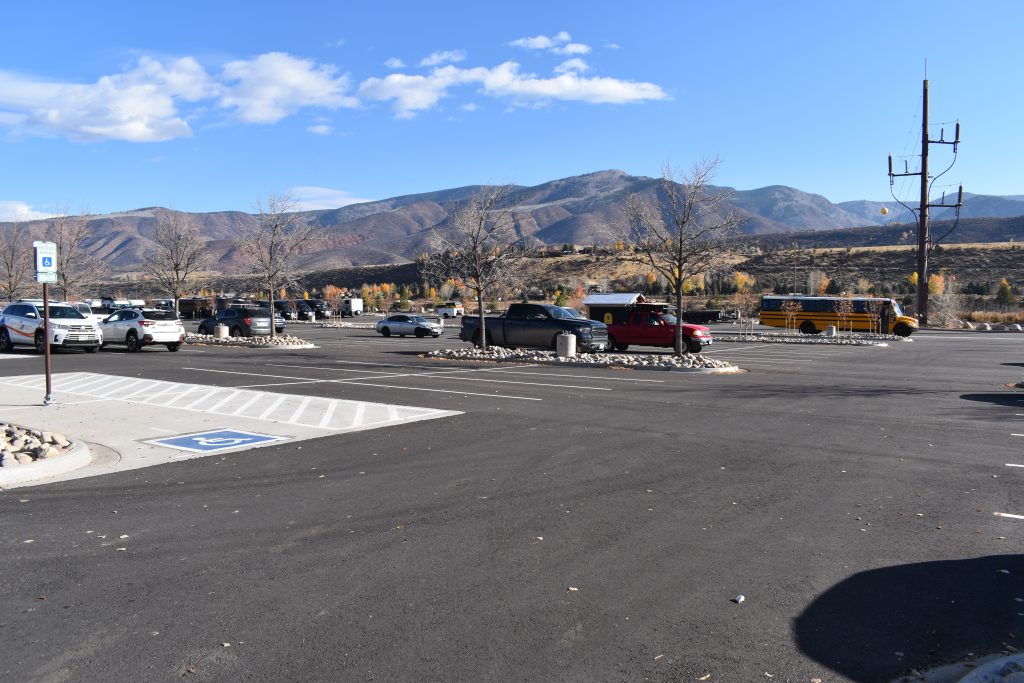
However you refer to the lot, its purpose is to minimize vehicular traffic into both Aspen and Snowmass by providing a free place for commuters and visitors to park their cars and ride into town. And a construction project in the works since 2016 doubled its parking capacity. It fully opened last month after ongoing work since May.
“We hope that it is not only going to meet our needs today, but also our needs into the future,” said Pitkin County Manager Jon Peacock to a small crowd at a ribbon cutting for the expanded parking lot on Thursday morning.
Additions to the lot include approximately 200 more paved parking spaces, totaling around 400 paved spaces, a paved sidewalk trail connector for pedestrians and cyclists to the Rio Grande Trail or the Brush Creek Bike Path into Snowmass, landscaping, and infrastructure preparation for 29 EV charging stations, with potential for more in the future. Improved lighting installation is expected later this season.
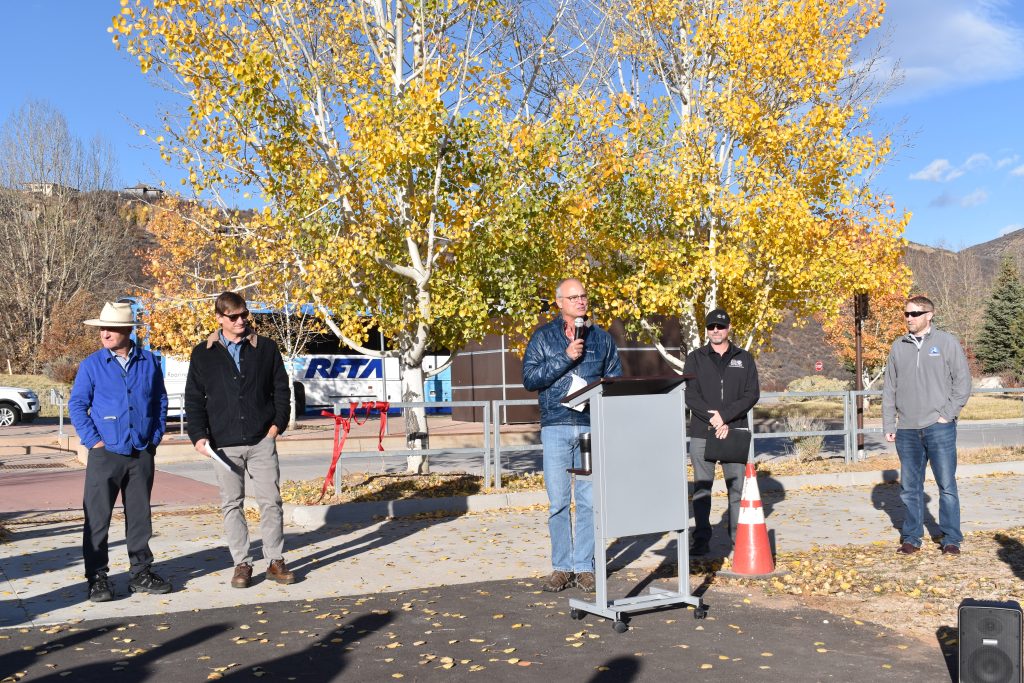
Restrooms will come sometime in the future, according to Pitkin County Public Works Director Brian Pettet. The plans are going through a value engineering process and will later be presented to the Elected Officials Transportation Committee (EOTC) for funding, he said.
“I would love to see this parking lot full,” Pettet said. “The sooner we can get people out of cars and onto buses, the better.”
The project was led by the Federal Highway Administration in partnership with the EOTC — which includes representatives from the City of Aspen, Pitkin County, and the Town of Snowmass Village — the Colorado Department of Transportation, and RFTA. Colorado-based Siete, Inc. was the contractor on the project.
Costs amounted to about $8 million, with funds from a Federal Lands Access Program grant, $500,000 from RFTA, funds from the EOTC, and a grant from the state Congestion Mitigation and Air Quality (CMAQ) program.
EOTC funds come from a 0.5% use tax in Pitkin County.
When construction began in May, regular occupants of the lot had to vacate — including corporate-owned van fleets and people, many of whom were local workers, who lived out of their vehicles.
During the lockdown phase of the COVID pandemic, the Brush Creek lot became a home for the unhoused and other transient people. It’s not fully clear where people who regularly parked at the lot went after May, but Linda DuPriest, regional transportation director for the EOTC, said construction project prompted the EOTC to propose a master plan study of unhoused, transient people and inhabited vehicles in the Brush Creek and Buttermilk lots.
That study will look at the specific situations of people living out of the lots and potential solutions. The work is expected to start in 2024, she said.
Right now, signage at the Brush Creek lot indicated a 24-hour limit on a vehicle’s presence. She noted, however, it’s a difficult rule to enforce as people come and go.
According to RFTA Program Manager Brian Ludlow, 250,000 riders come through the Brush Creek Park & Ride annually.
The City of Aspen Carpool Pass Kiosk is still open in the unpaved section of the lot. Vehicles with two or more passengers can pick up a free parking pass 6 a.m.-noon, Monday-Friday, to the designated carpool spaces in Aspen and in the residential parking zones.
The land on which the lot sits belongs to CDOT, but Pitkin County is allowed to occupy the land for certain use like transit. Pettet said that there is still developable space on the parcel should it need to expand further in the future.
Aspen airport to reduce sound exposure, improve sustainability in remodel
Pitkin County last week approved Atlantic Aviation’s improvement plan to Aspen/Pitkin County Airport’s private-plane infrastructure.