Big changes to proposed development near downtown Basalt leaves council members lukewarm
Councilors and community excited about affordable housing, but density and environmental impact questions remain
Josie Taris Follow
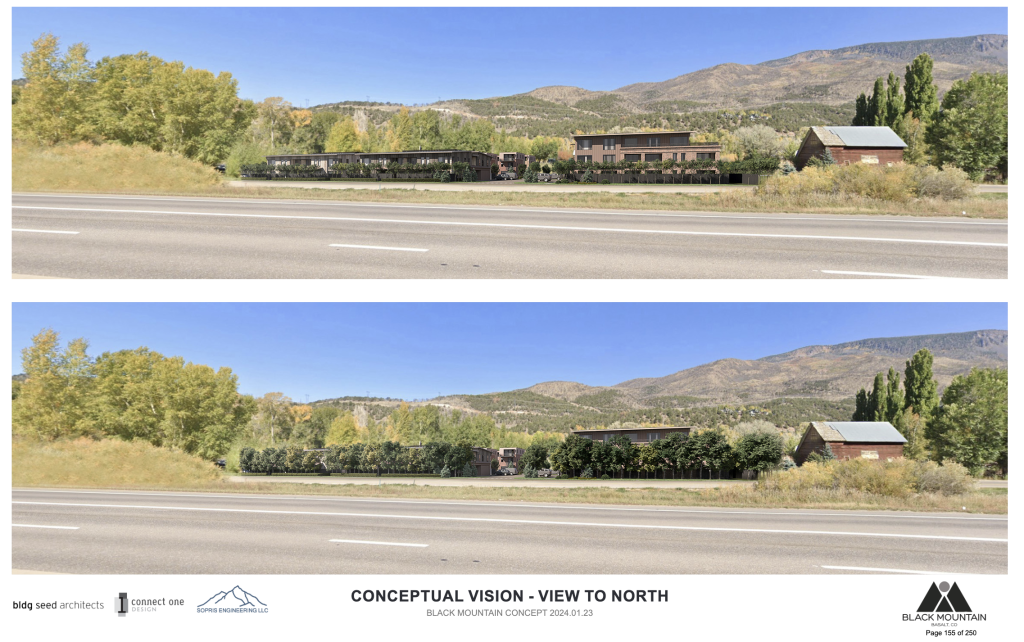
Credit bldg seed architechts
Updates to a development application on a downtown Basalt parcel include a greater share of deed-restricted units and the elimination of glamping pads, but Town Council still has reservations.
Partners from the 431 Emma Road parcel, along with assorted representatives from the architecture and landscaping team, gave updates to the sketch plan at Tuesday’s Basalt Town Council meeting.
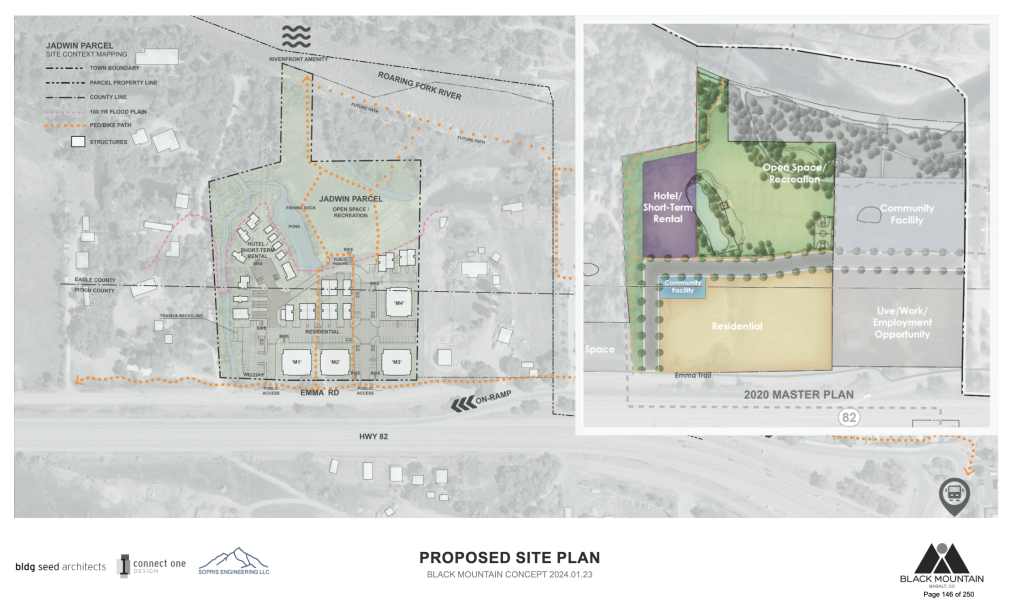
The Jadwin parcel is 9.3-acre swath of land west of the Basalt Post Office. Owners first presented the sketch plan in October and were met with a laundry list of notes from council, mostly directing the applicants to bolster deed-restricted housing and mitigate impact to the Roaring Fork River.
The unit count is up from 68 to 72, with more than 50% of units (37) to be deed-restricted. The applicants proposed 30% of the deed-restricted units to be tied to 120% Area Median Income, 30% to 150% AMI, 14% to 200% AMI, and 26% resident occupied with appreciation caps. All of the deed-restricted units would be ownership units.
Ramsey Fulton, principal and design architect with bldg seed architects, said the team intentionally bumped the deed-restrictions up higher in AMI, leaving out Category 2/85% AMI, to meet community needs for higher-income but still deed-restricted housing.
The proposed unit breakdown: 32 studio units, eight one-bedroom units, four two-bedroom units, and 28 three-bedroom units. The units would be spread across multi-family buildings and single-family townhomes. The application also proposes 132 parking spaces.
The remaining free market units would be a mix of ownership and rental, exact count to be determined at a later date. The application proposes that the sale or rental of the free market units become available to Roaring Fork Valley residents, workers, and employers 30 days before outside buyers or renters.
The development would also host 12 short-term rental fishing cabins.
To address concerns about visibility from Colorado Highway 82, the mutlifamily buildings designs were lowered by two feet and the building height slopes downward away moving westward across the property. The development will also sit about six feet below the Highway 82 corridor.
Another factor in the application is the 0.83-acre “dog leg” on the parcel. Applicants originally offered it back to the town as a community benefit, but the sketch plan update now proposes a cash-in-lieu fee of $700,000 to the town.
“Sometimes it’s great, and sometimes it’s just not a good fit to hand over a piece of land,” said Heather Henry of ConnectOne Design.

Council members also heard from Robert Krehbiel of Matrix Design Group, the town’s consulting hydrologist. He said that the Colorado Water Conservation Board mapping will likely completely remove the southern two thirds of the Jadwin parcel from the Zone A floodplain since there is no hydrological basis for it to be in the floodplain, though further mapping is needed.
Basalt Assistant Planning Director James Lindt said that if council decides to move forward with the sketch plan, a condition would be necessary requiring the initial CWCB modeling be completed prior to the submittal of a Preliminary Development Plan Application.
Applicants also offered to reduce or eliminate the proposed glamping pads, which council members decidedly said to cut from the plan entirely.
Black Mountain partner Michael Forrest stressed the positive feedback from community partners that he and co-owners/developers Bridger and Colter Smith and Ryan Chadwick, heard in their process revising the sketch plan.
“Affordable housing is a public health crisis in this valley,” he said to council. “Research and data and our own firsthand conversations with non-profits, businesses, and leaders of the essential workforce prove this fact over and over.”
They listed affordable housing partners including the Roaring Fork Fire & Rescue Authority, Aspen Valley Ski Club, Roaring Fork Transit Authority, Colorado Mountain College, Pitkin and Eagle Counties, and more — with letters of support from some included in the meeting packet.
Comments on the proposed development split about 50-50 in support and opposition. Those in support pointed to the need for a 50% deed-restricted development within the town’s Urban Growth Boundary. Opposers brought up their desire to see the space remain open and prevent a dense project that would impact traffic.
Ultimately, council members reacted to the updates with cautious interest. The increased mix of deed-restricted units was a plus, but abandoning the Category 2/85% AMI household was a problem for council members. And the 72-unit plan plus 12 short-term rental cabins seemed too dense to some.
“We’ve grown out of the small town we once were,” said Councilor Ryan Slack.
The 2020 Basalt Master Plan identified the Jadwin parcel as a suitable location for dense development, as all but the dog leg parcel is located within the Urban Growth Boundary.
The application is working through a Planned Urband Development process, which is three phases: sketch plan, preliminary plan, and final plan. The application is still in the first phase, determining if the application has merit. Vested rights are not established at this phase, nor will annexation occur without an approved development plan.
Citizen group Keep Basalt Special opposes the project, and its website says it has collected more than 200 signatures objecting Black Mountain, specifically calling out floodplain protection and traffic impacts.
Another presentation on traffic impact is set for the council’s Feb. 13 meeting. Mayor Bill Kane said it was unlikely that the meeting will result in a decision on the sketch plan, but a vote will likely come at the Feb. 27 meeting.

Aspen Cycling Club results: Butterhack MTB race from June 3
Aspen Cycling Club results: Butterhack MTB race from June 3