Bark beetles will overwinter in Aspen’s already-infected trees

Kelsey Brunner/The Aspen Times archives
While bark beetles have been slowly infesting trees in Aspen, winter won’t offer any respite.
Aspen is currently home to the Douglas-fir beetle, the spruce beetle, the mountain pine beetle, Ips beetles, and the fir engraver beetle. Spruce beetles are “Colorado’s most destructive high-elevation bark beetle,” while the mountain pine beetle affects lodgepole, ponderosa, and limber pines, according to Aspen City Forester Heather Gale. Colorado State University Extension identifies 11 Ips species in Colorado, which are a specific type of bark beetle that develops under bark and tunnels through the tree. Fir engraver beetles attack subalpine fir, particularly trees weakened from drought.
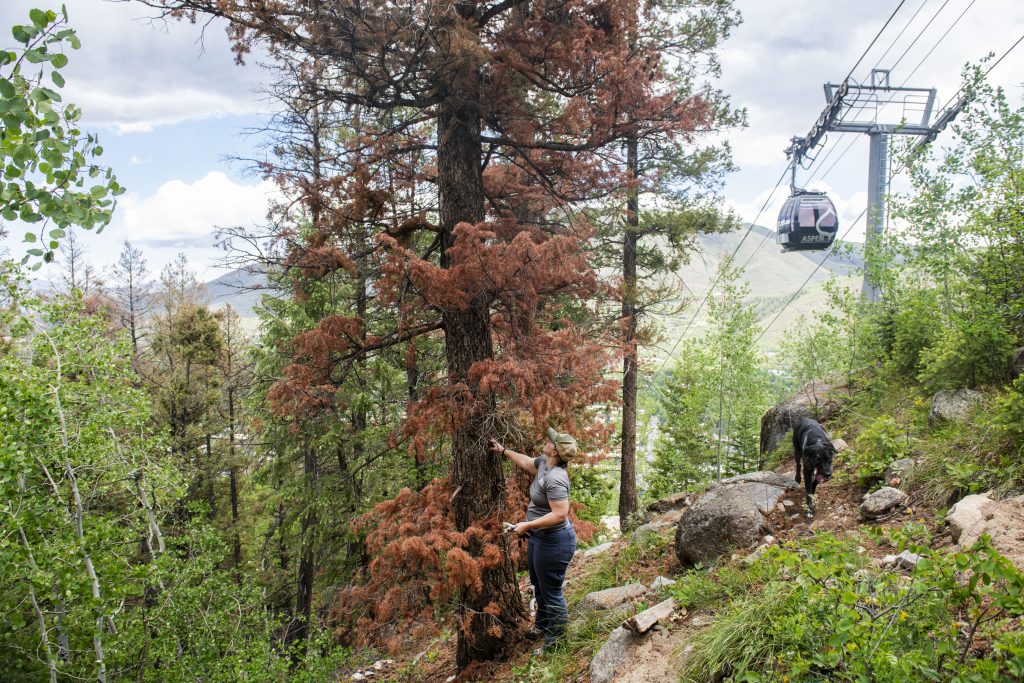
The city of Aspen has been attempting to address bark beetle activity for decades, according to Gale, focusing most recently on the Douglas-fir beetle on Aspen Mountain.
“This is currently the most significant bark beetle affecting forests in and around Aspen,” Gale said. “Its activity is closely tied to drought, windthrow, and other stressors, and because the beetle overwinters beneath the bark, winter does not interrupt its development.”
Douglas-fir beetles are causing the most new tree mortality in the Rocky Mountain region as a whole, along with the balsam bark beetle, spruce beetle, and mountain pine beetle, according to the U.S. Forest Service’s Forest Insect and Disease Conditions in the Rocky Mountain Region 2024 report. The report confirmed that both Douglas-fir beetle and mountain pine beetle activity increased across the region last year.
Once beetles enter a tree, both the larvae and the adults overwinter beneath the bark, Gale confirmed. According to Gale and Colorado State Forest Service, beetles stay insulated throughout the winter within tree phloem, or living tissue known as inner bark. Inside phloem, temperatures are warmer than the ambient air and buffered by snowpack.
“As a result, the injury process continues even when trees are dormant,” Gale said. “Because conifers do not produce meaningful resin in winter, trees are unable to mount a defensive response until spring. Any tree successfully attacked before freeze-up remains vulnerable throughout the winter months.”
CSFS data confirms that any hope for winter mortality of bark beetles requires prolonged, extremely cold conditions — brief cold snaps won’t cut it. Temperatures near –20°F could kill some larvae, but will not significantly reduce populations; only when temperatures are sustained near –30°F over several nights can “meaningful mortality” occur.
But beetles under thick bark or insulated by snowpack could still make it through those low temperatures.
“These temperature thresholds explain why even historically cold Colorado winters rarely eliminate bark beetle populations,” Gale said. “Cold weather helps, but it is not reliable as a primary control strategy.”
The winter season can temporarily halt flight, the stage, Gale said, where new host trees are attacked. But for trees already infected, there’s little hope. Warmer winters might even see the larvae continue to slowly develop, ready to emerge and spread early in spring.
“So basically, a relatively cold winter can pause new infestations but does not meaningfully reverse existing ones unless extremely cold conditions persist,” Gale said.
According to Gale, the city of Aspen’s goal is to stabilize bark beetle activity where possible, prioritize protection of high-value forested viewsheds, and maintain long-term forest resilience. Key actions the city has recently taken include annual MCH pheromone treatments, with thousands of MCH packets installed on Aspen Mountain since 2022 to deter bark beetles from trees, and targeted forest health work, with over 180 acres treated. The city deploys monitoring traps along ski runs and what Gale calls “key forest corridors” to track beetle pressure year to year.
“These traps have helped us refine treatment locations and better understand population trends,” Gale said.
The city coordinates with CFSF, Pitkin County Open Space and Trails, Aspen Fire Protection District, Aspen Skiing Company, and Aspen Center for Environmental Studies to share staff capacity, map, access, and monitor data, Gale confirmed.
Community updates are also provided through mailings, website posts, and coordinated messaging. The public can help slow the spread of bark beetles by not moving firewood, reporting any suspicious bark beetle symptoms in trees to trees@aspen.gov, considering “shadow planting” new species near susceptible trees, and hiring a local, certified arborist to treat trees with basal trunk sprays, soil drenches, or trunk injections.
For those removing an infested tree, Gale reminds homeowners to ensure contractors chip away any material before it is transported off the property.
Quarantine and movement guidelines and resources can be found at https://ag.colorado.gov/eab, and more information can be found at https://storymaps.arcgis.com/stories/c5cfa14f7c394f5faf42bf0ae63e2749 or https://www.aspenrecreation.com/parks-trails/natural-resources-forestry/forestry.