Aspen One funds climate change study for Colorado, speaks at capitol
The data shows Colorado is projected to lose another 10 days of winter by 2050, with conservative total projected costs in 2025–2050 at $50–54 billion

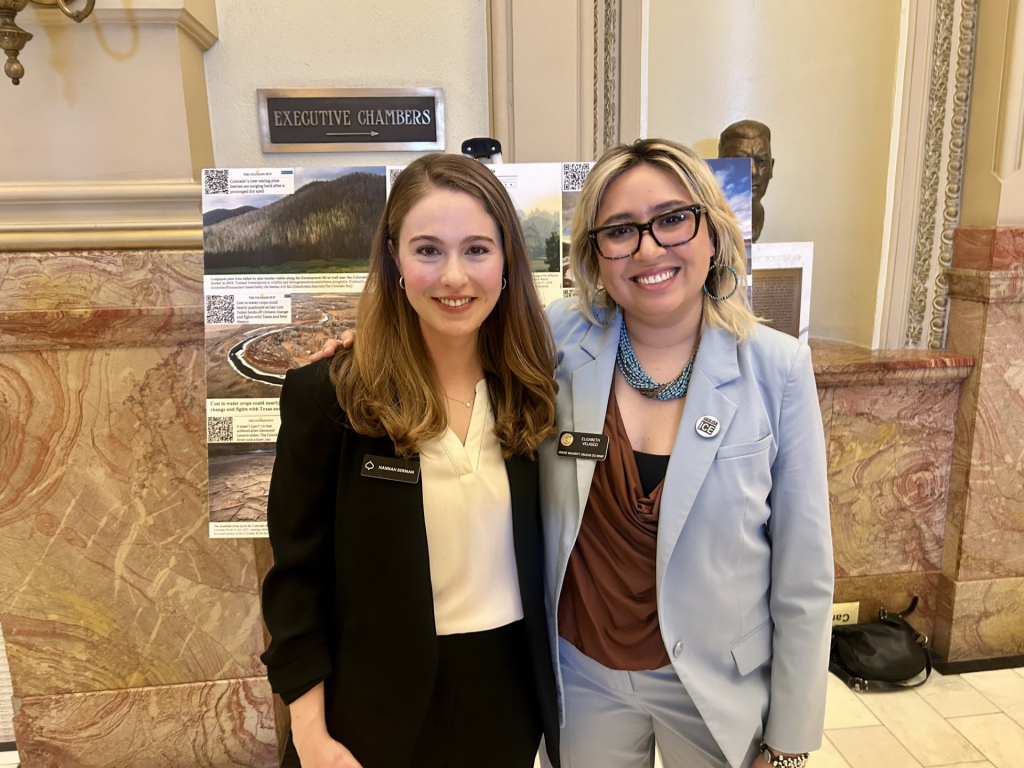
Hannah Berman/Courtesy photo
Aspen has lost a month of winter since 1980, and that’s just the tip of the melting iceberg, according to new data from a climate change study by the Colorado Fiscal Institute funded by Aspen One.
The new 2026 Colorado Climate Damages and Adaptations Costs Report is a look into how climate change has impacted Colorado’s economy and an anticipation of costs looking forward through 2050. It includes five sections — heat, wildfires, infrastructure, storms, and drought — to provide a comprehensive understanding of why climate action is a necessity not just for individual mountain communities like Aspen but for the state and legislation as a whole.
“We are very concerned about people acting on climate with the urgency that it merits,” Aspen One Sustainability and Philanthropy Director Hannah Berman said. “If we don’t act … it impacts not only our business but our community.”
Berman traveled to the Colorado State Capitol in Denver on Friday to speak at a press conference alongside over 60 groups, health and business leaders, and state and local representatives, including Colorado Rep. Elizabeth Velasco — a Glenwood Springs Democrat — Senator Lisa Cutter, environmental nonprofits like 350 Colorado, people who lost homes to Colorado wildfires, and more. The press conference highlighted the findings of the study and urged Colorado’s electeds to act on climate in the upcoming legislative session.
“The report is … about real costs that are showing up today, from 2025 to 2050,” said Chris Stiffler, senior economist at the Colorado Fiscal Institute who spoke at the conference.
According to data highlighted by Micah Parkin, executive director and co-founder of 350 Colorado, Colorado is projected to lose another 10 days of winter by 2050, with the state’s temperatures rising faster than the U.S. national average and warming about 2.9° Fahrenheit since 1970, compared to the national 2.5° Fahrenheit.
“Climate disasters are happening here and now,” Parkin said.
The study used historic and predictive models in order to analyze potential climate-related costs (in 2024 dollars) through 2050, according to a press release. Those estimated costs include $1.34 billion for wildfire damage and smoke mortality; $2.3 billion for wildfire adaptation; $220.3 million for storm damages; $8.68 billion for impacts on roads, bridges, building upgrades and stormwater systems; $351 million for winter recreation; and $24.9 billion for heat mortality. According to the release, these estimates use “medium and high climate emissions scenarios.”
The preliminary data will be updated as new information becomes available, the release confirms. Authors of the report are also currently in the process of quantifying drought damages to the agriculture sector, which will then be added.
Ultimately, the study found Colorado conservatively faces total projected costs in 2025–2050 of $50–54 billion if heat-trapping pollution is not addressed, according to the press release, where $36–37 billion represents additional costs directly attributable to climate change (and defined resilience investments), for the impacts quantified in the report.
“These numbers should be considered a floor,” Parkin said. “We know that these costs will be far greater. This report is very conservative and these numbers are still scary.”
But Berman emphasized that the cost of climate action is far less than the cost of inaction.
“I think people understand that climate action takes money and resources, but not taking climate action and advancing a clean energy economy is incredibly expensive for Colorado and our communities,” she said. “Not working on climate is an active choice that is very expensive for our state.”
Especially close to home is the data analyzing drought and its projected impact on winter sports.
“Colorado’s ski season depends on reliable winter snowpack, both how much snow accumulates and how long it persists into the core winter months,” the report states. “As temperatures rise, more winter precipitation falls as rain instead of snow, and snow that does accumulate melts earlier. For Colorado’s mountain communities and winter recreation economy, that means the natural ‘margin of safety’ shrinks: good seasons become less consistent, and the risk of poor conditions increases, especially around the holiday period when visitation and revenue are typically highest.”
The research states that as drought worsens, snowmaking becomes more of a requirement. According to the report, the total incremental snowmaking cost, meaning the extra cost that resorts would incur to maintain skiable conditions, from 2025–2050 is between approximately $98.2 million and $121.1 million.
But increased snowmaking needs raise operating demands and water demands that compete with other winter and spring water demands, and it still might not be able to successfully offset losses in natural snow reliability.
“When snowmaking is included, the effective season length (meaning the natural season length of climate-driven snowfall and melt plus snowmaking during the early season) remains substantially longer than the natural season in both periods, but it still declines over time,” the report reads.
Berman echoed this sentiment at the Colorado State Capitol conference.
“By 2050, the natural ski season is expected to shrink more than 10 days, and that’s even with modern snowmaking,” she said. “We’re the largest employer in the Roaring Fork Valley … Climate change not only impacts our way of life but our livelihoods. We want to make sure that we are working on climate action not only because it benefits the environment but because it is critical to our business, our mountain economy, and our way of life.”
She noted that a ski instructor she talked to this year said he’s always been booked every day during the Christmas week, but this past Christmas week, he was only booked three out of eight days.
Berman said one of the ways that Aspen One is attempting to mitigate if snowmaking isn’t possible in above freezing temperatures is by Hero’s mountain terrain expansion.
“It’s high alpine terrain, it’s north facing, you get shading by the trees,” she said. “It’s a mitigation for some of the climate impacts we see when the bottom of the mountain melts out.”
While the study separates climate impacts into five distinct sections, she emphasized that the five sections are not mutually exclusive. Rather, they integrate into a holistic overview of the breadth and urgency of impact.
“It’s a double-edged sword,” Berman said. “The impacts of climate are wide-reaching, but the solutions can also benefit many different parts of our state.”
The complete study and all the data can be found at