Artist links ancient to modern in new Aspen Art Museum exhibition

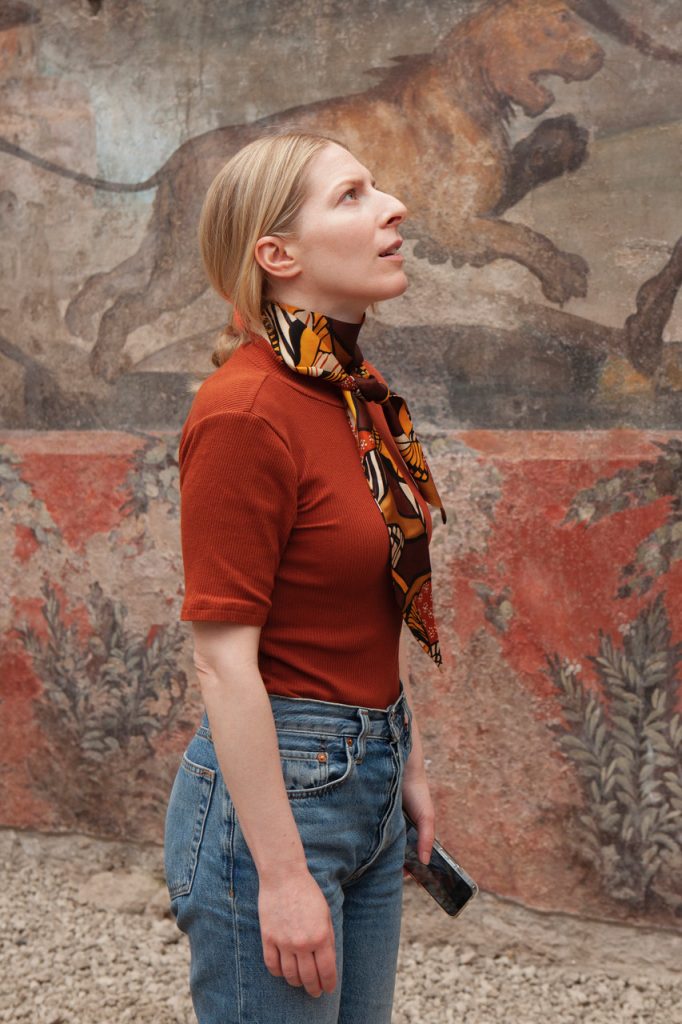
Amedeo Benestante/Courtesy photo
It was a series of connections that brought artist Allison Katz to stage Aspen Art Museum’s current exhibition “House of the Trembling Eye.”
Katz — who has spent over a decade investigating ways that “aesthetic practices link and absorb personal narrative, commodity culture, information systems, and art history” — found herself in a residency studying fresco painting through Pompeii Commitment, a program curated by Stella Bottai, who also serves as senior curator at large for Aspen Art Museum.
It was through the work she was doing in Pompeii around the placement of paintings as well as conversation around the ancient house being a precursor to the modern museum that she received an invitation to curate a show marking Aspen Art Museum’s 45th anniversary and the 10th anniversary of its Shigeru Ban–designed building.
“House of the Trembling Eye,” which opened on Thursday, May 30, and runs through Sunday, Sept. 29, is a group exhibition staged by Katz across three floors of the museum that features over 100 works that include her paintings alongside artworks by over 50 artists, as well as a series of frescoes from Pompeii that are being shown in North America for the first time.
The Aspen Times’ arts and entertainment editor, Sarah Girgis, chatted with her about the juxtaposition between ancient and modern, the challenges of stepping into a curator role, and what she learned about Aspen in the process.
The interview has been edited for clarity and brevity.

Sarah Girgis: When you were first approached by Aspen Art Museum, what excited you about the project?
Allison Katz: Aspen Art Museum is a non-collecting museum, so their invitation was to make a show with local collections. My first thought was that this idea of borrowing works from private collections and bringing them into a free public space had affinities with the mixed-use function of the domus, or ancient Roman house, that I was looking at in Pompeii, and that it would be the perfect template to graft back onto the museum as a structuring device.
It was important to me that we include fragments of the actual frescoes from Pompeii because it situates painting on a continuum of 2,000 years. The works in Pompeii are so alive and remarkably contemporary that it is also a way to transcend any particular moment in time.
A show like this would only be possible in Aspen. There is a concentration of world-class art here. Looking at Pompeiian painting was the research I happened to be doing at that moment. So, it all aligned.
SG: You are an artist first; how was it to step into the role of curator?
AK: I wanted the conversations to be between the paintings themselves as much as between the viewer and the painting because I’m not a curator, I’m a painter.
That’s the strength of the Aspen Art Museum as an institution — they are artist-led. It was an amazing opportunity for me to almost take the practice of painting as I do it privately in the studio and extend it onto choreographing the display of other paintings. I also wanted to preserve the event of the exhibition, where in this temporary moment, all these disparate things come together, form new relations and meanings, and then go back to where they reside. Painting has this very flexible, inexhaustible capacity to be seen anew when put in a new context.
SG: Aspen has a lot of serious art collections. How did you sift through what was available and ultimately choose?
AK: I asked very much to be guided by the museum. I didn’t want it to become personal for me. We kept the process, design plans, and my selections private. I was able to visit certain collections in person last year. And then once I was home in London, I was sent images to look through. There was always a conceptual structure that led me to make my choices, a poetic development of individually titled rooms and corresponding themes. I wasn’t interested in relying solely on my taste and just going into people’s homes and saying ‘I like this’ and ‘I don’t like that.’
SG: When you’re approaching other people’s work, do you feel a responsibility to the other artists whose work you are showing?
AK: Absolutely. It’s such a privilege to be able to spend this amount of time with these paintings and to understand that they are loved by other people — and that they’re not necessarily shared publicly so often. There was a real kind of sense of discovery.
I also felt a huge amount of responsibility to respect each painting and its’ individual story as much as I was trying to make a new world temporarily by bringing them together.
SG: What did you learn about Aspen through this process?
AK: Well, first, I learned that the museum is extraordinary and very unique in the way that they trust artists 100%, which is very unusual.
I was constantly surprised by the connections that occurred between the works, and the way they spoke to each other and brought out new reflections or focus points. That kept happening between works even once I thought I’d understood the reason I wanted them to be seen in the same space together. New layers kept revealing themselves.
SG: You have your paintings scattered throughout the exhibition; how did you kind of think about your work in relation to the other pieces?
AK: Half of my paintings are new, and half are recently made. What was exciting for me as a curator was that I was being led by my paintings and how I think as a painter. So these are ideas and themes that I was already interested in, that I would be painting anyway, and I was able to expand them into staged rooms from within my own painterly logic.
I wanted my painting to be seen as an act of curating as well as curating to be understood as an act of painting. It had to be blurred, which is the same as it was in the ancient house; it was blurred between public and private spaces. And in this instance, the curator and artist are very blurred.
SG: Why title the exhibition “House of the Trembling Eye?”
AK: In Pompeii, archaeologists name the excavated houses by an identifying feature for example, “House of the Tragic Poet,” “House of the Golden Bracelet,” etc. So I kept thinking to myself, ‘What is specific about this house?’ Right away, it is the woven facade by Shigura Ban, a porous framing device. I also kept thinking about the name of this place, the word Aspen, the tree itself. The trembling leaves of the aspen tree speak to the trembling of the eruption of Vesuvius (in Pompeii) and the very reason why we even have access to these ancient paintings. The destruction of the city was paradoxically its preservation. And then the eye. Our own eyes that we use to look at paintings with, which so happens to also be the unique markings all over the bark of the aspen trees, these strangely realistic renderings of human eyes on every tree, expressive, fantastic, and surreal.
Sarah Girgis is the Publisher for The Aspen Times. She can be reached at 970-429-9151 or sgirgis@aspentimes.com.