Willoughby: Lost underground
Tim Willoughby Follow
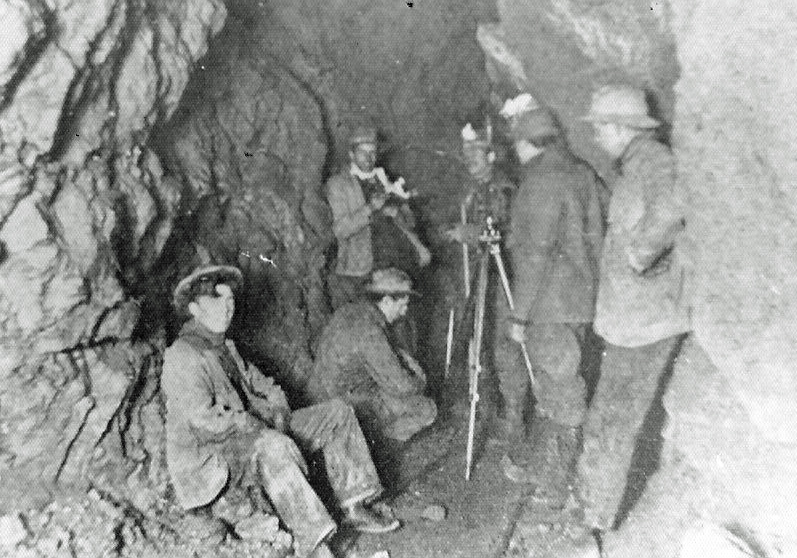
Willoughby Collection/Courtesy photo
An article in an 1890s Engineering and Mining Journal caught my eye. Titled “The Surveying of Mines” and penned by John L. Culley, it reminded me of an interesting Midnight Mine story centered around underground surveying.
The article’s beginning states, “In order to insure accurate work in the surveying of a mine, the surveying party should consist of the engineer, a pilot or foresight, who goes ahead and selects the transit or angle points, two chainmen, a torch-bearer for the instrument, and a backsight. The duty of the torchbearer is to first light the plumb-bob, then the upper plate until it is level, then the vernier, then flashes the cross hairs, and finally the vernier reading”.
In my teen years, I sometimes accompanied my uncle, Frank Willoughby, when he was doing survey work. He was elected county surveyor several times and did most of the surveying for Aspen’s early chairlifts. I, mostly through watching, learned some of the finer points of surveying. The plumb-bob was my favorite. It was a heavy metal object that connected to the bottom of the transit at its exact middle point, then the line dangled in line with gravity. The end of the plumb-bob came to a point that pointed to the exact point below the transit. Measurements were made from that point. If you marked that point a few inches off, the survey would be off.
Imagine doing all that underground under torchlight.
My grandfather, trained in the finer points of a mining engineer, did all the Midnight’s underground surveying. At the end of a ten-year, 10,000-plus feet of tunneling, it reached a point about a thousand feet below the Little Annie Basin surface that the company believed the silver ore vein was located. The original Midnight shaft ended a couple hundred feet above when it could not deal with the water.
But there was no vein. Had the vein stopped above or were they in the wrong spot? How would they know? The surveying told them they were at the right location. The most plausible explanation was the survey work was wrong. To locate an underground point, there were actually two surveys — the one in the tunnel and the one on the surface. The surface survey was done by a contractor.
Grandfather redid the tunnel survey. Instead of using a transit, he employed a Brunton Compass that doubled as a survey instrument but was sometimes much less accurate. The difference was often the surveyor more than the instrument. His resurvey produced the same results.
The company had the surface survey done again, and — surprise — that was the problem. The difference between the two was around 200 horizontal feet. A two-hundred-foot error was gargantuan in a survey that was about two miles long.
What I learned from going with my uncle was how he pointed out the challenges of surveying in the mountains. Surveying in a dark tunnel has its challenges, but the tunnel was relatively flat — just enough of a grade, so water would flow out. But think about starting a surface survey in Queens Gulch and going over the ridge and then down into the basin.
The plumb bob explains what maybe happened to a less skilled surveyor. It points down, but the transit is about 4 or 5 feet above; so on a slope, you must account for the fact that the point on the ground — because on a slope the plumb bob is hanging at an angle to the surface — is inches different than the transit above.
Now, those of you who know about surveying would point out that that plumb bob difference would more likely develop an error in the elevation drawings; but as you know, when you hike, going up a steep slope does not move you far horizontally quickly.
A surveyor drinking a jug of hootch is just as plausible an explanation. The good news is the Midnight took an educated guess and tunneled upward and at a slight angle and ended up where it had planned over a decade earlier, hitting the ore vein just before the 1929 stock market crash. The ore vein was mined for over 20 years after that.
Tim Willoughby’s family story parallels Aspen’s. He began sharing folklore while teaching at Aspen Country Day School and Colorado Mountain College. Now a tourist in his native town, he views it with historical perspective. Reach him at redmtn2@comcast.net.