Willoughby: February-March of 1962
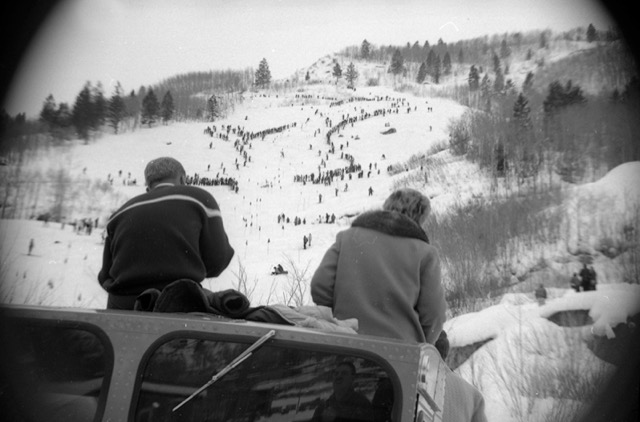
Aspen Flyer Collection/Aspen Historical Society
The talk of the town in February and March 1962 triggers memories for me, but they also might help today’s readers understand context of Aspen six decades ago.
The X Games today has an international audience; in 1962, it was the World Professional Ski Championships that Aspen hosted, like the World Pro Ski Tour of today. Aspen, with around 3,500 watching, enjoyed it — especially because the winner, Anderl Molterer, was a local. Second through fourth places went to racers from other countries, but fifth place also went to an Aspen local: Max Marolt. Molterer’s prize included a Mercury Comet.
The Roch Cup, still a major Aspen race, attracted attention because for the first time, locals won — both men’s and women’s in 1962. Bill Marolt won the men’s by taking 1st in the downhill and the giant slalom and 2nd in the slalom. Jim Heuga won the slalom, but the paper noted that while he was living in California, he had been a junior racer in Aspen when younger. Local Sharon Pecjak took the women’s in a similar fashion: firsts in the downhill and the giant slalom as well as fifth in the slalom.
More than 80 years after Aspen was founded with property purchased/staked from federal government, land ownership was still contentious. Known as the East Aspen Patent, the disagreement was over land boundaries, around 62 acres, and ownership for the area on the Smuggler side of the Roaring Fork. The city was working with the feds on what appeared to be an incorrect survey and an oversight issue. It was also wanting to expand the city boundaries.
My uncle, John Herron, was one of the litigants pleading his case to District Judge Clifford Darrow. He owned or had leases on many mining claims and knew the history where mine owners were mostly fighting over: whether if the vein of ore surfaced on your claim, you could follow it wherever it went, or if the property boundaries determined who owned the ore.
Darrow ruled in Herron’s favor, but that was not the end. The city continued to work with Herron, and others, to arrange an out-of-court settlement. He and the city agreed to exchanging deeds in 1964. That continued beyond that settlement. Finally, the city ended up with the land right on the river that became a park, and the city, in 1968, renamed it Herron Park.
Aspen in 1962 was looking for any way possible to promote the town. The Times reported whenever a publication, or television, had anything about Aspen, and there were several during the year. In February, it reported a great story: The U.S. State Department with its Internation Cultural Exchange Service was going to fund the MAA’s Young Artists of Aspen program for a nine-week tour of 11 countries.
Another MAA artist and faculty member, Roman Totenberg, reported to Edger Stanton, a board member, that on a radio station, he heard a duet he did with Walter Trampler (Both were violinists) when he was touring in Europe. Stanton recorded the MAA concerts to be used by the Voice of America, which was how Totenberg heard it. Stanton checked and found that the Voice of America audience for the MAA recordings was 30 million. He also reported that 150 U.S. radio stations were broadcasting the recordings of the Friday student concerts.
The world movie theater premier of “Fantasy On Skis” was in Aspen in February. The movie, a combination product of local ski school head Fred Iselin and Disney Productions, had already aired on NBC with 40 million viewers. The movie crafted by Iselin, filmed two years before, featured Susie Wirth, who was nine at the time of the filming. Wirth’s parents ran the Sundeck restaurant, and they lived there. Wirth literally skied to school each day. The movie had her caught in an avalanche and rescued by a St. Bernard dog. It should be noted that Iselin and his wife Elli, over the years, had more than one St. Bernard.
With a bit of humor, the Times reported that Hans Gramiger had skied and snowshoed to the top of the Shadow Mountain ridge where he was planning to build a restaurant he would call “On The Rocks.” He had installed a light there — the Times labeled as a promotional stunt — for all to see, but it had gone out. The cord ran down to his office in the West End. Wind had loosened the bulb; Gramiger replace it with a brighter light. The permit application dragged on for over a decade with lawsuits.
Tim Willoughby’s family story parallels Aspen’s. He began sharing folklore while teaching at Aspen Country Day School and Colorado Mountain College. Now a tourist in his native town, he views it with historical perspective. Reach him at redmtn2@comcast.net.





Branham: Over 80 billionaires live in Pitkin County — what if they were the world’s most generous?
When we share, we are happier. Full stop. If this is true, why do philanthropists only give away such a small percentage of their wealth?