Trump administration threatens to take over wolf program from Colorado Parks and Wildlife
The U.S. Fish and Wildlife Service said it will terminate its agreement with Colorado, should the agency fail to produce summaries and documents about the wolf restoration and two recent decisions

The U.S. Fish and Wildlife Service is threatening to take over Colorado’s wolf restoration program from Colorado Parks and Wildlife.
Brian Nesvik, the federal agency’s director, sent a letter on Dec. 18 to Laura Clellan, Parks and Wildlife’s acting director, stating that the agency will terminate the agreement that grants the state agency management authority over gray wolves should Parks and Wildlife fail to produce a “complete reporting of all gray wolf conservation and management activities that have occurred” since the state released its first 10 wolves in December 2023.
The letter gave the agency 30 days to comply.
Luke Perkins, a spokesperson for Parks and Wildlife, said the agency intends to comply with the request and provide the requested information.
“(Colorado Parks and Wildlife) has coordinated with U.S. Fish and Wildlife Service throughout its gray wolf reintroduction effort, and has complied with guidance from (Fish and Wildlife) as well as all applicable federal and state laws,” Perkins said. “(Parks and Wildlife) values the partnership with (Fish and Wildlife) in the wolf management context as well as in many other collaborative situations.”
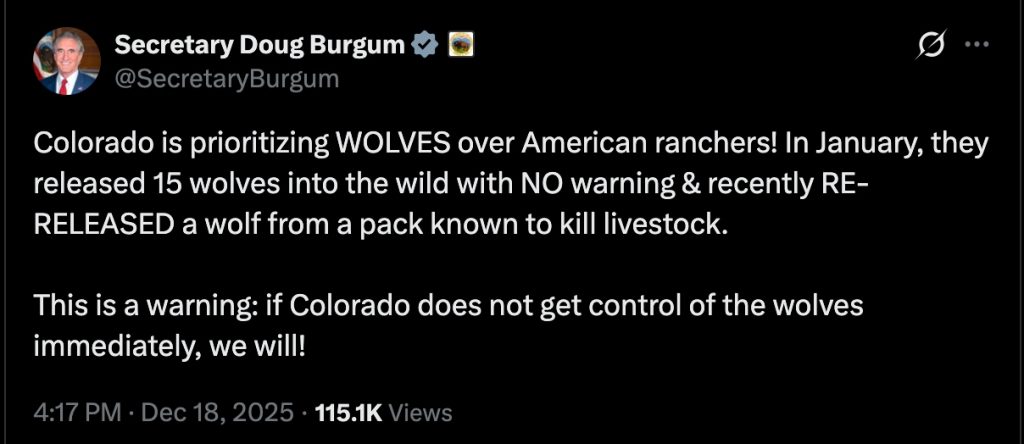
The letter was sent the same day that U.S. Department of the Interior Secretary Doug Burgum posted his own warning on X, “Colorado is prioritizing WOLVES over American ranchers. … If Colorado does not get control of the wolves immediately, we will!”
Colorado Parks and Wildlife is the first state agency to lead the reintroduction of wolves, with the Fish and Wildlife Service leading previous efforts, including in Yellowstone National Park and Idaho. Gray wolves are listed as endangered federally in Colorado. Under the federal Endangered Species Act, the U.S. Fish and Wildlife Service is granted primary oversight over the conservation of any species federally listed as endangered or threatened.
To oversee the reintroduction and restoration of gray wolves in Colorado, Parks and Wildlife was granted a special 10(j) rule establishing wolves as a “nonessential, experimental population” in the state and giving it certain capabilities, including to kill wolves as a management tool. The authority to lead Colorado’s management of the wolves was granted in a separate agreement with the federal agency in December 2023.
In the agreement, the Fish and Wildlife Service granted approval for Colorado’s Wolf Restoration and Management Plan, adding that the state has demonstrated it “has the authority and management capability to conserve gray wolves” in accordance with the plan and 10(j) rule.
Should Colorado not comply with Nesvik’s request, this agreement would be terminated.
“Termination of the (memorandum of agreement) will result in the immediate revocation of all (Colorado Parks and Wildlife) authority over grey wolves in its jurisdiction,” Nesvik wrote. “In the case of revocation of authority, the Service will reassume all gray wolf management activities, including relocation and lethal removal, as determined necessary.”
Perkins said that Parks and Wildlife “believes that it is advantageous for (Parks and Wildlife) to continue as the lead management agency for Colorado’s gray wolves,” continuing to “closely coordinate on wolf management decisions with (Fish and Wildlife) staff.”
In August 2024, when lawmakers were questioning Parks and Wildlife decision-making and producers sought federal interference, Gov. Jared Polis’s office issued a statement guarding against the Fish and Wildlife Service taking over.
“We respectfully disagree that a Washington D.C.-based federal bureaucracy thousands of miles from Colorado with very limited resources in the state would somehow be better equipped to manage on-the-ground efforts and voter-approved wolf reintroduction efforts, and would only put more government barriers in place,” the office stated.
Why is the federal agency threatening action?
The letter expresses concerns about two management decisions made by Parks and Wildlife in the past year. It requires that the agency provide narrative summaries and all associated documents as part of its request.
First, it claims that the state wildlife agency “with no notice or warning to its own citizens, released 15 wolves imported from Canada.”
The letter’s claims mirror those made in January 2025 by U.S. Reps. Lauren Boebert, Jeff Crank, Gabe Evans and Jeff Hurd, all of whom are Republicans representing Colorado in Washington.
When asked about these claims, Perkins pointed to several announcements and meetings made surrounding the January 2025 releases. He said that Parks and Wildlife publicly announced it would source wolves from British Columbia on Sept. 13, met with county commissioners and members of the public in northwest counties where the releases were considered and shared a “comprehensive update of the wolf program” at its Jan. 8 commissioner meeting.
Perkins added that the agency publicly announced when the operations began, concluded and held a press conference two days later.
The second concern expressed by Nesvik is that Parks and Wildlife “recently released a wolf from a pack with a confirmed history of repeated depredation,” referring to the Dec. 11 release of a Copper Creek wolf in Grand County. The wolf was relocated after being captured in New Mexico by wildlife officials there.
This was done as part of an agreement between Colorado, Utah, New Mexico and Arizona, which requires any of the other Four Corners states to capture and return any gray wolves that leave Colorado. The agreement is reportedly meant to protect the genetic diversity of Mexican wolves, which are part of an experimental population overseen by the Fish and Wildlife Service in southern New Mexico and Arizona.
However, the wolf’s origin drew concerns from Grand County officials.
The male wolf, tagged 2304, was born to the Copper Creek pack when it first denned in Grand County in 2024. The wolf was among the pack members that were captured and held in a wildlife sanctuary from September to January 2025 after the pack was tied to repeated livestock attacks in the county. The pack’s surviving matriarch and four yearlings were released into Pitkin County in January 2025. This spring and summer, several animals in the Copper Creek pack were connected to a series of livestock deaths, with Parks and Wildlife killing one of the yearlings responsible.
“While this wolf, who had dispersed from its natal pack months before, met the definition of ‘depredating wolf’ at the time of re-release, the situation did not meet the criteria for ‘chronic depredation’ in CPW’s administrative directive,” Perkins said, adding that the wolf is no longer in Grand County.
Perkins said that this decision was made in accordance with its wolf plan, which grants “flexibility to address unique circumstances” like this situation, where Colorado was “obligated to retrieve from New Mexico a wolf from the Colorado experimental population.”
The decision to release the animal in Grand County was made by Parks and Wildlife leadership with knowledge from local managers and wolf program biologists, according to Perkins. The release location was selected for its “winter concentration of elk herds near the release area, its isolation from major roadways and developments in Grand County and its distance from substantial livestock operations during the winter months,” he added.
While notice was given upon release to Grand County commissioners, Perkins said that local officials and community members were not part of the decision-making process for safety reasons and because most wolves move away from release sites quickly. He added that this follows agency protocol for all wildlife releases.
A growing federal interest in Colorado wolves
This is the second letter Nesvik has sent to the Colorado wildlife agency since assuming the position in August. Nesvik previously served as the director of the Wyoming Game and Fish Department before President Donald Trump tapped him to lead the federal agency.
In October, Nesvik imposed a new interpretation of where Colorado can source its gray wolves from, claiming the animals must come from the United States’ Northern Rockies region, where wolves are federally delisted. This includes Idaho, Montana, Wyoming, and portions of Oregon, Washington and north-central Utah.
Parks and Wildlife had already signed an agreement with British Columbia to source another 15 wolves for the third release, but the letter and interpretation set them back to finding another source.
Montana, Idaho and Wyoming all declined to provide wolves in 2023.
Roger Phillips, a spokesperson for Idaho Fish and Game, said Idaho re-engaged in 2025, but “respectfully declined to provide wolves, as we did to a similar response in 2023.”
Washington officials declined Colorado’s request in a November meeting, with 9News reporting that Washington’s Colville Tribes also declined to provide wolves this winter.
Faith Heaton Jolley, a spokesperson for Utah’s Division of Wildlife Resources, said it has not received any requests from Colorado this winter and is not “aware of any wolves in the delisted portion of Utah for them to even take.”
Montana, Wyoming and Oregon did not respond to multiple requests for comment on the matter. Oregon supplied the first 10 in December 2023.
Despite the challenges to find a source for wolves, as recently as Monday, Jan. 5, Perkins said the state is still evaluating “all options to support this year’s gray wolf releases in alignment with the Colorado Wolf Restoration and Management Plan and recent (Fish and Wildlife Service) guidance.”
The window is closing for the agency to find wolves for 2025-26 winter release, which would keep Parks and Wildlife on track to release between 30 and 50 wolves in the program’s first three to five years as recommended by its wolf plan. In November, Colorado officials told Washington that the agency had time through February to relocate wolves this winter.
Snowmass reports more snowfall than any Colorado ski resort after most recent storm
After the first real winter weather of 2026, Snowmass has picked up 12 inches of snow in the past 24 hours, the most snowfall of any ski resort in Colorado from this storm cycle.




Aspen High School graduate battles rare illness with over 120 days in ICU
An Aspen High School graduate is currently battling a very rare illness, spending her birthday, Christmas, and New Year’s in the Intensive Care Unit.