Ranchers, farmers finding sustainable, efficient ways to better care for their land

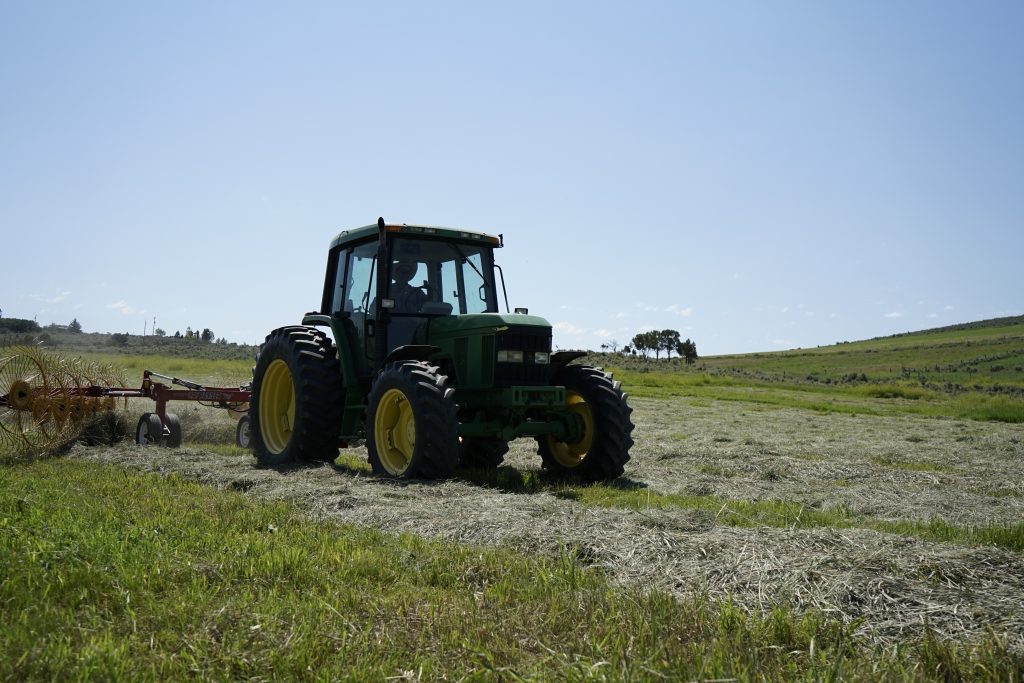
Beau Toepfer/The Aspen Times
Water is a limited resource in the Western United States, especially in August. Ranchers and farmers in the Roaring Fork Valley have to consider the benefits and drawbacks of different irrigation methods — especially as climate change becomes a more pressing issue.
The two most common forms that provide the vast majority of the irrigation in the valley are flood irrigation and overhead irrigation, or sprinkler irrigation.
Overhead irrigation uses the least amount of water. The sprinkler is able to irrigate more land with less water and can fully cover a field, spraying water in areas that may have been missed by flood irrigation.
However, according to the owner and operator of Spradley Farms in Carbondale, Mike Spayd, overhead irrigation can do a worse job at fully saturating a field, and also much of the water used with overhead irrigation will end up evaporating.
“Water lost to evaporative loss is not necessarily going to stay in our watersheds,” he said.
For many of the ranches in the valley, especially at higher elevation ranches like in Missouri Heights, gravity pressurizes the water used in overhead irrigation. For many of the ranches in the area, projects to strengthen overhead irrigation infrastructure have been supported by grants instead of coming out of the rancher’s pocket. When gravity can’t be used to pressurize the water, pumps have to be used. These are typically either diesel or electric. The use of electric pumps can be beneficial to the environment as they can implement renewable forms of electricity.
In comparison to gravity pressurization, pumps are far more expensive. Not only does the rancher need to pay for the electricity or fuel to run the pump, but the water used isn’t filtered. The silt and debris in the water wears the pump out quickly.
Flood irrigation doesn’t require the use of pumps.
“If you’re looking to have a 15 horsepower pump run roughly 60 acres of irrigation, you’re spending around $1,000 a month in electricity,” Spayd said.
Flood irrigation, when set up correctly, better saturates a field as compared to overhead irrigation. It is also far less expensive to set up and maintain. Setting up a field, however, especially on the difficult terrain most ranches in the valley are on, is difficult to achieve.
According to Spayd, more work will often end up going into setting up an effective flood irrigation system. This form of irrigation uses far more water than overhead irrigation, but almost all of that water will be absorbed into the ground surrounding the target area or staying in the watershed.
“For flooding, you just need a huge amount (of water); you’re basically throwing water on the ground and letting it flow over the pasture and flood it,” owner of Milagro Ranch on Missouri Heights Felix Tornare said. “And then you have to keep moving it to try to flood everything.”
The Douglas Cerise Ranch Company ranch uses 50% overhead and 50% flood irrigation, but owner Cassie Cerise is in the final stages of a full transition to overhead irrigation. Transitioning the 100 irrigated acres on her ranch and installing the piping system to pressurize the sprinklers will cost a total of $200,000. Much of that cost was covered by grants.
“We’re up in Missouri Heights, which means we’ve got some hills to our property, and the sprinklers cover the hills a lot better for us,” Cerise said. “And a second benefit is it’s easier to farm; it’s much easier to get (cover crop) plants established when you’re utilizing sprinkler irrigation.”
A lot of the success of irrigation relies on the health of the soil. Cover cropping — or planting grasses and plants that cover the ground at all times — is a popular regenerative farming technique.
“This is all kind of new to us, but it just seems so basic that if there’s something between the dirt and the sun, it’s got to be a good thing,” Cerise said.
Tornare has helped the Douglas Cerise Ranch Company to transition from a fully flood irrigated operation to the eventual goal of only using overhead irrigation in the hopes of saving on water and helping cover crops grow. The sprinklers on Cerise’s ranch are fully pressurized by gravity. The pressure is so strong it requires frequent replacement of the risers in her system, which wear out from the constant water pressure.
According to Tornare, healthy cover crops have deeper roots, which can reach water stored much deeper in the soil. Those deeper roots are able to access water even when the soil is dryer in drought. Cover crops also don’t need to be tilled; they can stay planted year-round. Healthier plants can not only absorb more CO2, one of the most common greenhouse gasses, but they can also store more CO2 in their root systems.
“It’s like a sponge,” he said. “The bigger, the fatter the sponge, the more absorption you get. Now you release the CO2 by plowing and disking and turning it over. And now you’re basically ruining everything that you’ve built.”
Even late in the season after ranchers have run out of water allotted in their water rights, healthy, saturated soil with proper cover cropping is still incredibly usable for grazing. According to Cerise, cover crops on her ranch have grown better using overhead irrigation.
“When I look out there now, it is still deep green,” Tornare said. “So I’m hoping that continues, and that even if it might be harder on top, the roots down below are going to be healthier, and there’s still going to be moisture there because it’s protected by layers that we’ve put on.”

Football: Basalt honors Frerichs ahead of homecoming victory; Aspen wins third straight
Basalt improved to 4-2 overall and 2-1 in league. Up next is arguably the biggest game of the season for the Longhorns as they will host mighty Delta.