Life as a toilet … in Aspen: City Parks Department installs 2 lavatories at Herron Park following 3 years of planning

Regan Mertz Follow
Michael Tunte/Courtesy Photo
What exactly goes into conceiving the plan for a new toilet? How is the toilet brought into this world (or rather Aspen’s Herron Park)? What happens once it’s on its own for the first time?
If you were wondering about any of these questions, Michael Tunte, Aspen’s Parks Design and Review Landscape architect and construction manager, may have the answers.
“Actually, it’s an interesting story,” Tunte said, as the city spent Tuesday installing permanent bathrooms at Herron Park. “Three years ago, we did community outreach for the Herron Park playground. We were replacing the old playground with a new one, and we asked questions that were very specific to the playground. And what was interesting to us is that people happily answered and provided input on the playground, but they also said, ‘Hey, we really need to get a permanent bathroom there.'”
For years, porta-potties ruled the park, and people were growing tired of them. A permanent bathroom, however, was beyond the Parks Department’s budget for that year, since they were already replacing the playground.
With their hands tied, Tunte and others in the department kept this request in mind over the next several months. Until finally, new budgets were decided, money was allocated, plans were approved and designs were created to give the people what they want: a porcelain throne in their favorite city park.
“We’re now at the time where it’s ready, and we’re ready to put it in the ground,” Tunte said. “So, it’s about as much of a community-driven request as you’re gonna get.”
The city settled on two contracts, one for the design and fabrication of the bathrooms themselves. This contract cost $300,000. The other one is the contract for the actual site, which includes the installation work, such as utility connections, site preparation, concrete work and landscaping. This contract cost $280,000.
The bathrooms are prefabricated, so the actual architecture was already chosen from the start. But what makes these facilities unique is that the design components — like stone types, wall colors and fixture customizations — were all custom made to fit in with the Aspen aesthetic.
“We worked with an interior designer and really dialed in the materials, in terms of longevity and in terms of aesthetics and long-term maintenance,” Tunte said. “And this is a new thing for the city of Aspen. We have never done this before. And it does present an interesting alternative. So, we’ll see once it’s in place, and we’ve had a chance to use it for a couple years, if that’s a viable solution we want to consider moving forward.”
Kyle Earlywine, co-founder of and planner at Washington-based Green Flush Restrooms, has worked with the Parks Department over the past few years, designing a loo that dreams are made of. He began with a few questions:
“How many rooms do you want? How many people do you need to serve at a time? Do you want these to be single-use cabins? Do you want it to be multi-stall?,” he said. “We asked the questions, and we started narrowing things down. Eventually, when we started talking about aesthetics, in particular, we started looking at pictures of other restrooms in Aspen and other buildings. And funnily enough, we actually didn’t go in the same direction as a lot of the other buildings that have been done in Aspen.”
Earlywine said the Parks Department was in the market for a building that was good looking but did not require an exorbitant budget. Green Flush Restrooms, which is celebrating its 14th anniversary next month, offered the department the look they wanted to achieve with the least amount of money.
For the exterior, it is a traditional mountain motif. It is not extravagant, but it fits into a place like Aspen, Earlywine said. The intent was to find nice materials for the outside, so wood paneling was chosen.
He also said the department knew exactly what they wanted when it came to the interior plan. As the architect and designer were giving them different options, the department would counter with ideas, and eventually a common ground was established and came together in the final look.
Nontraditional features are a staple in the bathrooms. The faucets are two in one with water and an air dryer. The mirrors are backlit, which is important, Earlywine said, because lighting matters when trying to create a hospitable environment.
These nicer features were achievable because Aspen is not plagued with some of the usual problems other cities in America are, like vandalism, he said.
“So they were able to really lean more towards hospitality, than toward building the restroom for criminals or for rowdy teenagers in the community,” Earlywine said. “It was really cool to be a part of something that was not just about function first but really looking at making this a nice experience for people that come in. And, I mean, normally I tell folks that we build restrooms that are trying to create a totally forgettable experience for people coming in. On the rare occasion, we get to make an interior where we don’t want people to forget this. We want people to remember, ‘Oh, this is a really nice restroom.'”
Originally from Glenwood Springs and an avid skier in Aspen throughout his childhood, Earlywine said the Parks Department reached out to him first regarding the project. He was just in the area last month for his 20-year high school reunion.
“It was just so cool to be at the high school reunion and to know that I’m doing business in my old neck of the woods, just to be able to do one in the Roaring Fork Valley,” he said. “It was really cool for me, personally.”
After all, all of their restroom designs are named after Colorado ski resorts: Vail, Aspen, Durango. Aspen is getting the Durango model.
“And I think they ended up getting a good look that they really liked,” Earlywine said. “It’s actually, of all the designs I’ve been through with clients, I’d say that the interior for Aspen is the most proud I’ve been of any of our interior, so I just cannot wait to see the actual pictures of it.”
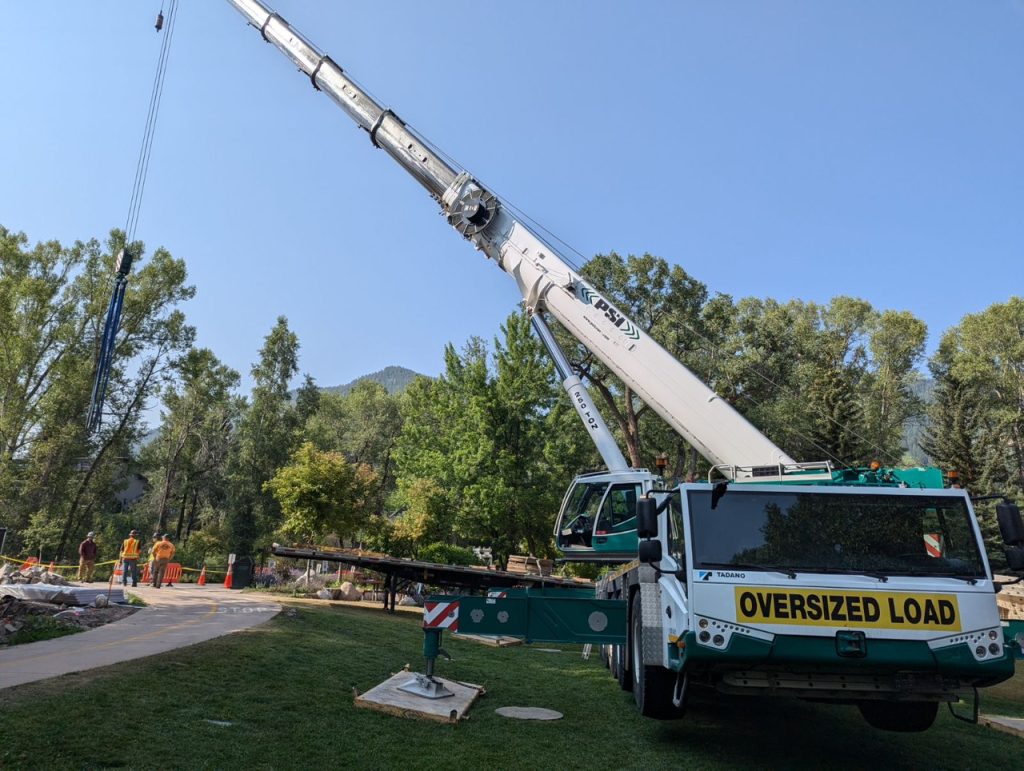
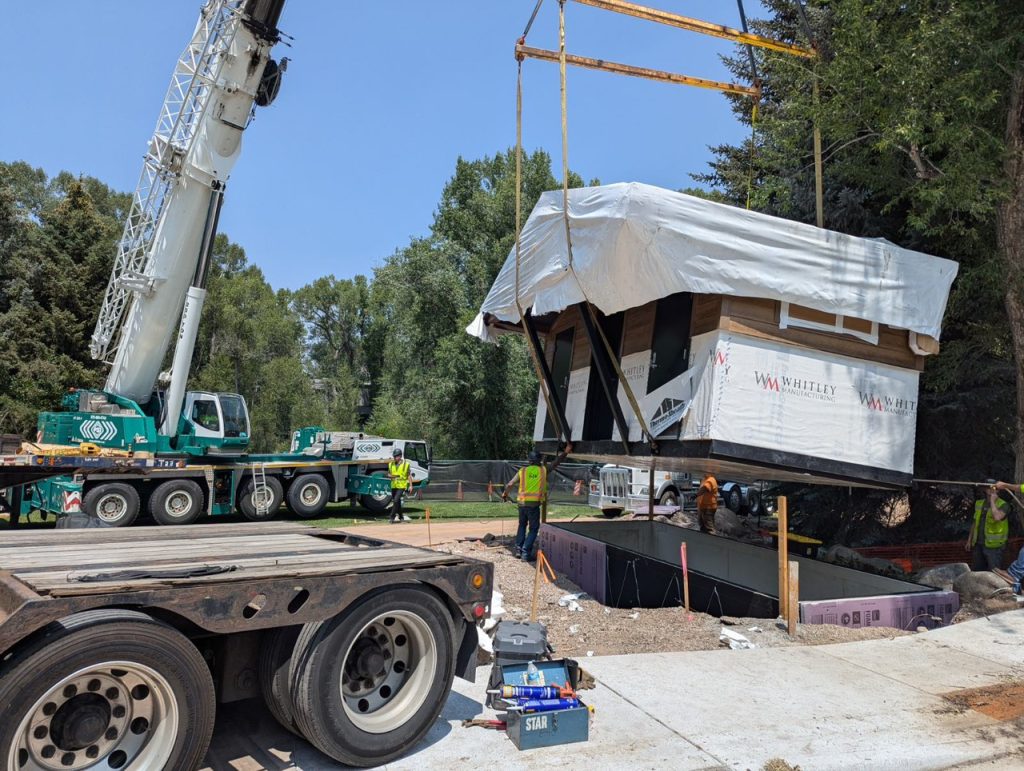
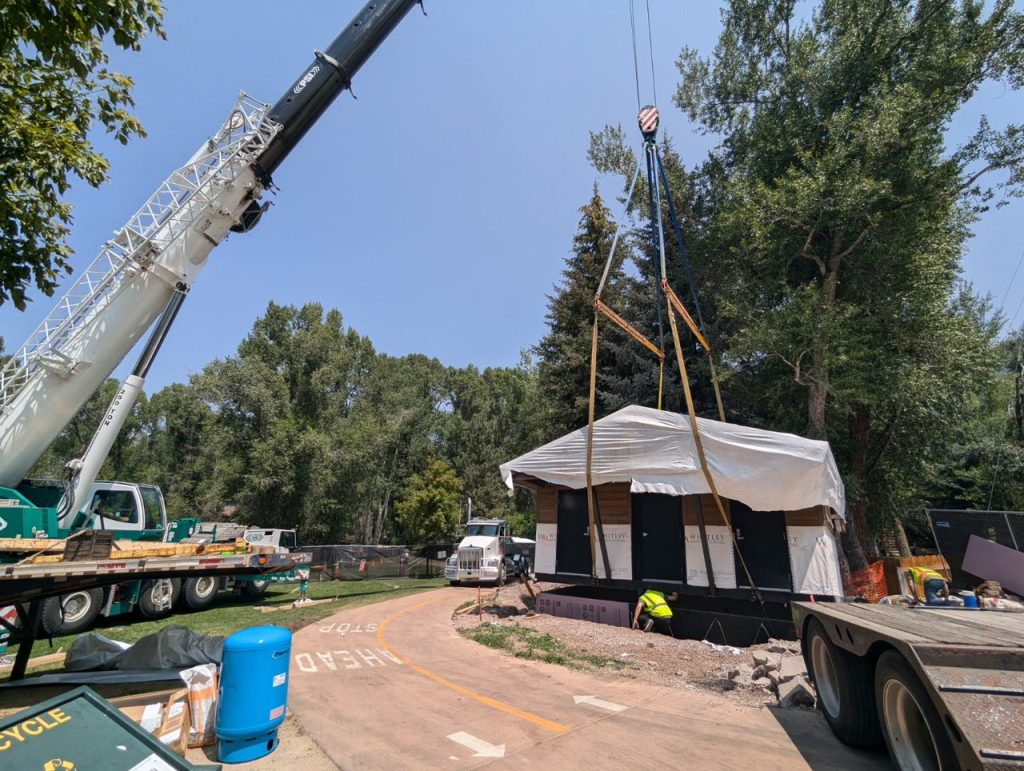
With the style and building of the bathrooms complete, the latrines were ready to be placed on their designated sites on the morning of Tuesday, July 23. Although the utilities and connections are ready to go, there is additional work that will need to be done before they are ready for public use. The toilets meet the current standards for gallons per flush.
“The vast majority of it is prefabricated off-site to our specification. But there is some work that will happen on-site, like some of the heavier stonework on the lower part of the building,” Tunte said. “We anticipate it will be open sometime in September for the public to use.”
Visitors can expect two uni-sex, ADA-accessible bathrooms. They both have a toilet and a urinal, as well as a changing station. While not specifically designated as a family bathroom, the bathrooms are large enough to accommodate families. They are intended to serve anybody, Tunte said.
And now here is the $580,000 question: Why a toilet over a porta-potty?
Porta-potties require third-party vendors to come out as often as they need to to clean the site and dispose of waste. At a location like Herron Park, which Tunte argues is the busiest park in the city, the third-party vendors can never catch a break.
The city must hire pump trucks to travel to every park in the city that has porta-potties. These trucks and those who operate them will pump out waste from the porta-potties, use various chemicals around the area to ensure cleanliness at the park and then drive away. The chemicals mixed with the emissions coming from these large trucks have an impact on Aspen’s environment, Tunte said.
How often the trucks visit these locations depends on the popularity of the park. A popular one like Herron Park requires a visit at least every other day during peak times, like the summer.
“It’s where our community has birthday parties. Kids love the playground and beyond. You have maybe the most attractive thing, and that’s the beach along the river,” Tunte said. “And so it’s just the dynamic that occurs with a beautiful park and playground and the river beach that attracts a lot of families. And so what we have seen is a very, very high use of kids and families using that park. And that really is what drives this need for a permanent bathroom.”
The bathroom foundation and building were delivered and raised over 100 feet in the air with a crane before they were placed. The Rio Grande Trail trailhead was closed during crane operations. Large parts of Herron Park, like the lawn area, were closed, but the playground and the beach stayed open.
The old porta-potties will be removed, and the enclosure around them will be disassembled and stored in the Parks Department’s storage yard. The department’s intent is to relocate the porta-potties and the enclosure to the new tennis and pickleball courts eventually.
“You know, for me, I just think the process is phenomenal. Now this really came from our community. We heard loud and clear that this is a need, and our council at that time supported that need,” Tunte said. “They said, ‘Yep, don’t forget about the bathroom. You guys have to go ahead on the playground, but don’t forget about the bathroom.’ We then planned for the bathroom and executed on it. And so I would say it’s a great example of how local government can serve our community and serve them well and be responsive. I find that a really compelling part of my job.”
Regan Mertz can be reached at 970-429-9153 or rmertz@aspentimes.com.

Aspen One announces artist for 2026/27 winter lift tickets, season passes
Brazilian artist Beatriz Milhazes has been selected to contribute artwork for Aspen One’s 2026/27 winter season lift tickets and season pass cards, as well as at the Silver Queen Gondola station.