Colorado wolves expand activity around central mountains, May map shows

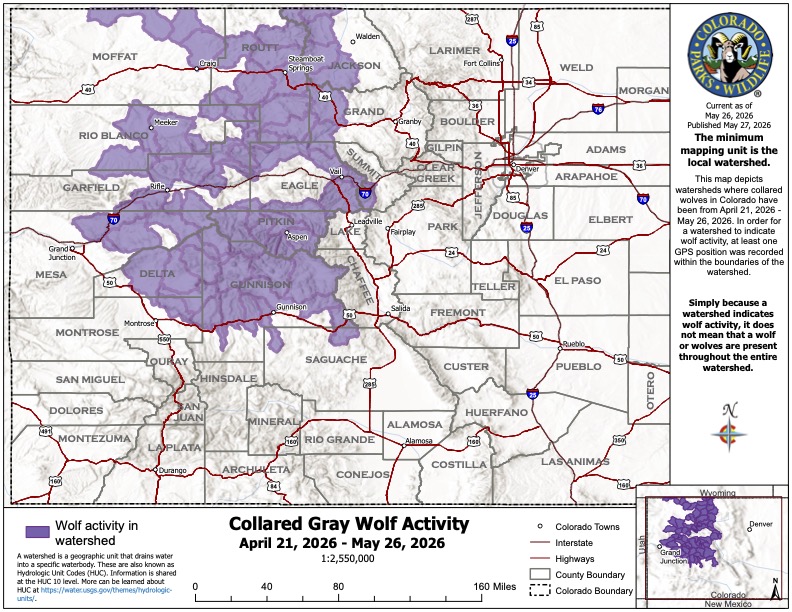
Colorado Parks and Wildlife/Courtesy photo
As gray wolves approach the end of denning season, many are concentrating their activity across Colorado’s central mountains.
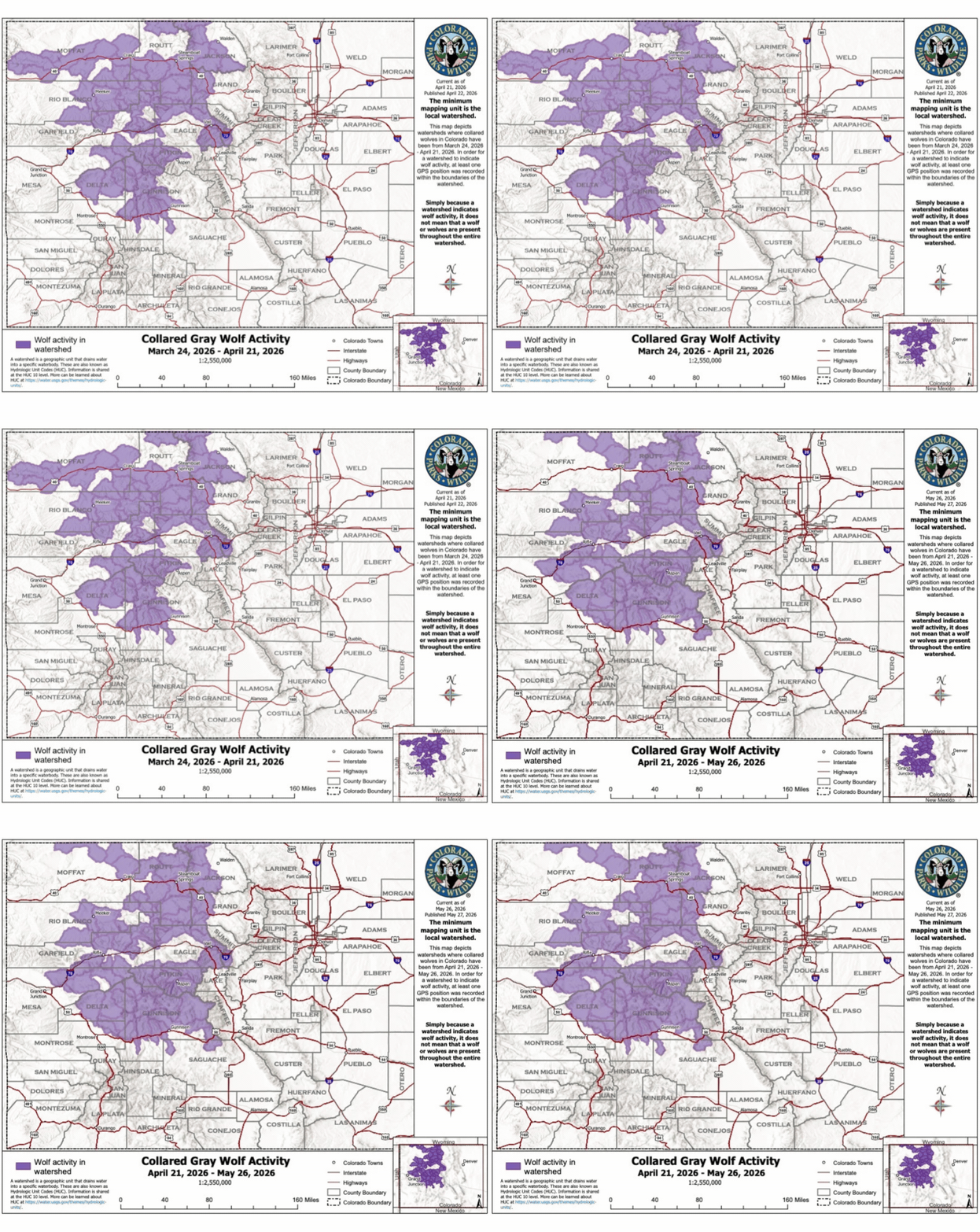
Colorado Parks and Wildlife’s most recent wolf activity map, which marks the watersheds where the state’s collared gray wolves were located between April 21 and May 26, shows broad movement. Those in packs with developed territories, however, are displaying more localized movements around the northwestern and central mountains.
The updated May map reveals that wolves were primarily located in Colorado watersheds across Routt, Rio Blanco, Garfield, Jackson, Grand, Eagle, Pitkin, Summit, Gunnison and Delta counties.
Moffat County, which saw ample wolf activity across the county in April, saw a notable reduction in May as some wolves migrated north toward the Wyoming border. Meanwhile, wolf activity in the northwest expanded around the central mountains to fill in more of Eagle, Pitkin, Gunnison and Mesa counties, with some light activity in Montrose and Saguache counties.
If a watershed is highlighted, it means that at least one GPS point from one wolf was recorded in that watershed during the 30-day period and may not currently occupy it. GPS points are recorded roughly every four hours. No wolves have crossed I-25 or spent time near urban centers, according to Parks and Wildlife.
While April’s wolf map highlighted some watersheds bordering Utah, wolf movement has strayed away from the region and moved more heavily toward the Wyoming border.
These maps only show wolf activity within the state of Colorado. Gray wolves that leave Colorado face different rules and protections depending on where they go. Wolves that travel into Wyoming lose their federal and state protections and can be hunted in the vast majority of the state.
Three of Colorado’s collared gray wolves have died in Wyoming, including two that were legally hunted and one that was killed by the U.S. Wildlife Services after it was tied to the death of five sheep.
Parks and Wildlife estimates there are at least 32 wolves in Colorado — including 18 adults and 14 pups born to Colorado’s four packs in the spring of 2025 — based on surveys conducted this past winter. The count doesn’t include information on whether the packs had additional pups or whether new packs were formed during this spring and breeding season.
Wolves typically begin breeding in February and denning as early as mid-March through to May. Luke Perkins, Parks and Wildlife’s public information officer, said May 5 that the agency “continues to monitor the movement of wolves during the reproductive season to determine if there are any suspected new packs.”
The following lists the minimum distribution of wolves in each pack as of the winter survey, according to Parks and Wildlife:
- The Copper Creek pack, located in Pitkin County, had two pups and four adults (including two breeding adults and two born to the pack in 2024).
- The King Mountain pack, located in southern Routt and Eagle counties, had four pups. The two breeding adults died this year, so there are zero adults.
- The One Ear pack, located in Jackson County, had five pups and four adults.
- The Three Creeks pack, located in Rio Blanco County, had three pups and two adults.
Colorado Parks and Wildlife said biologists continue to monitor wolves in Colorado for the formation of additional packs and indication of successful reproduction.
Aspen authorizes restoration work after illegal dumping on Maroon Creek wetlands
Aspen City Council unanimously approved a resolution to authorize restoration work by Statesman Gerbaz, Inc. to areas of the Maroon Creek wetlands that were damaged by illegal dumping of pond debris from a neighboring parcel.