Unlimited no more: Colorado imposes new daily limits on wildlife hunted for fur
Wildlife Commission gave the go-ahead for a daily limit of two for all 17 furbearer species hunted for sport, after hours-long debate over wildlife values, ethics and science

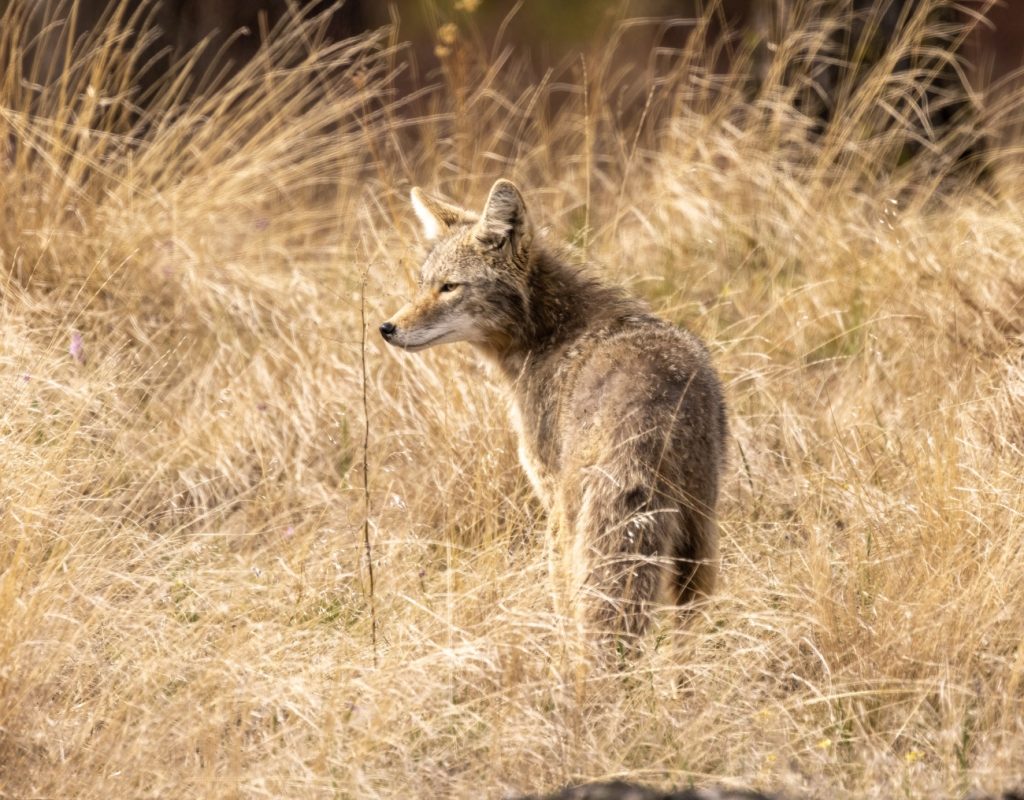
John Crowley/U.S. Fish and Wildlife Service
The Colorado Parks and Wildlife Commission narrowly passed a new daily hunting limit for the 17 species it classifies as furbearers at its Thursday, July 16 meeting in Ignacio.
Recreational hunters can now only kill two per day — down from the previous unlimited precedent — of each of the furbearer species, a group that includes beavers, foxes, coyotes, bobcats, marten and other mesocarnivores.
The limit, which was lower than the two options brought forth by staff, was proposed by new Commissioner Rebecca Niemiec who was appointed alongside Commissioners Johnny Le Coq and Dr. Peter Maguire by Gov. Jared Polis in June. Niemiec and Le Coq were joined by Gabriel Otero, Richard Reading, Jessica Beaulieu and Jay Tutchton in approving the daily limit of two. Commissioners Maguire, Jack Murphy, Frances Silva Blayney, Tai Jacober and Dallas May voted against it.
At its March meeting, with Parks and Wildlife staff claiming that there was no biological need to implement such a limit, commissioners instead suggested it could help to build social tolerance among non-hunters of the practice by closing a perceived regulatory loophole and helping prevent a small group of furbearer hunters from “overharvesting,” and thus reducing opportunities for other hunters, trappers or wildlife viewers in a certain area.
Niemiec said her primary driver is that a daily limit of two “better enhances social acceptance than a higher bag limit,” citing her own research from Colorado State University’s Animal-Human Policy Center.
“With a bag limit of two, people can still trap hundreds of animals in a season,” she said. “We’re not limiting people. We’re enabling trappers to keep trapping. We’re only talking about those localized overharvesters who might be reducing hunting and trapping opportunities for other recreationalists and who might be reducing non-consumptive opportunities as well.”
It is the first of two furbearer management questions facing the commission during its two-day July meeting. On the second day, it will weigh a ban on the commercial sale of fur in Colorado.
How Colorado currently manages furbearer hunting
The idea to impose a limit has been raised in public comments for several years and was among the recommendations made to the agency by a 2025 stakeholder group.
Matt Eckert, Parks and Wildlife’s deputy assistant director, said in a presentation on Thursday that while the agency understands that “the ability of any person to take an unlimited quantity of any species may seem and feel wrong,” that “unlimited daily bag limit, in practice, does not mean unlimited take.”
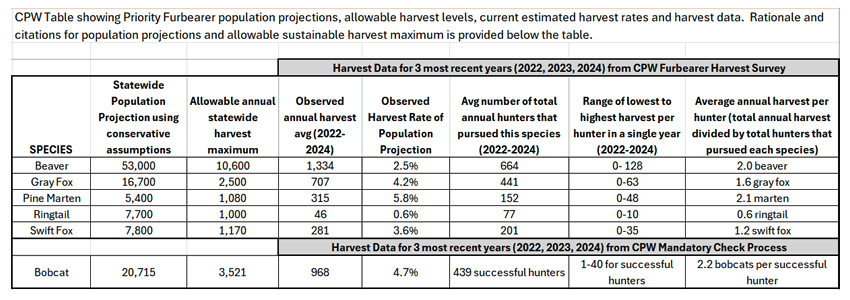
Parks and Wildlife has long allowed unlimited harvest of its 17 furbearer species to hunters who purchase a $10 furbearer permit on top of a small game license. In its 2024-25 fiscal year, the agency sold 19,620 furbearer permits. According to Parks and Wildlife, the average hunter kills fewer than 2 furbearers per year. Reid DeWalt, the agency’s deputy director, said that while there are a few people who are “super harvesters” and kill more than this average, 85% of permit holders are unsuccessful and kill none.
In a July memo to the commission, Parks and Wildlife Director Laura Clellan wrote that “current annual harvest rates range from 0.6-5.8% of the conservative population projections,” and that there is no scientific evidence that the current level of hunting is causing population declines.
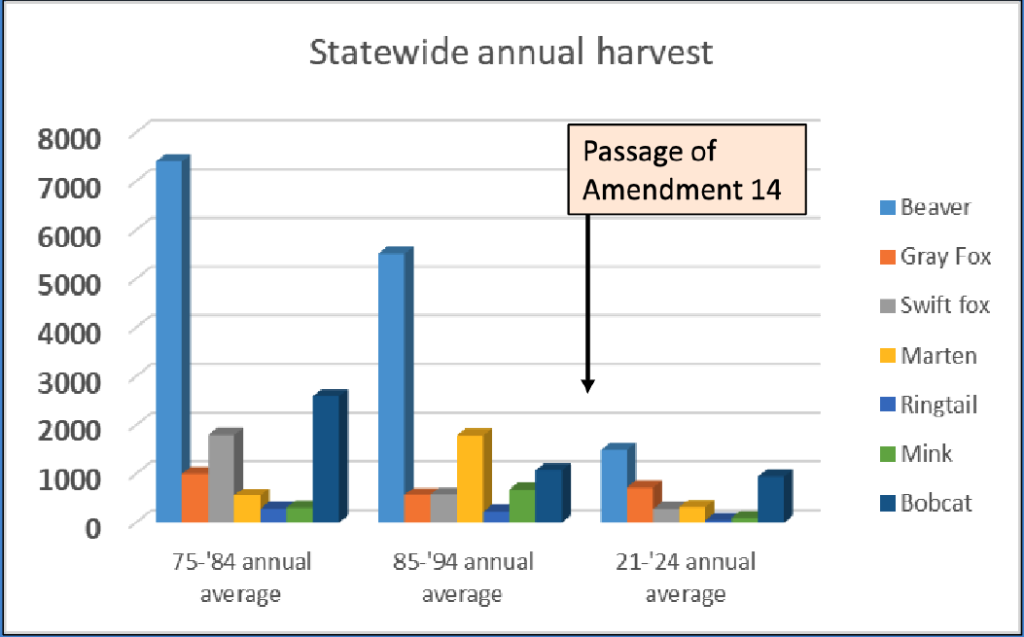
“The division has not yet set a daily bag limit for furbearers because there has not been a biological or management reason to do so,” Eckert said, adding that a 1996 ballot measure that banned certain methods of hunting has “strongly reduced trapping success rates and substantially reduced harvest, despite unlimited daily bag limits.”
The limit passed by the wildlife commission on Thursday only applies to recreational hunting and does not impact the state law that allows property owners and producers to kill animals causing damage to property and agricultural assets without a permit.
The debate over hunting limits for Colorado furbearers
Wildlife advocates and some commissioners pushed back on Parks and Wildlife’s initial proposal in March to limit recreational hunting to 15 per animal per day, arguing it didn’t go far enough.
On Thursday, while it maintained a daily limit of 15 was its recommendation, Parks and Wildlife staff also offered an alternative, tiered approach with a species-dependent limit of eight or four. The higher limit of eight would have applied to nine species identified by state law as those that can cause property damage, with the remaining eight species subjected to the lower limit of four.
However, many wildlife advocates who spoke on Thursday argued that these limits still did not go far enough — some pushing for a lower limit, others asking for annual limits rather than daily ones and many arguing for an outright ban on hunting furbearers.
“Wildlife is a shared public resource, and bag limits should preserve fair access for all Coloradans,” said Aubyn Royall, the Colorado state director of Humane World for Animals. “CPW’s data showed that the average hunter kills about two beavers or bobcats over the year. Yet the proposed limit of eight would allow one person to kill four times that typical annual amount in a single day. A limit set so far above ordinary participation does not promote equitable access; it accommodates the small number of those who kill many animals.”
Rhonda Dern, a Colorado wildlife advocate, was among those asking for an outright ban, arguing that “ethical science requires an end to trapping and hunting of mesopredators.”
“You’re undermining the intrinsic value of these species,” she said. “The climate catastrophe and biological crisis that threaten all of us, you must understand that mesopredators play an important role in our survival. A bag limit of zero is the best option, and killing is never conservation.”
Niemiec added that the discussion of limits is “all about values.”
“My desire to see a bobcat alive is just as legitimate as a consumptive user’s desire to trap a bobcat,” she said. “Our values are just as legitimate.”
Other public commenters, however, urged the commission to heed the advice of Parks and Wildlife staff.
“Rio Blanco County is rich in hunting, fishing and trapping. It’s not only essential for our local economy, but it’s deeply rooted in our customs and culture,” said Reece Melton, the director of natural resources for the county, adding that Parks and Wildlife’s proposed limit of 15 was “far past sufficient.”
“You should trust their recommendation,” Melton said. “I don’t know why we continue to consider very radical changes to systems and to science that has worked for decades in our state. We have some of the most robust wildlife resources across the nation, and it’s not by chance. It’s because those individuals right there that know exactly what they’re talking about.”
Chris Jurney, who operates a hunting outfitter in Craig and who has been involved in several working groups for furbearers, said that while “there are a lot of assumptions, allegations and false claims without proof of any scientific or biological problems on overall populations,” Parks and Wildlife did not indicate any “biological evidence of a problem to merit change.”
“Just because you might not like it or don’t personally agree with furbearer harvest doesn’t make it wrong,” Jurney said.
In the subsequent 6-5 vote to implement a limit of two per day, the dissenting commissioners cited their trust in Parks and Wildlife staff’s expertise as the motivating factor.
“I’m perplexed because throughout these comments, there was a large portion of the commissioners that understand that these bag limits have no implications on the take, have no implications on the population,” said Commissioner Jacober. “So why are we not just choosing a motion to support the staff in their recommendations?”
Commissioner Blayney said she was “disheartened by the amount of time that we’ve had to spend on this issue when furbearers aren’t a problem from a biological perspective.”