Colorado Republican among bipartisan group in Congress pressuring leaders for a vote on health care subsidies
Rep. Jeff Hurd, whose district encompasses much of Colorado’s Western Slope, is part of a coalition of 35 lawmakers who’ve outlined a new framework to reduce health insurance costs. They want Congress to vote on their proposal by Dec. 18.

Robert Tann Follow

Larry Robinson/Grand Junction Daily Sentinel
As federal health care subsidies barrel toward expiration, a bipartisan group of 35 U.S. lawmakers is calling on leaders in the House and Senate to hold a vote on extending the benefits before the end of next week.
The group includes Rep. Jeff Hurd, a Grand Junction Republican who has been pushing for a renewal of the subsidies, known as the enhanced premium tax credit. The subsidies, passed by Democrats in Congress during the COVID-19 pandemic, helped lower insurance premiums for plans purchased through Affordable Care Act marketplaces, but are now slated to expire on Dec. 31.
Many Coloradans have begun seeing major increases in their insurance premium for next year as a result. Rural and mountain communities are expected to be hit particularly hard, and some Western Slope residents have reported monthly premium increases as high as 400%. Hurd’s district includes most of western and southern Colorado.
In a statement, Hurd said he is “proud to be a part of this bipartisan group of lawmakers working towards a real solution on healthcare.”
“It does not matter how red or blue your district is — the cost of healthcare is not a partisan issue,” Hurd said.
Hurd is the only member of Colorado’s federal delegation in Congress who is part of the bipartisan group, which outlined a two-year plan for extending the enhanced tax credits and reducing health care prices. The lawmakers sent a letter last week to House and Senate leadership outlining their plan and asking for a vote no later than Dec. 18.
The group’s proposal would extend the full tax credits through the end of 2026, but only for those making below 600% of the federal poverty line. The benefit would be phased out for those making between 600% and 1000% of the federal poverty line. Currently, there is no income limit on receiving the benefits.
The framework includes a proposal to extend the open enrollment period through March 19. Open enrollment currently ends on Jan. 15. It also calls for measures to reduce waste and fraud, as well as price transparency reforms.
The second year of lawmakers’ plan would include “more significant reforms” aimed at reducing health insurance costs without the help of the enhanced tax credits. The framework put forward by lawmakers includes suggestions like requiring hospitals to disclose prices, eliminating $0 premiums, while providing assistance for those who can’t afford a minimum payment, and shifting funding that would have gone to the enhanced tax credits into individuals’ health savings accounts.
Some of those strategies mirror other proposals that have already been floated by lawmakers.
Hurd was one of four House lawmakers last month who sponsored a bill that includes many of the same fraud-reduction measures, such as requiring Affordable Care Act marketplaces to check death records and cracking down on malpractice from insurance agents or brokers. His bill, however, would have extended the tax credits for two years, as opposed to the one-year renewal now being put forward.
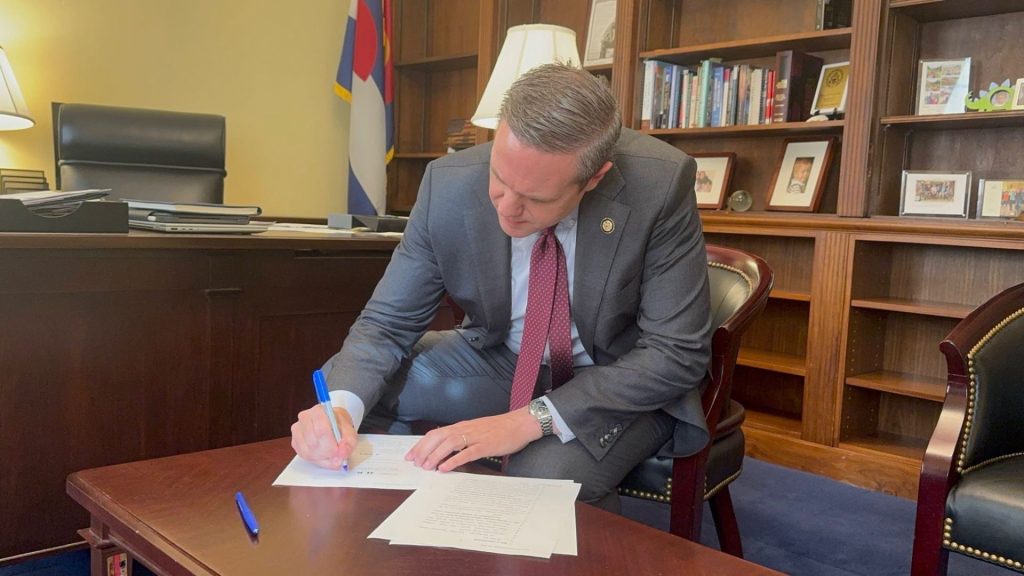
In his statement announcing the latest bipartisan proposal, Hurd said he is “committed to working with anyone, Republican or Democrat, who wants to find a solution,” calling the new framework “common sense.”
Senate Majority Leader John Thune, a South Dakota Republican, has already promised a vote this month in Congress’ upper chamber on extending the tax credits. The promise was part of the deal Republicans struck with Senate Democrats to reopen the government in November.
In both the Senate and House, Democrats are pushing for a three-year extension of the subsidies without caveats like income caps.
Democrats aren’t optimistic about the Senate vote, however, as Republicans look to put forward their own ideas and are holding off on supporting the extension sought by Democrats. Sen. Michael Bennet, in a call with reporters last month, said he “wouldn’t hold out hope” for an extension.
House Speaker Mike Johnson, a Louisiana Republican, has not committed to bringing the issue up for a vote in his chamber. House Democrats have signed a discharge petition to try and force Johnson to schedule a vote on their proposal for a three-year extension.
All four Colorado Democrats signed onto the petition, including Rep. Joe Neguse, whose district neighbors part of Hurd’s and includes central and northern mountain communities.
Democrats currently have 214 signatures, and need four more to force a vote, meaning a handful of Republicans would have to sign on. No Republicans have currently done so.
A spokesperson for Neguse’s office did not immediately provide a comment on whether Neguse could support the bipartisan effort Hurd is championing alongside nearly three dozen other House lawmakers.
Republicans hold a 220-213 majority in the House, with two vacancies, and a 53-47 majority in the Senate.

PHOTOS: Despite low flow, Slaughter Fest paddles forward with racing
Slaughter Fest, the annual raft and kayak race that features the Roaring Fork River’s Class IV Slaughterhouse Falls, returned to Aspen on Sunday.