Colorado saw record-high tourism spending last year, but challenges could curb the trend in 2026
Increasing competition from other states and weather-related challenges have slowed tourism to Colorado, causing its travel spending to lag behind the U.S. norm


Austin Colbert/The Aspen Times
Colorado’s tourism industry set a new record in traveler spending for 2025, thanks in part to increased visitation to Denver and western mountain towns. However, economic and environmental challenges emerging in 2026 could spell challenges for the tourism industry going forward, experts warn.
Colorado tourism contributed a record $29.2 billion to the state’s economy in 2025, according to a Tuesday release by Gov. Jared Polis and the Colorado Tourism Office.
Colorado welcomed over 96 million visitors in 2025, an increase of 1.4% from last year. Traveler spending was 2% higher than the $28.5 billion from 2024, according to the release.
Denver and the surrounding metropolitan area remained Colorado’s largest travel economy at roughly $14.2 billion, nearly half (48.5%) of all travel spending in the state. Other top travel markets included California, Texas, New York and Florida.
Travel generated $1.91 billion in state and local tax revenue and supported roughly 187,860 jobs across the state, a decline of 1,160 jobs compared to 2024, though worker earnings rose 1.6% to $10.5 billion. Every $1 million in travel-related spending resulted in approximately 6 jobs for the industry.
“Not a big loss of jobs, but it’s the first year that we’ve seen since COVID where the jobs have actually ticked down,” said Leon Aliski, senior project manager at Dean Runyan Associates, during a Tuesday presentation.
A deceleration in Colorado’s tourism industry
Beyond the superficial financial gains, factors like increasing competition, uncertainty related to federal policy changes and weather-related challenges have created some friction among Colorado’s tourism markets, including on the Western Slope, according to annual research compiled by Dean Runyan Associates and Longwoods International Travel USA.
Although Colorado’s 2% growth in visitor spending is consistent with other Western states like California, which saw an increase of 1.7% in 2025, it lags considerably behind the 4.2% increase in U.S. travel spending as the competition over travelers intensifies across the country. Colorado’s domestic overnight market share has also continued to decrease, dropping from a high of 2.3% in 2019 to 1.79% in 2025, according to the release.
“We have been on a continuous decline … where even though our number of overnight visitors have grown and have kind of leveled off, the number of people traveling more than 50 miles in the United States continues to grow, and that’s why we’re losing market share to the rest of the country,” said Tim Wolfe, director of the Colorado Tourism Office, during the virtual presentation. “We’re forecasting 2026 to be relatively flat again.”
Wolfe said 2025 is at least the second year in a row that Colorado hotels have recorded lower occupancy, lower rates, and lower revenue per available room.
So far in 2026, the research also indicates that some of the fluctuations in visitation are related to weather challenges, including a historically low snowfall and growing wildfires. Some mountain resort destinations have experienced seasonal declines in visitation as high as 40% due to these conditions, the release states.
“We acknowledge that 2026 is also going to be a tough year,” Wolfe said. “We continue to work with crisis management on a number of areas impacted by forest fires. … We know the mountains were down a little for the first quarter with some of our weather patterns, so we’re anticipating that we’re going to lose share these next coming years.”
Western Slope counties contribute to spending record
With “outdoor and entertainment activities” being the No. 1 draw for overnight visitors, Western Slope towns were among the most popular destinations.
The Rockies Playground Region — consisting of tourism hotspots like Glenwood Springs, Aspen, Vail and Breckenridge — recorded the second-highest visitor spending in 2025 at $4.5 billion, roughly 15% of the state’s overall spending.
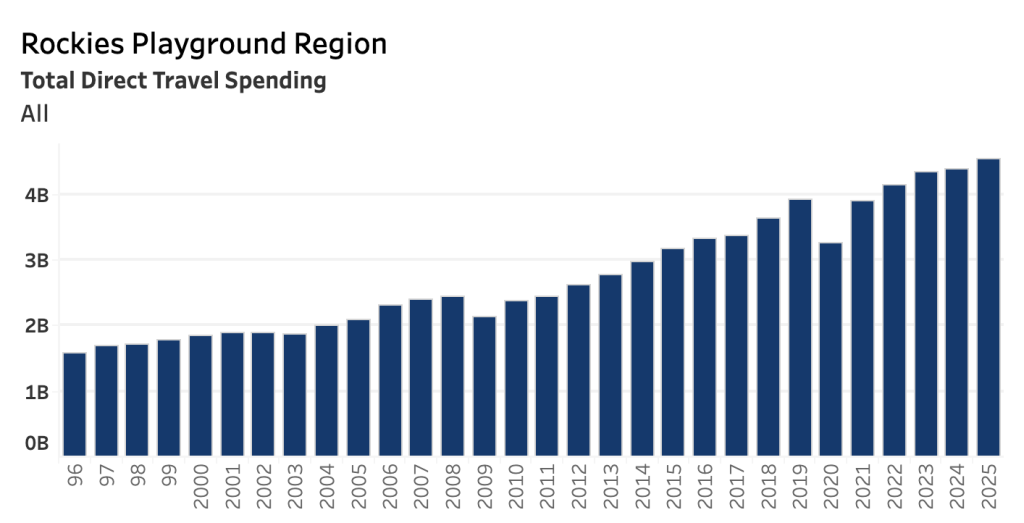
Pitkin, Summit and Eagle counties were among the counties in the region with the greatest contributions to tourism spending. Eagle County brought in $1.7 billion, consistent with 2024. Others saw modest growth, including a 8.7% hike to $1.2 billion in Summit County and a 5.6% increase to $1.1 billion in Pitkin County.
Other counties saw lower visitor spending compared to 2024. Spending in Garfield County dropped 1.5% to $316.8 million, while Routt County dropped 0.2% to $668.8 million.
Although a large percentage of Colorado’s overnight and daytime travelers identified themselves as outdoor and adventure seekers — roughly 16%, according to survey data from Longwoods International Travel USA — even more identified as “budget-friendly” travelers, suggesting that price-sensitivity is growing among consumers.
Statewide, slightly fewer visitors said they were likely to return to Colorado compared to the U.S. norm, with the state seeing a 2 percentage point decrease in repeat visitors in 2026.
“It’s going to take all of us to try to make sure that we’re encouraging our guests to come back and visit Colorado so that we can try to curb this trend,” Wolfe said.

Rob Ittner to return to BOCC after 11 years
Rob Ittner will be returning to the Pitkin County Board of County Commissioners more than a decade after leaving office as unofficial election results shows him beating out challenger John Doyle in the race for the District 1 seat.