Colorado’s latest geothermal report and regulations dig into the resource’s potential across the state
The Energy and Carbon Management Commission set new rules for deep geothermal drilling and released an in-depth look at the energy resource

Ben Roof/Vail Daily archive
As Colorado deepens its interest in alternative, clean-energy resources, new regulations and a new report from its Energy and Carbon Management Commission are digging into how and where geothermal resources can be used.
Following the directive of Gov. Jared Polis, who launched the “Heat Beneath our Feet” initiative during his time as chair of the Western Governors’ Association, the state has begun investing more seriously in the burgeoning geothermal industry.
In August, Colorado’s Energy and Carbon Management Commission, which was renamed from the state’s Oil and Gas Conservation Commission in 2023, released new rules for deep geothermal drilling and operations. The rules came just a month after the commission, the Colorado Geological Survey and Teverra released an in-depth report on the state’s geothermal resource history and potential.
“With additional funding and research moving forward throughout the nation, deeper geothermal technologies have been progressing and becoming more viable in Colorado,” said Kelsy Been, interim public information officer for the commission. “These new rules provide a proactive pathway for these technologies to move forward in Colorado in a safe, protective and efficient manner.”
What is geothermal energy?
Put simply, geothermal energy is heat energy that comes from the Earth’s core and is pulled to the surface.
The Energy and Carbon Management Commission’s 2024 Geothermal in Colorado report states that the working definition of a geothermal resource is “a thermal energy source in the earth from which heat transfer by groundwater or an engineered heat-exchange system may extract or exchange useful energy.”
“Geothermal energy has been part of Colorado life for thousands of years,” Polis stated in his introduction to the July 2024 report. “But it is just recently that we are aggressively pursuing the promise of geothermal energy to save people money on utility bills and accelerate the reduction of our dependence on fossil fuels.”
Currently, there are three broad use cases for geothermal energy outlined in the report.
First is direct use, where thermal energy is used with no energy conversion. This encompasses uses such as hot springs, hot water and space heating. The second use is geothermal power production, which includes taking the thermal energy and converting it into electricity. The third is geothermal geoexchange or ground source heat pumps, where the earth acts as a thermal reservoir to heat and cool structures above the surface.
As an alternative energy, geothermal has multiple environmental advantages. In addition to simply providing an alternative, the resource has “limited land use requirements, minimal impacts on water quality and usage, and positive contributions to air quality by reducing ozone pollution and mitigating climate change,” the report states.
However, there are possible challenges including the potential for land subsidence and induced seismicity, noise pollution, visual intrusion and thermal pollution.
“With all energy development, infrastructure installation, and/or drilling operations, there are impacts,” Been said. “Generally, geothermal development has lower impacts than other energy operations and provides several positive impacts such as emissions reductions and clean energy.”
Specific impacts of geothermal depend on the different applications for the heat source, Been added.
Mitigating these challenges is part of the reason for the commission’s new rules around deep geothermal drilling, which refers to operations deeper than 2,500 feet.
Regulating deep geothermal drilling
In Colorado, there are two agencies tasked with regulating the geothermal industry.
The Division of Water Resources, which generally oversees development in operations including tributaries and water, had previously established rules for shallow geothermal operations. The Energy and Carbon Management Commission was recently tapped as part of 2023 legislation to regulate deep geothermal operations.
The commission’s recently released rules were part of the requirements stipulated in this law.
“On the whole, the new rules do a good job of balancing community and public health protections and a wide range of interests while fostering an emerging industry that may prove instrumental in reducing climate pollution,” stated Anita Seitz, Colorado Communities for Climate Action Advocacy Director, in a press release.
In her statement, Seitz emphasized the importance of these rules in ensuring “safe and clean deep geothermal operations.”
Been said the rules include creating protections for health, property and public welfare as well as wildlife and environmental resources.
More specifically, the rules outline permitting pathways for surface and subsurface permitting considerations, a process to “bring together geothermal resource owners and protect property rights,” and requirements for monitoring reporting and wellbore integrity, Been said.
Tapping into geothermal potential in the mountains
While the resource is being explored across the state, various mountain communities are digging into the geothermal potential for ski resorts, airports, employee housing projects, snowmelt systems and more.
A significant part of the commission’s July report explores where Colorado’s geothermal potential lies as well as where the resource is underutilized.
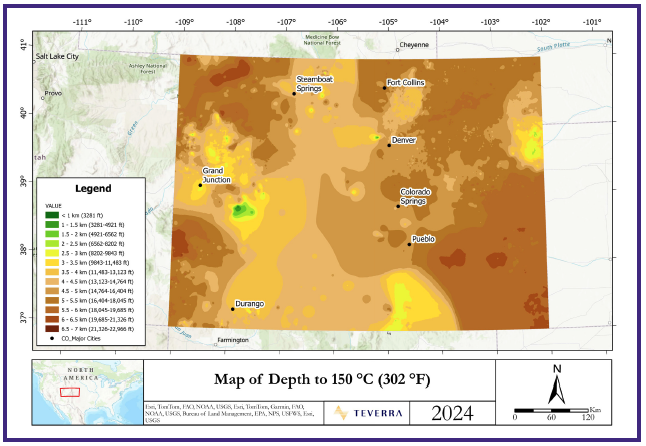
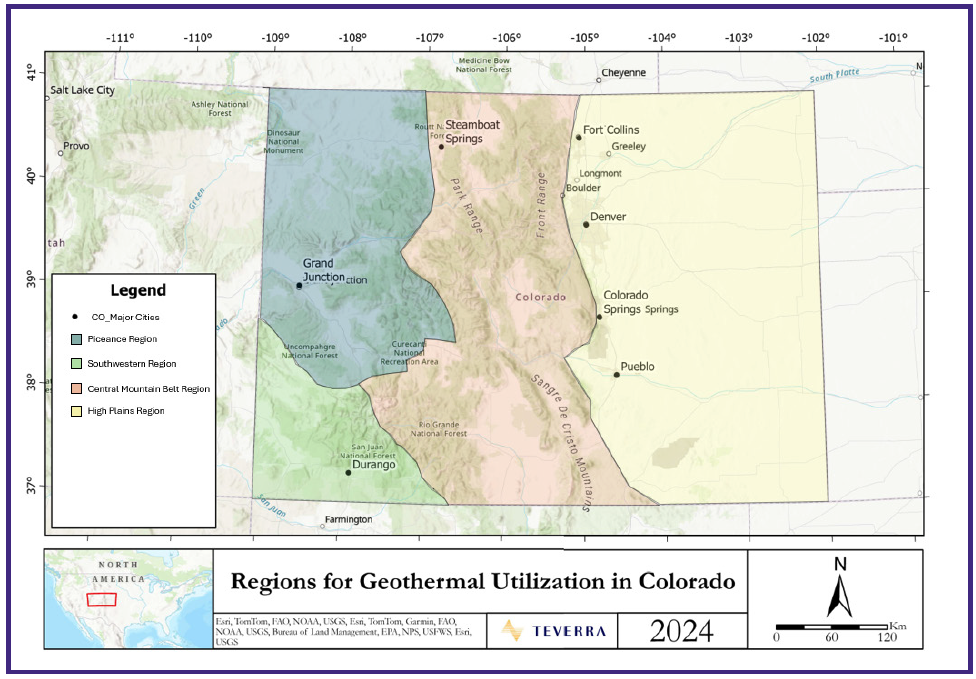
The report determined the state has several areas with higher-than-normal subsurface temperatures and a greater potential for geothermal energy. According to the report, the five regions with the most “favorable” potential for geothermal electricity are the Upper Arkansas Valley, the Raton Basin, the Piceance Basin, the San Juan Basin and an eastern “hot spot” in the Denver Basin.
Other areas — including many parts of Northwest and Southwest Colorado — have low to moderate subsurface temperatures, but still have good potential for direct use and thermal energy networks. In looking at the central mountainous region, the report identifies that there “appears to be high thermal resource potential.”
“The data points that do exist show more variability than what is suggested by the interpolated maps,” it adds.
Within the central mountain belt, the report states that the “positive thermal resource in this region” is “poorly constrained by data.”
“There is no reason to doubt the data that exists, but further exploration is warranted to confirm the resource in a given location,” the report adds.
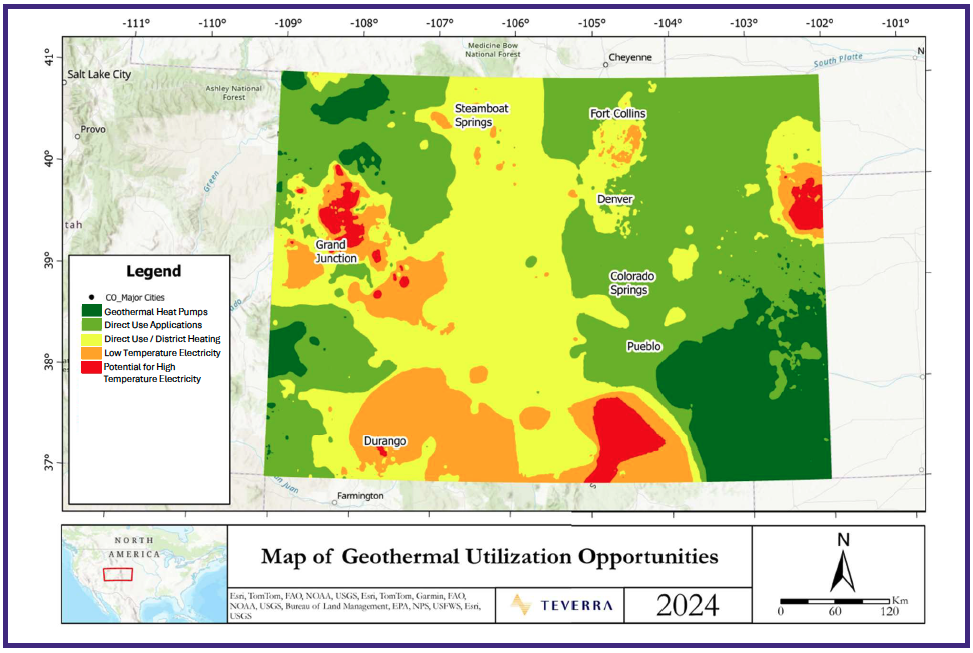
Still, geothermal opportunities in the central mountainous region have the potential to provide a “reliable sustainable resource.”
“Given that these population densities are in remote, mountain towns with long winters, direct use applications would be highly effective. Geothermal could be used for heating and cooling of residential and commercial buildings, town thermal energy networks, snow melting, and other uses. This would provide remote towns with methods to use the heat energy resource at their location and add resiliency. New development could bring new opportunities to these towns where oil and gas wells don’t exist in proximity,” the report states.
As Colorado’s exploration of geothermal potential deepens, so does its investment. In May, the Colorado Energy Office announced $7.7 million in funding for 35 geothermal projects. Among these projects are several in Colorado’s central mountain region.
This includes projects for an employee housing complex in Granby at YMCA of the Rockies’ Snow Mountain Ranch; a heat district in Pitkin County that includes the airport, public works and transportation authority buildings; a thermal energy system in Carbondale; a heat district in Steamboat Springs that includes the ski resort’s base area; replacement of gas boilers at the Eagle County government complex; a heat district in Vail’s civic area, which could replace its gas-reliant snowmelt system; and more.