Aspen Security Forum discusses range of global challenges
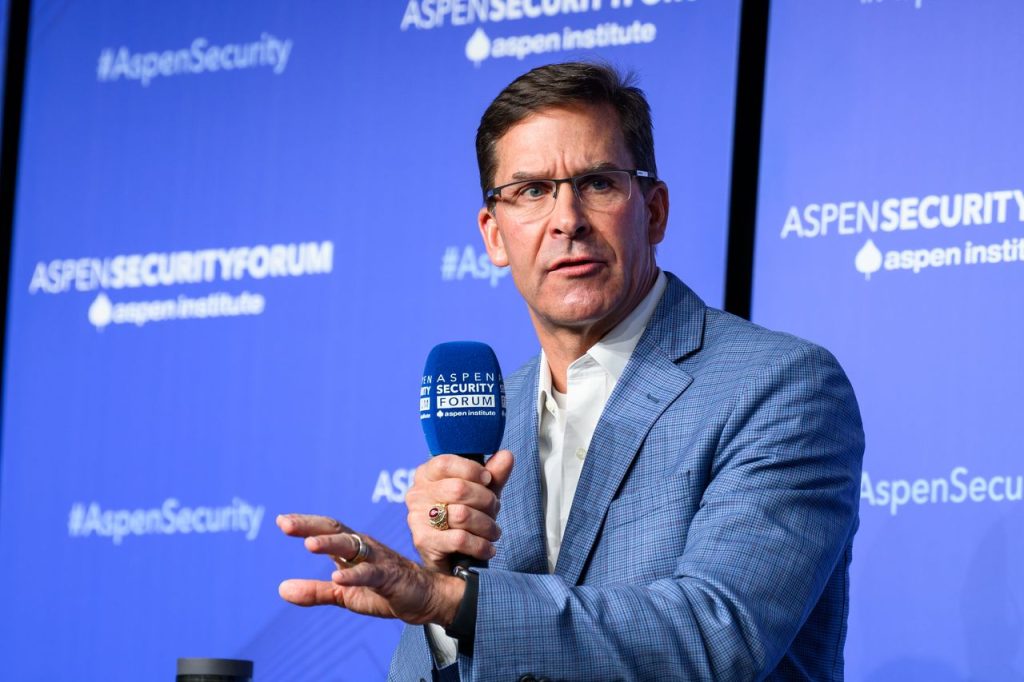
Aspen Institute/Courtesy photo
“So, there sure is a lot to talk about,” said Nicholas Burns, the former U.S. ambassador to China as he opened the 2026 Aspen Security Forum on Tuesday at the Aspen Institute. “We are facing a set of challenges that are as daunting as any I remember in my own career over 40-plus years.”
And to his point, the first panels of the four-day national security conference discussed Iran, Ukraine, Russia, China, NATO, drones, AI and warfare in space.
Left unsaid was that this was the second year in a row at the Security Forum without active senior U.S. military members and senior Department of Defense officials on the agenda, which has been a main feature of the event in the past.
The Defense Department abruptly pulled out of the Security Forum in 2025, and a Pentagon spokesperson said the event, “promotes the evil of globalism, disdain for our great country and hatred for the president of the United States.”
According to The Hill, the Defense Department said Tuesday its stance on the Aspen Security Forum has not changed since last year. There are three administration officials on the agenda, but the lack of senior military members is noticeable.
While he did not directly address the Pentagon’s stance on the Forum, Burns, who is co-chair of the Aspen Strategy Group at the Institute, did say in his introduction that the “radical idea” that the Strategy Group’s founders had 42-years ago was that “Republicans, Democrats and Independents should come together, maybe outside the noise of a city like Washington, put aside their political differences and come together, as Americans, to think about our national security.”
Condoleezza Rice, who served as U.S. secretary of state from 2005 through 2008 under President G.W. Bush, is co-chair of the Strategy Group along with Burns. On the first panel of the conference Tuesday, in a packed Greenwald Pavilion, she downplayed the threat of Iran building a nuclear bomb in the near future.
“I would not buy a nuclear agreement under any circumstances,” Rice said. “I’d just let them sit there and stew in their lousy economy, where most of their A-level nuclear scientists have been killed, where I believe there are deep splits in the Iranian government.”
She added, “And let’s just see what happens. Because I am quite confident it’s going to be a long time before they can actually build a usable nuclear weapon.”
Mark Esper, who served as U.S. defense secretary from 2019 to 2020 under President Donald Trump, said he didn’t see a resolution to the Iranian conflict “through aerial bombardment. Introduction of forces changes that equation, but nobody wants to go there. I certainly don’t. So what does that leave you with?”
Esper said what was left was a return to economic pressure, coupled with going after Iran’s ballistic missile and drone capabilities.
“Go after their economics,” he said. “Strangle them from the sea, by reinstating the blockade. Block their land routes, their air routes and put economic pressure on them. Now, the challenge is, that takes time, patience, discipline.”
Esper also said that “the cost for us is going to be higher gas prices for a while, but look, we are where we are.”
Also on the opening panel was Penny Pritzker, who served as U.S. commerce secretary from 2013 to 2017 under President Barack Obama.
When asked about tariffs, she first cited a list of reasons America remains a vital nation, but also said there are a lot of big domestic challenges facing the country right now.
“We’re an extraordinarily strong country,” she said, “both economically and militarily. We’re the world’s leading innovator. We have unmatched universities. We have extraordinarily deep capital markets. We have an extraordinarily powerful military. We have abundant energy. We’re resilient and adaptive, which all inure to our benefit.”
But, Pritzker said, “We have a serious affordability problem. People cannot afford a home. They cannot afford their transportation. They cannot afford childcare. They cannot afford food. They cannot afford health care. If you’re making $60,000, $80,000, $100,000 a year, it’s not working.”
The second panel of the day was focused on the commercialization of space, the growing dependence in everyday life and, in war fighting, on satellites and GPS technology and the need to weaponize space in order to defend modern space technology.
Andrea Mitchell, the chief foreign correspondent and chief Washington correspondent for NBC News, moderated the space panel.
And while introducing her, Nicholas Burns asked the audience to stand in respect to Mitchell’s late husband Alan Greenspan, who served as the chair of the Federal Reserve from 1987 to 2006, and who died in June.
Greenspan had appeared multiple times at the Aspen Ideas Festival after he retired from the Federal Reserve.
“He loved this place,” Mitchell said, “and so many of you. Thank you. It’s wonderful to be here. There is a healing quality to Aspen, and to the dialogue here, and the nonpartisan aspect of this wonderful conclave.”

Bookings to Colorado resorts reveal high-spending tourists are cutting back
Colorado’s luxury consumers are hungover from last year’s poor snow conditions and economic instability, tourism data shows. Now, they’re beating price sensitivity by hunting for bargains.