A glorious ‘Messiah’ with Dame Jane Glover in command
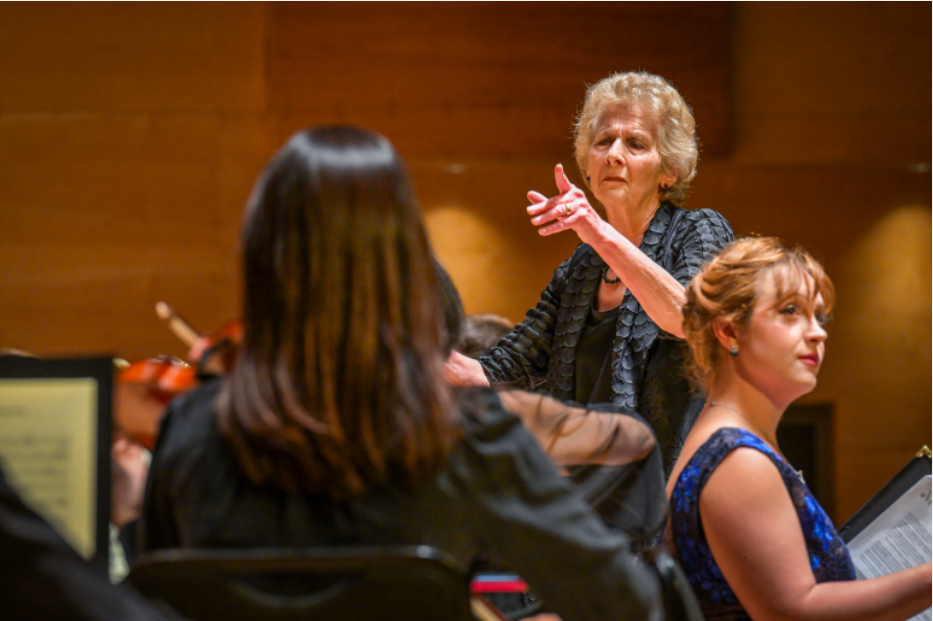
Diego Redel/Courtesy photo
Handel’s “Messiah” can carry a wider, more all-encompassing meaning if it’s not wedged between concerts of Christmas carols in December. With Dame Jane Glover conducting her own Chicago-based Music of the Baroque Chorus, a particularly adept ad-hoc orchestra and a quartet of well-chosen solo voices from the Aspen Opera Theater and VocalARTS program, Wednesday’s savory account in the cozy confines of acoustically perfect Harris Hall proved a performance for all seasons.
All hail Dame Jane! She strode to her place center stage without a podium, a baton, or a music stand for a score. She used her hands, her body, and indefatigable energy to bring the music of this familiar and popular oratorio to vivid life. The performance hit all the right inflections, rhythms, and expressions with elegance, and, when necessary, power. She was a conjurer of the music’s magic.
The chorus, 26 strong, is one of the most responsive vocal groups I’ve ever heard. Every inflection served a purpose, whether it was delineating the intertwining lines of counterpoint, gloriously enlivening the famous ‘Hallelujah’ chorus, or articulating the soothing harmonies of the extended hug of the closing “Amen.”
The four soloists impressively enunciated the words (taken from English-language scripture). Musically, the standouts were Jonghyun Park and Ashlyn Brown (who, earlier this summer, sang the roles of Ferrando and Dorabella in “Così fan tutte” here). Park’s polished lyric tenor carried the meanings as well as the notes. Brown’s flexible mezzo-soprano may have softened on the low notes in arias written for a true alto, but she caught their flow and character.
Bass-baritone Jared Werlein, who is singing roles at Deutsche Oper Berlin this year, conveyed the authority necessary in his solo moments, and soprano Jennifer Robinson, despite some distracting fidgeting when she wasn’t singing, lavished a creamy voice on her arias.
The orchestra, mostly strings for most of the evening, benefited from some excellent pumping up with timpani at the end and occasional brightness from an oboe and three trumpets. The continuo — Michael Beattie (harpsichord and electric organ), Sanghyeok Park (cello), Andrew Salaru (bassoon), and Anderson Bernal (bass) — kept things moving with refinement and zip.
The perfect sound of 500-seat Harris Hall, much better than a cold, stone cathedral or a big symphony hall, plus Glover’s masterful leadership made for an unforgettable experience.
The biggest fiasco of the season came on Tuesday, a recital by pianist Lang Lang in the Klein Music Tent. The first piece, Fauré’s lovely Pavane in F-sharp minor, revealed some of the pianist’s well-known mannerisms, including sudden changes in tempo and dynamics. Things only got more bizarre in Schumann’s Kreisleriana, as he exaggerated every aspect of the piece to the point where nothing made sense.
After intermission, a series of 11 Chopin mazurkas was even more disheartening. A mazurka is a dance. Anyone trying to dance to Lang Lang’s rhythms, which sped up and slowed down randomly, would have tripped. He was more flourishes and physical gestures than substance. It was quite the show, just not music as we know it. The program culminated with Chopin’s Polonaise in F-sharp minor, a show-off piece for sure, but any semblance to a cohesive narrative was purely coincidental.
The rapt audience lapped it up. They leaped to their feet for standing ovations. The few musicians I recognized in the audience tried to hide scowls.
The next evening in Harris Hall was so much better, as Aristo Sham presented his first recital in Aspen as the the gold-medal winner from June’s Cliburn Competition. Curiously, the first half of his program echoed two recent Aspen piano recitals. Comparisons? Here it goes.
The first two pieces were also on Tom Borrow’s program. Rachmaninoff’s arrangement of three movements from J.S. Bach’s Partita No. 3 for Unacccompanied Violin in E major, in Sham’s hell-bent tempos, demonstrated dazzling technique, and Busoni’s arrangement of the Chaconne from Bach’s Partita No. 2 for Unaccompanied Violin emerged with more clarity than Borrow’s.
Sham loves a big crescendo, and he can play loud with the best of them. In the pianistic Everest that is Ravel’s “Gaspard de la Nuit,” a technical challenge for any pianist, the difference between Sham’s playing and that of Seong-Jin Cho on July 22 was most evident in how they interpreted Ravel’s depictions of water, which permeate the piece. Cho emphasized its liquid nature, painting a pointillist picture of water’s movement. Sham’s extra-sharp clarity celebrated the splash, as if every drop of water had its own note. Both made the most of Ravel’s unique musical world, in their own way.
The second half was another matter. The Beethoven Piano Sonata No. 29 “Hammerklavier,” at nearly an hour’s duration, needs a dramatist’s touch. Sham seemed more interested in speed. (Few, if any, pianists actually heed Beethoven’s blazing-fast metronome marking at the beginning because it lacks drama.) Repetitions here felt exactly the same as what preceded. He did get more expressive in the Adagio sostenuto, but by the time we got to the the fugue in the finale, I was weary.
A no-nonsense presence, Sham wasted no time on flourishes nor communication with the audience. He walked out, settled for a moment at the piano, and started to play. After the sonata, he took only one bow before returning to the piano for a pleasant encore: Brahms’ Intermezzo in E-flat Op.117 No.1.
On Monday in Harris Hall, the percussion ensemble filled up the entire stage with drums, mallet instruments, cymbals, chimes, and other paraphernalia not usually thought of as musical instruments. The musicians delivered their customary program of discovery and, when it all clicked, sheer joy.
The group’s organizer and conductor, Jonathan Haas, allowed as how this year’s collection of students is the best in his Aspen experience. They showed it right off the top, in Haas’ own arrangement of “Train to São Paulo,” from Philip Glass’ film score to “Powaqqatsi.” Rhythms drove with pizzazz and found all sort of sonic colors.
Of the rest, the most impressive was Tan Dun’s “Elegy: Snow in June,” an 18-minute fantasia featuring a solo cello (Miles Reed) and a kaleidoscope of percussion both Japanese and Western. All hands were marvelous. A sassy arrangement by Javier Diaz of Phil Collins’s pop song ‘In the Air Tonight’ brought things to a lively finish.
Not to miss in coming days: In Harris Hall today, pianist Anton Nel plays two quartets with different groups of colleagues on this afternoon’s chamber music program, and tonight baritone Davône Tines offers his gospel-infused recital, by all accounts a unique and rewarding experience. Sunday’s Festival Orchestra concert spotlights violinist Augustin Hadelich in the Tchaikovsky concerto.
Harvey Steiman has been writing about the Aspen Music Festival for more than 30 years. His reviews appear in The Aspen Times on Tuesdays and Saturdays.
Beyond the Algorithm: The ecosystem of health
Born to author Roald Dahl and actress Patricia Neal, Ophelia Dahl grew up surrounded by creativity and resilience — qualities that would later shape her own path in a very different arena.